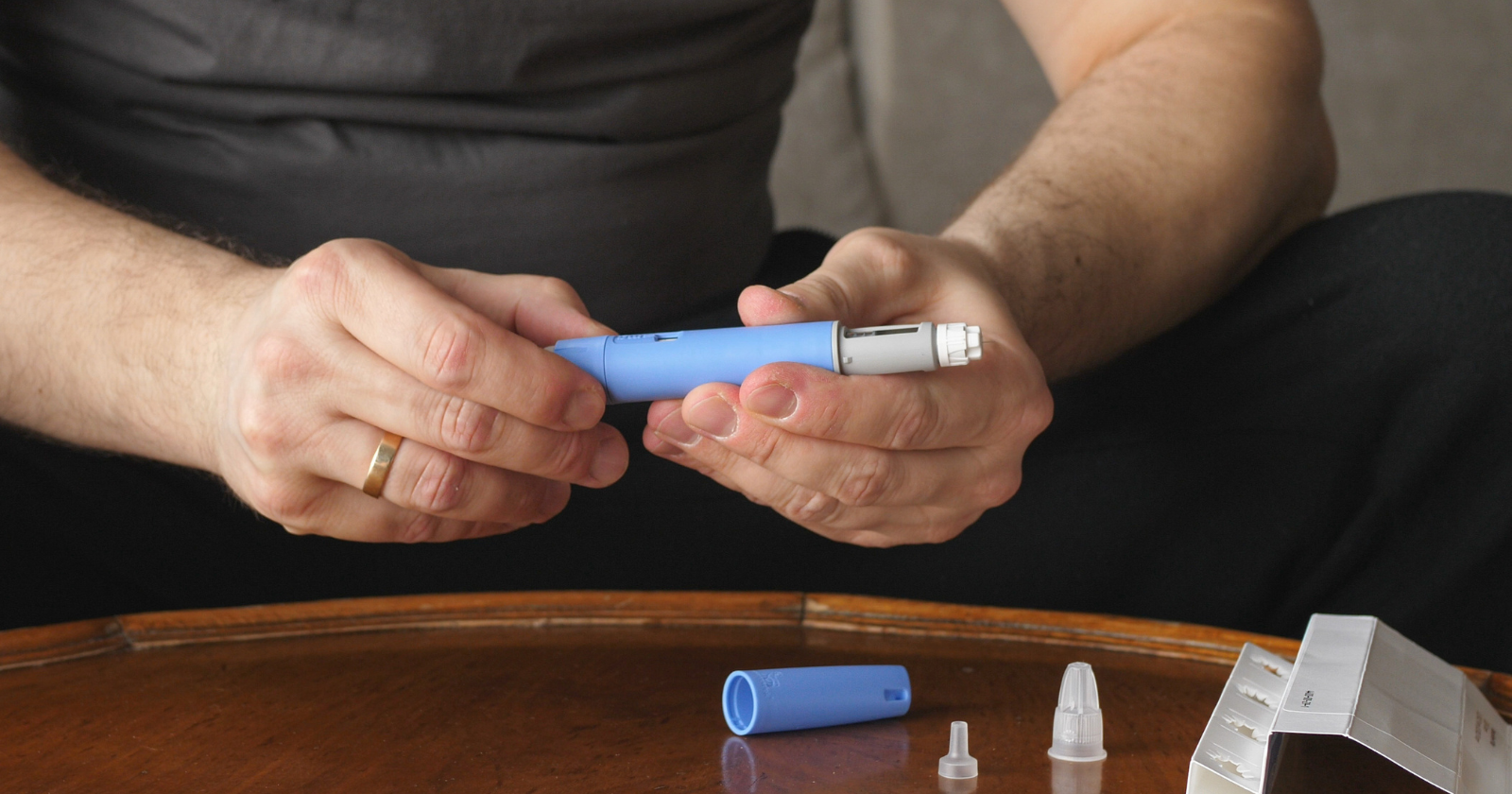
If you tried to buy Novo Nordisk today, you couldn’t. That’s not a comment on the price, though the market cap has recently sat somewhere north of half a trillion dollars. It’s a comment on the legal architecture. The company that makes Ozempic, Wegovy, and roughly a third of the world’s insulin is controlled by an entity that has no shareholders, cannot be acquired, cannot go public, and cannot be liquidated in the ordinary sense. The controlling entity does not, in the way most people understand the word, have an owner at all.
Here’s what actually sits behind one of the most valuable drugs on the planet.
The dual-share trick
Novo Nordisk is a publicly listed company. Its shares trade on the Copenhagen exchange and on the New York Stock Exchange, and if you have a brokerage account you can buy a few for yourself this afternoon. But you would be buying B-shares, and B-shares only carry one-tenth of the voting power of A-shares. The A-shares, according to Britannica’s corporate history of the company, are held by a single entity called Novo Holdings, which itself is wholly owned by the Novo Nordisk Foundation.
The specific numbers, verified through the company’s most recent annual disclosures and summarised in Yahoo Finance’s Company of the Year analysis, work out like this. Novo Holdings owns roughly 28 per cent of the total share capital of Novo Nordisk. But because it holds nearly all of the high-voting-power A-shares, it controls approximately 77 per cent of the votes at any shareholder meeting. Any takeover attempt, any strategic pivot, any change in dividend policy requires the Foundation’s approval. The public shareholders can complain, but they cannot outvote the Foundation.
And the founding charter of the Foundation legally prohibits the sale of those A-shares. They have never been traded. They cannot be traded. They are locked in perpetuity.
For a more visual dive into this story, we made a video that breaks down exactly how Ozempic operates.
What an enterprise foundation actually is
The Novo Nordisk Foundation isn’t a family trust and isn’t a charity in the way most Americans or Brits understand the word. It is, in Danish legal terminology, an “erhvervsdrivende fond,” which translates roughly as enterprise foundation or industrial foundation. And this specific legal form is genuinely unusual on the global stage. According to an analysis in The Spectator, an industrial foundation is a self-governing institution with no shareholders, no members, and no owners. It exists exclusively for the purposes laid out in its founding charter. Its board is bound by that charter and cannot legally deviate from it.
In the case of the Novo Nordisk Foundation, the charter commits it to two things. First, it must maintain and support the commercial activities of Novo Nordisk and Novozymes. Second, it must distribute the resulting wealth to scientific, humanitarian, and social causes. The foundation cannot be acquired, cannot be sold, and cannot be dissolved except under extremely narrow legal circumstances that essentially never occur. When money flows into it from Ozempic sales, that money either goes back into the company as reinvestment or out into research grants, hospitals, universities, and public-good projects across Denmark and the wider world.
The scale is difficult to overstate. As of the most recent public disclosures, the Novo Nordisk Foundation controls assets in excess of €100 billion, which makes it the largest philanthropic foundation in the world. It recently overtook the Bill & Melinda Gates Foundation. And unlike most private foundations, it is not slowly spending down a pool of donated capital. It is drawing dividends from an active pharmaceutical business that keeps producing new profit every quarter.
The Danish model
This structure is not unique to Novo Nordisk. It’s a feature of the Danish economy that most people outside Scandinavia never notice. Carlsberg, the brewer, is majority-controlled by the Carlsberg Foundation. Maersk, the shipping giant, sits under the A.P. Møller Foundation. Lundbeck, another major pharmaceutical company, is controlled by the Lundbeck Foundation. Danfoss, the engineering firm, is foundation-controlled. Even the wind-turbine maker Vestas has significant foundation ownership. A comparable model exists in Germany, where Bosch is controlled by the Robert Bosch Stiftung and Bertelsmann sits under the Bertelsmann Stiftung. IKEA is technically Swedish, but its ownership runs through a Dutch foundation with similar non-transferability provisions.
The Danish concept has a specific name in the academic literature. It’s called “foundation ownership” or “fondsejerskab,” and researchers who have studied it, including work summarised by the Copenhagen Business School’s research on Danish industrial foundations, have argued that companies structured this way behave measurably differently from ordinary public companies. They tend to accept slower returns. They tolerate higher research spending. They resist takeover bids that would probably succeed at conventional companies. And they survive over much longer timescales.
The critics point out that this looks less like philanthropy in the ordinary sense and more like an industrial dynasty with a charitable budget. The defenders respond that the structure has kept Novo Nordisk Danish, kept it research-focused, and kept it out of the merger-and-acquisition churn that has hollowed out much of European pharma. Both readings hold some truth. The empirical evidence, on the balance of published academic work, is that foundation-owned companies do outperform diffuse public companies on long-horizon measures, though the sample size is small and the specific Danish context is difficult to disentangle from the ownership structure itself.
Why this matters for Ozempic
The specific consequence for Ozempic, and for semaglutide more broadly, is that no single actor stands to gain from a short-term profit maximisation strategy on the drug. There is no controlling family cashing in stock options. There is no private-equity firm demanding quarterly earnings growth. There is no billionaire founder whose personal wealth expands with every prescription written. The A-shares that control the company are, in legal terms, held by an institution that cannot itself benefit from higher share prices, because the institution has no beneficiaries in the ordinary sense.
What the Foundation does with the money is a matter of public record. As documented on the Novo Nordisk Foundation’s own website, it distributed approximately 10.4 billion Danish kroner in grants during 2024, funding diabetes research at institutions worldwide, basic biomedical research at Danish universities, humanitarian projects, and a growing portfolio of climate and biotechnology initiatives. Most of the world’s most-cited diabetes researchers have received support from the Foundation at some point in their careers. Danish universities have entire buildings named after it.
None of this makes Ozempic cheap. The drug is expensive in the United States and mid-priced in Europe, and the Foundation structure has not translated into meaningfully lower list prices for patients paying out of pocket. But it does mean that the surplus generated by the drug is flowing somewhere unusual. Instead of being distributed to shareholders as dividends or absorbed into share buybacks, a substantial share of it is being routed into research funding that will probably outlast every current employee of the company.
The bigger question this raises
There’s a strange kind of thought experiment tucked into this whole structure. What would large parts of the pharmaceutical industry look like if more companies were built this way? What if the profits from the biggest drugs weren’t primarily flowing to institutional investors and executive stock plans, but into perpetual research endowments that could not be dissolved and could not be acquired?
The Danish industrial foundation model is not a template that plugs into every country. It relies on a specific legal framework, a specific tax treatment, and a specific cultural expectation that companies of national importance should be anchored to the country rather than sold off to the highest bidder. Attempts to introduce similar structures in the United States and the United Kingdom have run into resistance from both regulators and financial markets, which tend to view non-tradeable controlling shares as a violation of shareholder democracy.
But the Novo Nordisk case is at least a data point. It shows that a pharmaceutical company can grow into one of the most valuable in the world while remaining under the control of an entity that legally has no owner. It shows that ownerless capitalism, at least in one specific form, is not a contradiction in terms.
And it shows that the answer to the question of who owns Ozempic is genuinely, legally, nobody.
The Foundation just steward it.