

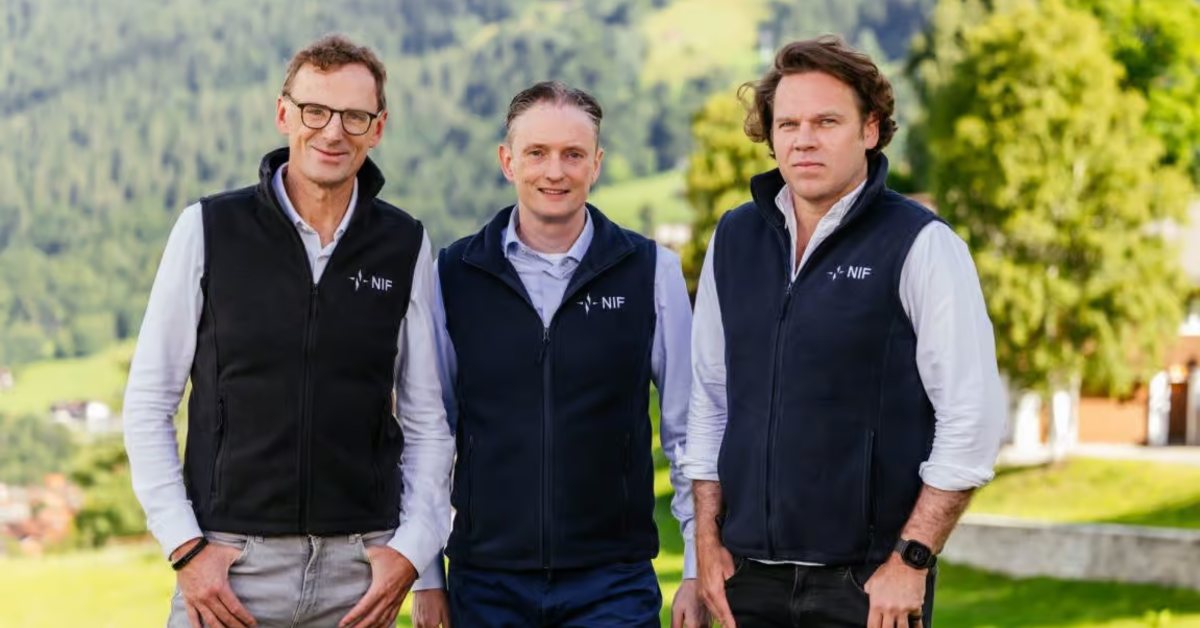
The NATO Innovation Fund (NIF), an independent venture capital firm backed by 23 NATO Allies, has announced the appointment of two seasoned deep-tech investors to its investment team.
Industrial adoption and deep-tech expertise will be crucial to implement the agenda agreed at the 2025 NATO Summit.
In the light of the Alliance’s strategic needs, Ulrich Quay and Sander Verbrugge will join the NATO Innovation Fund as Partners.
Contentlockr
“We warmly welcome Ulrich and Sander to the Fund’s partnership. Our two new Partners bring exceptional expertise in deep-tech investing, bringing experience and wisdom in adoption and scaling to founders and to other fund managers. They will enable us to move even more rapidly and decisively to drive the Alliance’s technological agenda and support the best founders across European ecosystems,” says Dr. Klaus Hommels and Professor Dame Fiona Murray, Chair and Vice Chair of the NATO Innovation Fund.
Ulrich Quay joins from BMW
Ulrich Quay is joining the NATO Innovation Fund from BMW, where he most recently was in charge of Corporate Investments as a Vice President.
He previously was the Founder and Managing Partner of BMW i Ventures – BMW’s autonomous €500M Venture Fund, focused on automotive technology, manufacturing, supply chain, and AI, among others.
Ulrich brings to the Fund a stellar track record of identifying and investing in innovations that have critically helped strengthen Europe’s industrial base.
“It’s an incredible time to be joining the NATO Innovation Fund. Technological breakthroughs are often the solution to some of the most pressing issues facing humanity, and I’m confident that we are well-positioned to strengthen the foundations of the Alliance’s defence and security, while also helping revitalise the industrial base of Allied nations,” says Ulrich Quay.
Sander Verbrugge comes on board from NXP
Sander Verbrugge is a highly experienced deep tech investor, joining the NATO Innovation Fund as a partner from Innovation Industries – a €900M AUM European deep tech VC fund.
He previously worked at NXP, a semiconductor design and manufacturing company. With a PhD in Molecular Biophysics and hands-on experience helping start-ups to grow their products and expand their market reach, Sander combines a very strong understanding of the operational demands for start-ups and scale-ups with exceptional technological insights.
“After years of combining my scientific background with my passion for supporting startups, I’m grateful for the opportunity to use my skillset in order to serve the NATO Innovation Fund’s important mission. I’m looking forward to working with some of the Alliance’s boldest entrepreneurs to unlock the potential of innovative technologies and help meet some of the Alliance’s most pressing needs,” says Sander Verbrugge.
Ulrich Quay and Sander Verbrugge bring the expertise needed to drive the Fund’s mission and deliver tangible impact for the Alliance.
They both have a strong track record in deep tech investment and industrial resilience, with experience in scaling and implementing innovative technologies.
This complements the work of the Fund’s Mission Platform Group, led by Chief Adoption Officer John Ridge, which was established to bridge the gap between startups and Ministries of Defence to accelerate the adoption of technological capabilities, protect those technological capabilities, and ensure the sustainment and responsible use of those technologies.
Kelly Chen departs
On the other side, Kelly Chen, one of the fund’s original partners, has decided to step away from her role as a founding team partner to build a new venture.
“It’s been a privilege to help stand up the world’s first multi-sovereign venture capital fund backed by 24 nations. In two years, we scaled from the ground up to 12 direct and 9 indirect investments – across critical deep tech domains,” says Chen in a LinkedIn post.
“From being an early partner at DCVC, when few funds in even Silicon Valley were dedicated to deep tech, to securitised bond trading on Wall Street, to my time at NIF, I’ve spent my career where capital meets new structures. From my roots in deep tech and AI, I believe private market structures will continue to be pivotal for speed, scale, and sovereignty,” she adds.
However, Kelly Chen didn’t reveal much about her next venture.
“We would also like to thank Kelly for her contribution to the Fund’s first two years. She will remain a valued member of the extended NATO Innovation Fund community. Building an ecosystem is what we set out to do. The Fund is now at the centre of a vast DSR network that spans the Alliance and is crucial to meeting its technological needs,” adds Dr. Klaus Hommels and Professor Dame Fiona Murray
Developing Defence, Security, and Resilience ecosystem
The NATO Innovation Fund has been key in developing a strong Defence, Security, and Resilience (DSR) ecosystem, enhancing the Alliance’s technology over the past two years.
As highlighted in the 2025 NATO Summit, there is a clear need to scale and accelerate the deployment of these technologies to meet urgent strategic needs.
The Fund is focused on connecting startups with governments, which is evident in the expansion of its senior investment team. This team will invest in solutions that address the Alliance’s immediate requirements and drive innovation efficiently.
NATO Innovation Fund: What you need to know?
Backed by 24 NATO Allies, the NATO Innovation Fund finances innovators across various emerging technology sectors, including energy, quantum computing, artificial intelligence, autonomy, novel materials, space, biotechnology, hypersonic systems, and next-generation communications.
Building on this initial portfolio of investments, the Fund will provide deep tech entrepreneurs with the support they need for up to 15 years, as well as the conviction and agility necessary to commercialise and implement their solutions at scale.
