

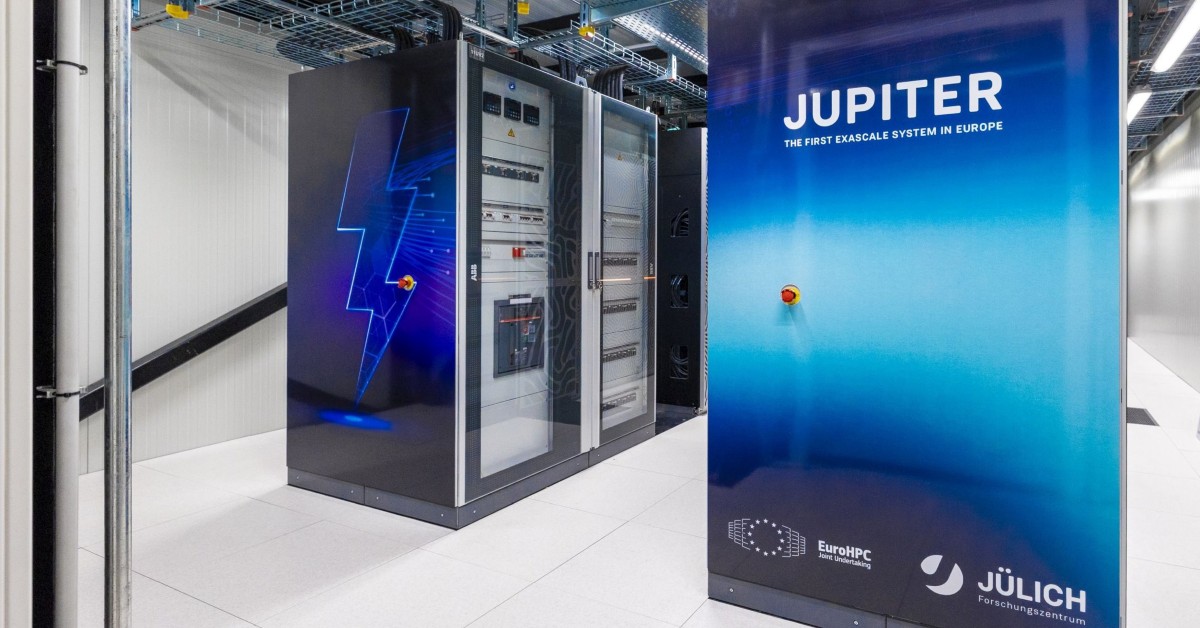
German research centre Forschungszentrum Jülich to inaugurate JUPITER, an exascale-capable supercomputer, on 5 September 2025.
Contentlockr
Germany-based Forschungszentrum Jülich, a research centre and founding member of the Helmholtz Association, has announced the launch of JUPITER, an exascale-capable supercomputer, at the Jülich Supercomputing Centre.
The system is the first in Europe, and a livestream of the launch will be available here.
JUPITER, which stands for “Joint Undertaking Pioneer for Innovative and Transformative Exascale Research”, was developed over ten years and is intended to support science and industry projects across Europe.
The system is expected to enable new computational tasks and expand computing capabilities for research and industrial applications.
Inauguration of Europe’s first supercomputer
JUPITER is the first supercomputer in Europe to exceed 1 quintillion floating-point operations per second. It is designed and operated by the Jülich Supercomputing Centre.
The system will support projects in artificial intelligence, data analysis, and simulation. It will also be used in research and industrial applications in areas including climate, energy, health, materials, mobility, and civil safety.
Forschungszentrum Jülich mention that JUPITER will strengthen computing capabilities in Germany and Europe.
Prof. Dr. Astrid Lambrecht, Chair of the Board of Directors of Forschungszentrum Jülich, says, “Whether it be the digital transformation, climate protection, the energy transition, or the development of a sustainable circular economy, it takes a great deal of computing power to solve many of the big issues facing humanity.”
“JUPITER will provide a huge boost for research in these areas – for the development and use of artificial intelligence, as well as for simulations and data analysis.”
The inauguration of the supercomputer will take place on Friday, 5 September 2025, from 13:00 at the Jülich Supercomputing Centre. The stage programme will run from 14:00 to 15:30, followed by a get-together.
Europe’s first exascale supercomputer
JUPITER is the first system in Europe to exceed one quintillion floating-point operations per second. The system will reach one ExaFLOP/s at 64-bit precision for scientific simulations. For AI tasks, it can provide approximately 40 ExaFLOP/s at 8-bit precision or 80 ExaFLOP/s in 8-bit sparsity mode.
This would make JUPITER one of the fastest computers for AI in the world. The system is provided by a supercomputer consortium of ParTec and Eviden and was procured by the EuroHPC JU in collaboration with the Jülich Supercomputing Centre (JSC).
JUPITER will have two computing modules. The Booster module will include about 6,000 compute nodes in 125 racks and 24,000 NVIDIA GH200 superchips connected via a Quantum-2 InfiniBand network. The Cluster module will have more than 1,300 nodes and use the Rhea processor from SiPearl, developed and manufactured in Europe.
Prof. Dr. Thomas Lippert, Director of the Jülich Supercomputing Centre, Forschungszentrum Jülich, says, “JUPITER is a dynamic modular supercomputer with two parts: a highly scalable booster module for particularly compute-intensive problems, which is massively supported by GPUs, and a cluster module that can be used very universally for all kinds of tasks, especially for complex, data-intensive tasks. Both modules can solve scientific problems separately or together, depending on what is required.”
The system is being installed in a modular data centre spanning about 2,300 square meters with 50 container modules. The design allows for shorter planning and assembly times, lower construction and operating costs, and flexible adaptation for future computing generations.
JUPITER is funded half by the European High Performance Computing Joint Undertaking (EuroHPC JU) and a quarter each by the Federal Ministry of Research, Technology and Space and the Ministry of Culture and Science of North Rhine-Westphalia through the Gauss Centre for Supercomputing.
Brief about the Jülich Supercomputing Centre
The Jülich Supercomputing Centre at Forschungszentrum Jülich has operated Germany’s first supercomputing centre since 1987.
Through the Jülich Institute for Advanced Simulation, it continues the tradition of scientific computing. JSC currently operates the supercomputer JUWELS and the European quantum computing infrastructure JUNIQ.
With about 300 staff members, JSC provides supercomputer resources, IT tools, methods, and expertise for researchers at Forschungszentrum Jülich and participants in over 200 German and European projects via the John von Neumann Institute for Computing (NIC), the Gauss Centre for Supercomputing (GCS), and PRACE.
It supports users through its Algorithms, Tools and Methods Labs (ATMLs) and Simulation and Data Laboratories (SDLs), assisting applications across natural sciences while conducting domain-specific research.
