

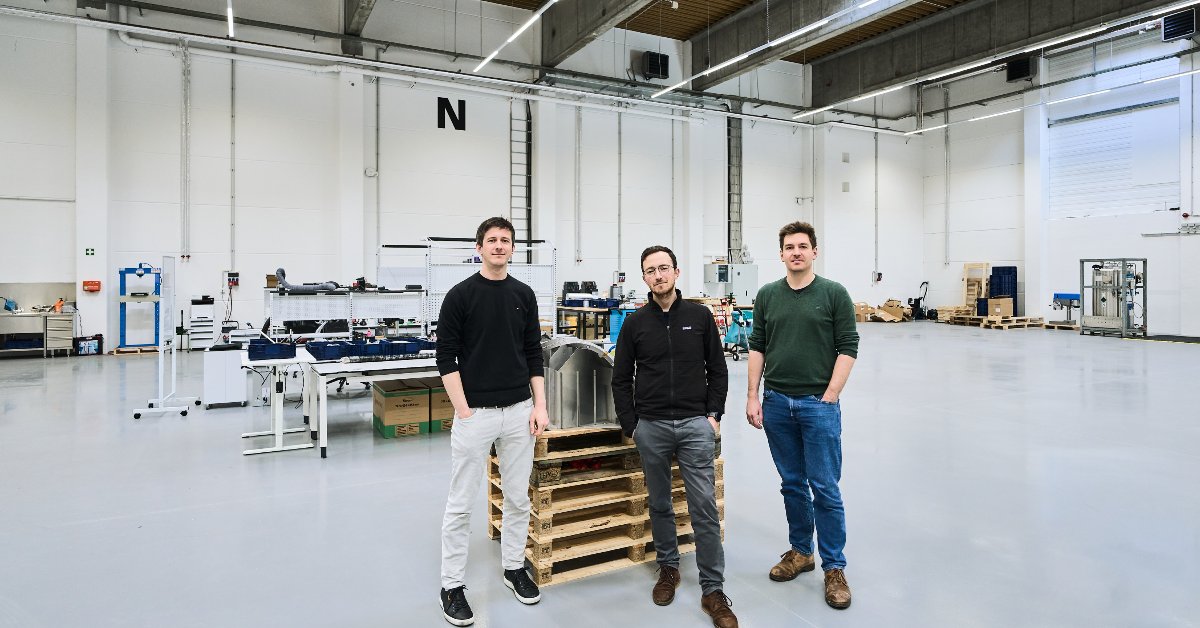
Munich-based Proxima Fusion secures additional funding and outlines its next steps in developing stellarator-based fusion power plants.
Contentlockr
Munich-based fusion company Proxima Fusion has raised an additional €15M in an extension of its Series A round. Investors in the extension include CDP Venture Capital (Cassa Depositi e Prestiti Group), the European Innovation Council Fund (EICF), and Brevan Howard.
The company previously secured €130M in Series A funding in June 2025, co-led by Cherry Ventures and Balderton Capital. With the new capital, Proxima Fusion’s total funding now stands at €200M.
Proxima Fusion stated that the round supports its objective of building a sovereign fusion company in Europe.
Toward the first generation of stellarator fusion plants
Proxima Fusion was founded in January 2023 as a spin-out from the Max Planck Institute for Plasma Physics (IPP). The company was started by Francesco Sciortino, Lucio Milanese, Jorrit Lion, Martin Kubie, and Jonathan Schilling, together with experts from IPP, MIT, and Google-X. Its goal is to build the first generation of fusion power plants using QI-HTS stellarators.
A stellarator is a type of fusion device that uses external coils to create a twisting magnetic field. This setup controls the plasma without using electric currents inside the plasma, which is how tokamaks work. Proxima Fusion is working on the design of a stellarator power plant and the key parts needed for it to operate under the conditions of a fusion energy system.
The company uses a simulation-led approach, relying on advanced computing and high-temperature superconductors to speed up research and lower costs. This work builds on the Wendelstein 7-X (W7-X) experiment, the world’s largest stellarator, based at IPP in Greifswald, Germany.
Through its projects, the company aims to help Europe take a leading role in the development of fusion energy.
Investors supporting Proxima Fusion
CDP, backed by the Italian state, invested through its Large Ventures fund and its Corporate Partners I Energy Tech fund, which targets companies developing technologies for the energy transition.
The EICF’s equity investment follows a €2.5M grant previously awarded to Proxima and adds to backing from other European public funds.
Earlier investors include the DeepTech & Climate Fonds (DTCF) and High–Tech Gründerfonds (HTGF), both supported by the German Ministry of Economics and Energy, Bayern Kapital, owned by LfA Förderbank Bayern, and the Max Planck Foundation, which funds research across the institutes of the Max Planck Society.
The CDP investment shows that more countries in Europe see fusion energy as important for energy independence and industry, and it brings major European economies together in support of Proxima’s mission.
Alessandro Scortecci, Chief Investment Officer, Direct Investments at CDP Venture Capital, says, “CDP Venture Capital believes firmly that Europe’s deep tech ecosystem has a key role to play in developing future energy solutions.”
“Fusion can contribute to technological independence, drive industrial competitiveness, and accelerate carbon-neutral economic growth. We are confident that Proxima will deliver and transform the global energy landscape.”
Francesco Sciortino, co-founder and CEO of Proxima, adds, “Proxima is bringing together public and private partners, developing as a truly European company, uniting expertise, talent, and capital from across the continent.”
“While our roots are in Germany, building on the record-breaking Wendelstein 7-X stellarator experiment at the Max Planck Institute for Plasma Physics, we are building a pan-European team and investor base. This collaborative ambition, combined with the Max Planck Institute’s incredible legacy, is giving us a powerful European foundation to lead the global race to fusion.”
Proxima’s recent growth and development
Three months after announcing Europe’s largest fusion funding round, Proxima Fusion has increased its workforce by 20 per cent to reach 100 employees.
The company is deploying its new capital into supply chain, manufacturing, and research initiatives to advance its development roadmap.
Proxima has placed purchase orders for HTS tape to secure a long-term supply for its HTS magnet program. It has also ordered the manufacturing of structural support plates for the SMC, its first HTS non-planar magnet.
In addition, the company is setting up an in-house cable manufacturing line to expand research and development capabilities and to produce its first long-length SMC cables.
Further orders include full-size and weight dummy coils and prototype vacuum vessel sections, which will be used to validate hardware design, test manufacturing capability, and develop assembly processes for stellarators.
Capital utilisation
Proxima Fusion says its latest funding will support progress on the Stellarator Model Coil (SMC), aimed at reducing risks in high-temperature superconducting (HTS) magnet technology. The company has set 2027 as the target for completing the SMC.
In parallel, Proxima is finalising the design of its net energy gain demonstration stellarator, Alpha, and assessing potential construction sites across Europe.
