

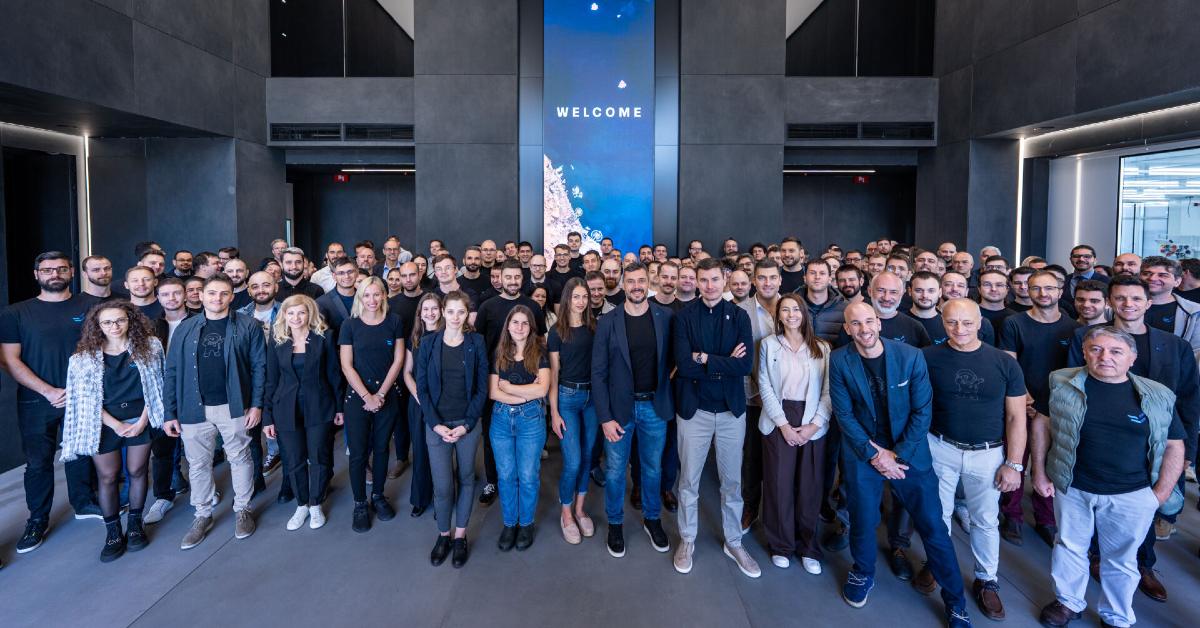
Sofia-based EnduroSat has raised fresh funds to expand its operations and advance its mission to simplify access to space data.
Contentlockr
Sofia-based EnduroSat, a Bulgarian space infrastructure builder that engineers, builds, and operates satellites, has raised $104M (nearly €89.90M) in new funding to expand its manufacturing operations.
The investment supports the company’s plan to increase production to two ESPA-class satellites per day, advancing its goal of reducing time-to-orbit for constellation operators.
The round includes participation from Riot Ventures, Google Ventures, Lux Capital, the European Innovation Council Fund, and Shrug Capital.
EnduroSat stated that the funding will strengthen its mission to simplify access to space-based data and services.
Stephen Marcus, co-founder and General Partner of Riot Ventures, says, “EnduroSat is redefining how space infrastructure is built and deployed. Their production capabilities are aligned with the evolving demands of a new generation of satellite operators.”
“We believe EnduroSat is uniquely positioned to empower businesses and governments to leverage the advantages of their own dedicated space assets, and we’re excited to support this vision.”
Roni Hiranand, Partner at GV (Google Ventures), adds, “At GV, we believe the next era of connectivity and exploration will be fueled by scalable, modular satellite platforms. EnduroSat’s technical depth, rapid manufacturing innovation, and customer-first mindset uniquely position them to set a new standard for satellite constellations.”
“We’re proud to support Raycho and the entire EnduroSat team as they unlock new possibilities for organisations of every size to access and leverage space data at unprecedented scale.”
A new Space Centre in Sofia
The announcement coincides with the opening of EnduroSat’s new Space Centre in Sofia.
The 188,340-square-foot facility enables production of up to two satellites weighing between 200 and 500 kilograms each day. It houses RF laboratories, hardware and mechanical facilities, ISO-certified clean rooms, and testing areas for space qualification.
The expansion aims to meet rising global demand for small and mid-sized satellite constellations while supporting faster, more efficient spacecraft deployment.
Raycho Raychev, EnduroSat CEO and founder, says, “This latest investment, combined with the launch of our new Space Centre, marks a pivotal moment. It not only validates our strong market traction but significantly accelerates our ability to deliver highly capable, cost-effective satellite constellations at an unprecedented scale, moving us closer to a future where space data will become universally accessible and instantly available.”
Making space universally accessible
Founded in 2015 by Raycho Raychev, EnduroSat develops and operates satellites that support missions for commercial, research, and institutional users. The company builds modular spacecraft designed to host multiple payloads and enable shared access to orbit.
EnduroSat’s mission is to transform the complex satellite industry into a streamlined data service. Its goal is to enable instant access and transactions with space data collected from hundreds of sensors operating in orbit.
The Bulgarian company manages the full process of satellite development, including design, manufacturing, integration, launch coordination, and mission operations. The company’s approach allows users to focus on data and applications rather than spacecraft design or logistics.
The company’s work supports organisations seeking to operate in orbit and leverage space data for communication, observation, and technology development.
Brandon Reeves, Partner at Lux Capital, says, “EnduroSat’s trajectory follows one of the great industrial playbooks of our time. Much like BYD began building battery components before vertically integrating into complete vehicles, EnduroSat started by building best-in-class subsystems for the space industry and has moved up the stack to now building satellites and full constellation solutions. They understand every layer of the technology stack because they built it themselves, and that deep systems knowledge translates into better performance, faster iteration, and ultimately, superior economics.”
