

Delft-based Back to Battery secures fresh funding to advance its battery recycling technology and expand operations.
Contentlockr
Delft-based Back to Battery, a company that produces battery materials from end-of-life Li-ion batteries, has obtained a €350K loan through UNIIQ’s Early Phase Financing program.
The funding will be used to build a bench-scale pilot plant to test and validate the company’s circular battery recycling process.
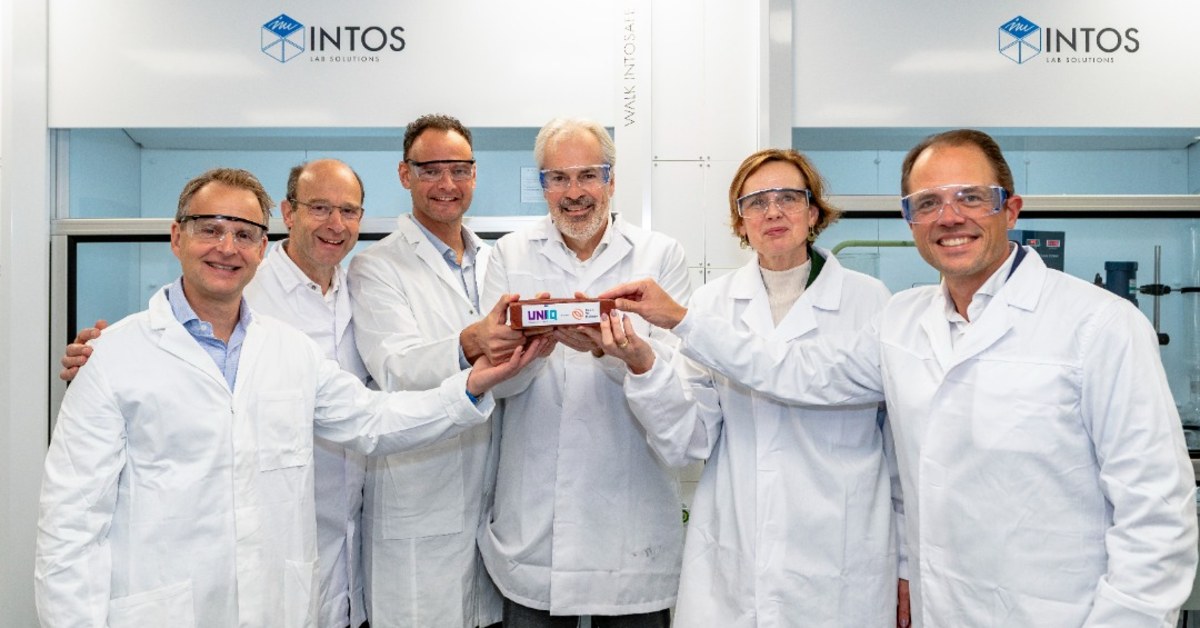
The announcement was made during a working visit attended by regional partners, including the Province of South Holland, the Netherlands Enterprise Agency (RVO), and the Port of Rotterdam Authority.
The investment, supported by additional contributions from the RVO, the Province of South Holland, and the municipalities of Leiden and Rotterdam, enables Back to Battery to develop further and expand its lithium-ion battery recycling technology.
Strengthen battery supply chain
The growing demand for batteries and raw materials, driven by the energy transition, is increasing the need for resource recovery. End-of-life batteries contain key materials, including lithium, cobalt, and nickel, which can be recovered and reused instead of being mined.
Back to Battery focuses on extracting these materials from used batteries and converting them into new battery materials. The company’s process enables recovery without waste and with limited use of energy and chemicals.
By reusing recovered materials, Back to Battery supports local production of battery components and reduces dependence on imported raw materials. The company’s work contributes to building a self-sufficient battery value chain in South Holland and across Europe.
Steven Lans, co-founder and CEO of Back to Battery, says, “We want to demonstrate that battery recycling can be not only cleaner, but also smarter. Thanks to this investment, we can further scale up our technology and prove that local reuse of battery materials is feasible.”
What’s next?
Back to Battery is working with InnovationQuarter, the Province of South Holland, Delft University of Technology, and the Battery Competence Cluster – NL, to expand its operations.
The company is producing test samples to present to potential customers and is assessing possible locations for its first production line. This step marks the beginning of its plans to scale operations and process the growing volume of discarded batteries.
Through these efforts, Back to Battery aims to build a system for reusing materials from used batteries and to support the circular management of battery resources.
Jasper Geselschap, Fund Manager at UNIIQ, says, “Back to Battery is a great example of entrepreneurship. The founders identified a gap in the European battery value chain based on their own experience and vision, and acted on it by simply doing it themselves. This demonstrates courage and ambition!”
“With this loan, we’re helping them bring their technology to market and contributing to a more sustainable Europe,” adds Geselschap.
Brief about UNIIQ
UNIIQ, a €50M proof-of-concept fund, supports entrepreneurs in South Holland in bringing new technologies and business ideas to market. The fund provides seed capital and coaching to academic spin-offs and startups, helping them move from concept to company.
Over 60 per cent of startups supported by UNIIQ have secured follow-up funding, with total investments exceeding €275M.
UNIIQ is co-funded by Erasmus MC, Delft University of Technology, Leiden University, Erasmus University Rotterdam, InnovationQuarter, the European Union, the Province of South Holland, the Ministry of Economic Affairs and Climate Policy, the RVO, TNO, and the municipalities of Rotterdam, The Hague, and Leiden. InnovationQuarter manages the fund on behalf of its partners.
What does UNIIQ’s Early Stage Fund offer?
Back to Battery has received investment from UNIIQ’s Early Stage Fund (VFF). The financing is part of a loan program for startups that aim to test and further develop their technologies.
The Early Stage Financing instrument is part of the Ministry of Economic Affairs and Climate Policy’s funding framework and is implemented by the Netherlands Enterprise Agency (RVO) and UNIIQ.
The VFF UNIIQ fund is supported by the Ministry of Economic Affairs and Climate Policy, the RVO, the Province of South Holland, and regional knowledge institutions.
With additional contributions from the RVO and other partners, the fund has increased its capacity to provide financial support to startups operating in South Holland.
