

Amsterdam’s Picnic has raised €430M funding to support its expansion plans and ongoing operations across multiple markets.
Contentlockr
Amsterdam-based online supermarket Picnic has raised €430M in funding, led by its existing investors. The unicorn plans to utilise most of the capital toward its operations in Germany, where it claims to be the market leader.
The funding will support the rollout of services in additional regions and cities. This includes investment in distribution centres and related infrastructure.
Later today, Picnic will present the new funding round during the 120th anniversary event of the German-Dutch Chamber of Commerce in The Hague (NL). The event will host Minister of Economic Affairs Vincent Karremans and German State Secretary for Economic Affairs and Energy Frank Wetzel.
Picnic highlights cooperation between teams in both countries as an example of cross-border progress toward a unified European online grocery network.
Picnic targets wider reach in Germany
Germany has around five times the population of the Netherlands and covers nearly nine times its land area. Picnic says it aims to reach a large share of German households, which requires substantial investment to build infrastructure on the same scale as in the Netherlands.
The company reports faster growth in Germany since its launch, with an aim for further expansion. Picnic is currently operationally profitable in the Netherlands.
Founded in 2015 after three years of development, Picnic expanded its no-fee delivery model across the Netherlands and now serves two million customers in two hundred cities through seven distribution centres. The company entered Germany in 2018 and France in 2021.
Picnic will announce its new investment round this afternoon at the 120th anniversary event of the German-Dutch Chamber of Commerce in The Hague, attended by Minister of Economic Affairs Vincent Karremans and German State Secretary for Economic Affairs and Energy Frank Wetzel.
Michiel Muller, co-founder of Picnic, says, “The collaboration between software developers and operational staff from both countries demonstrates the strength of cross-border cooperation and the building of a European market leader in online grocery shopping.”
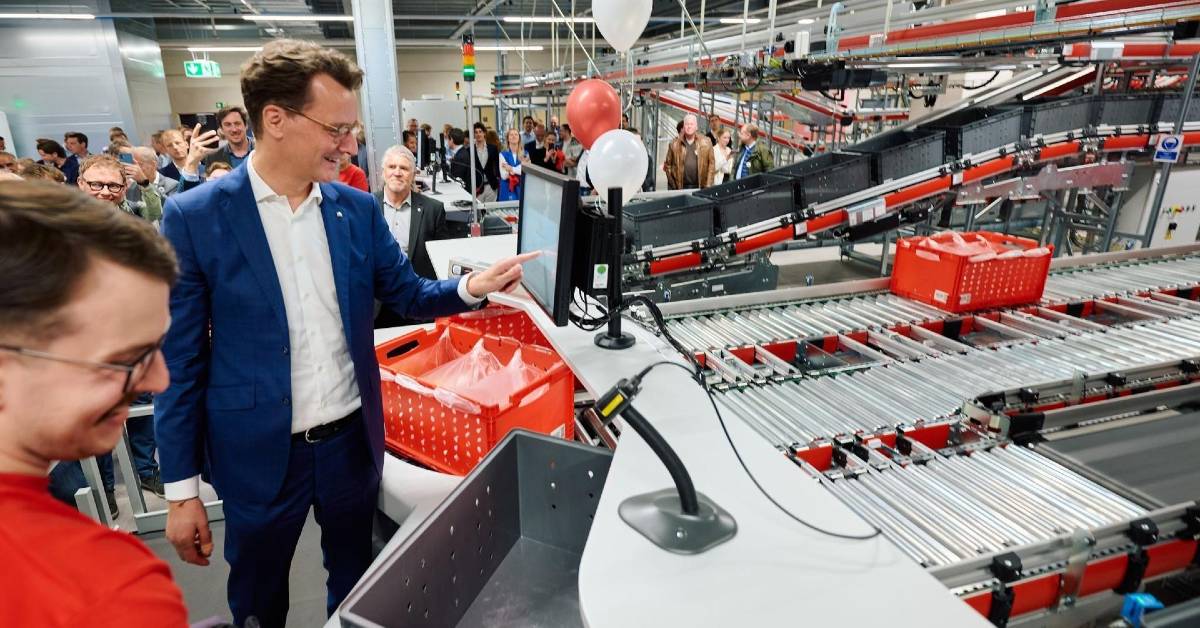
Three years ago, Picnic introduced a robotic distribution centre in Utrecht. A new facility in Oberhausen is now testing robopicking, in which robots place groceries in crates for customers. The system works with more than 15,000 products, each requiring its own method of handling, which creates a demanding set of tasks for the robots.
Muller adds, “A carton of eggs needs to be handled differently than a bottle of olive oil. Visual AI is used for this, which mimics human vision. Artificial intelligence understands what it sees and acts appropriately.”
Brief about Picnic
Picnic began in 2015 under the direction of founders Michiel Muller, Frederik Nieuwenhuys, Joris Beckers, and Bas Verheijen. Before its launch, the company spent three years developing a system to bring groceries directly to homes without extra steps in the chain. A team of 30 worked on the model, which centred on a route-based delivery method.
Customers select a delivery route that fits their schedule and receive the exact delivery time through the Picnic grocery radar. The structure of the distribution process keeps costs low enough for the company to offer delivery at no charge.
After establishing its service in the Netherlands, Picnic entered Germany in 2018 and France in 2021, extending its approach into new markets.
