

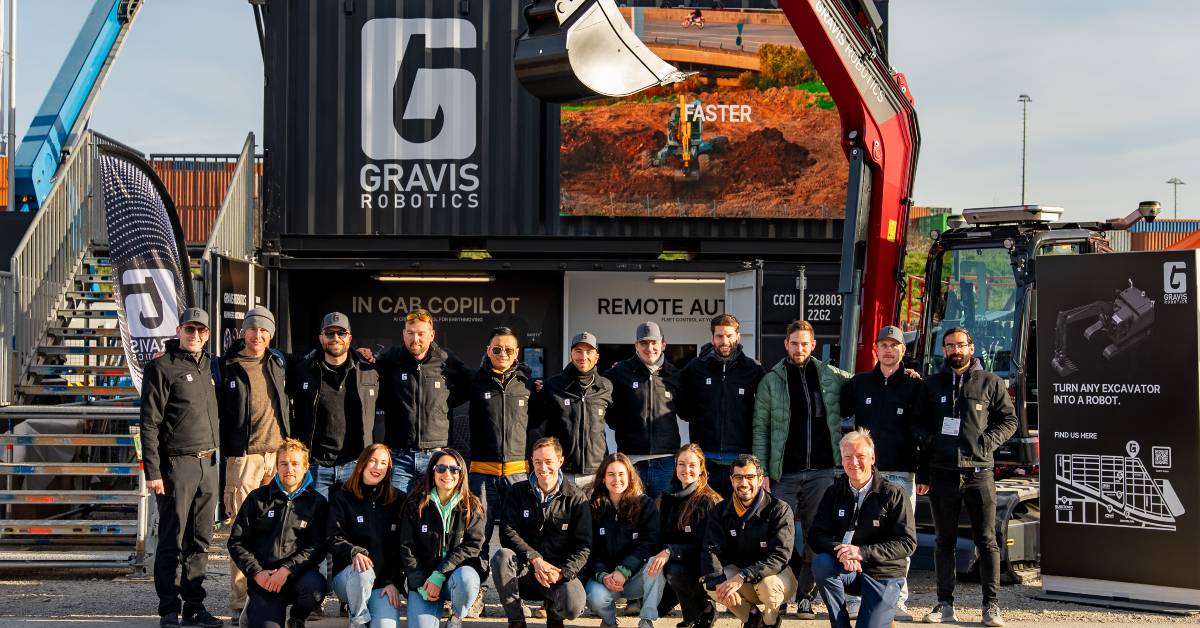
Gravis Robotics raises €19.9M to expand industry partnerships and deploy autonomous systems in construction and earthmoving equipment.
Contentlockr
Zurich-based Gravis Robotics, an earthmoving autonomy platform that aims to transform global construction, has secured $23M (nearly €19.9M) in funding and has entered a series of industry partnerships.
The round was co-led by IQ Capital and Zacua Ventures. Pear VC, Imad (the corporate venture arm of Nesma & Partners), Sunna Ventures, Armada Investment, and Holcim also took part in the raise.
Juan Nieto, General Partner at Zacua Ventures, says, “Gravis embodies the kind of innovation our industry has been waiting for: autonomy that truly works in the field. Built on deep ETH Zurich research and driven by a top-notch team, they’re already delivering productivity gains customers can feel.”
“The enthusiasm from our global investor base of leading builders, operators, and equipment groups is the clearest validation of how transformative Gravis’s technology can be.”
Gravis Robotics plans to use the funds to scale its platform in more regions, add more staff members, and build out its network of OEMs, contractors, and dealers. The company continues to work with stakeholders across construction, equipment supply, and infrastructure operations as it advances deployment of its autonomy system.
Adding autonomous systems to earthmoving equipment
Gravis Robotics was founded in 2022 as a spinout from ETH Zurich. The company addresses challenges in construction, such as high demand, falling output, and an ageing workforce, by focusing on productivity. Its platform delivers autonomous operation for earthmoving equipment, supporting contractors on job sites and in remote coordination.
Ryan Luke Johns, CEO and co-founder of Gravis Robotics, says, “The fastest path to autonomy is delivering productivity today. By giving operators real-time 3D intelligence and the ability to shift seamlessly between autonomy and augmented control, we cover more of the work, accelerate adoption, and create the data pipeline needed to learn new capabilities from the industry’s hardest jobs.”
The system uses AI and autonomy to operate beyond basic commands. It responds to ground conditions through a learning-based control system that collects data from hydraulics, LiDAR, cameras, and GNSS. This control system works with Gravis Slate, a tablet interface that integrates with construction workflows and supports manual operations using the robotic sensor suite. The combination creates a continuous data loop that allows Gravis to track performance and expand autonomous functions.
Gravis is designed to operate across tasks such as trenching, earthworks, grading and material handling while working alongside human teams. The company says the system can increase output by 30 per cent, lower rework and support safe operations.
Archie Muirhead, partner at IQ Capital, adds, “Gravis stands out, not just for its technical brilliance, but for how much it’s already achieved. The team’s thoughtful, grounded approach to autonomy – deploying real systems with real crews – has led to trusted partnerships with some of the largest global construction companies and OEMs and invaluable data from time-in-field. This huge and unserved market is ready now for autonomy, and Gravis is setting the pace.”
The Gravis team combines construction knowledge, learning-based robotics, and OEM experience. Co-founder and CEO Ryan Luke Johns is an architect and roboticist, and holds the Guinness World Record for the largest dry-stone wall built by a robot. Co-founder and CTO Dominic Jud specialises in autonomous control systems for machinery. The two met in the lab of co-founder and board member Marco Hutter, an AI researcher and serial robotics entrepreneur.
Expanding industry reach
Gravis Robotics extends deployment of its autonomy platform across construction sites, quarries, rental fleets, and OEM dealer networks.
Gravis Robotics systems are in use across construction operations and in quarry environments for the autonomous movement of material with Holcim and other partners. The platform supports site preparation, stockpile handling, and the loading of trucks and screeners.
The company recently began work with Taylor Woodrow on an infrastructure project at Manchester Airport. Taylor Woodrow describes the project as the UK’s first autonomous excavator trial on an active construction site.
Gravis Robotics has also formed a partnership with Flannery to offer a rental package for construction operators. The arrangement provides access to excavators fitted with the Gravis Rack at the point of hire.
A related model is available through dealer channels linked to Gravis Robotics’ OEM partners. The Develon-based integration is already in use in the UK, and the company has begun work with Kibag in Switzerland.
Autonomy at scale
Recent deployments and funding position Gravis Robotics to introduce large-scale autonomy to the earthmoving and mining industries.
Gravis says it operates across seven countries and supports both mixed-fleet and OEM-integrated equipment in several regions. The company also says it has integrated autonomous systems into the equipment rental market.
With its current technology, partnerships, and distribution channels, Gravis Robotics aims to expand autonomous operations across multiple regions.
