

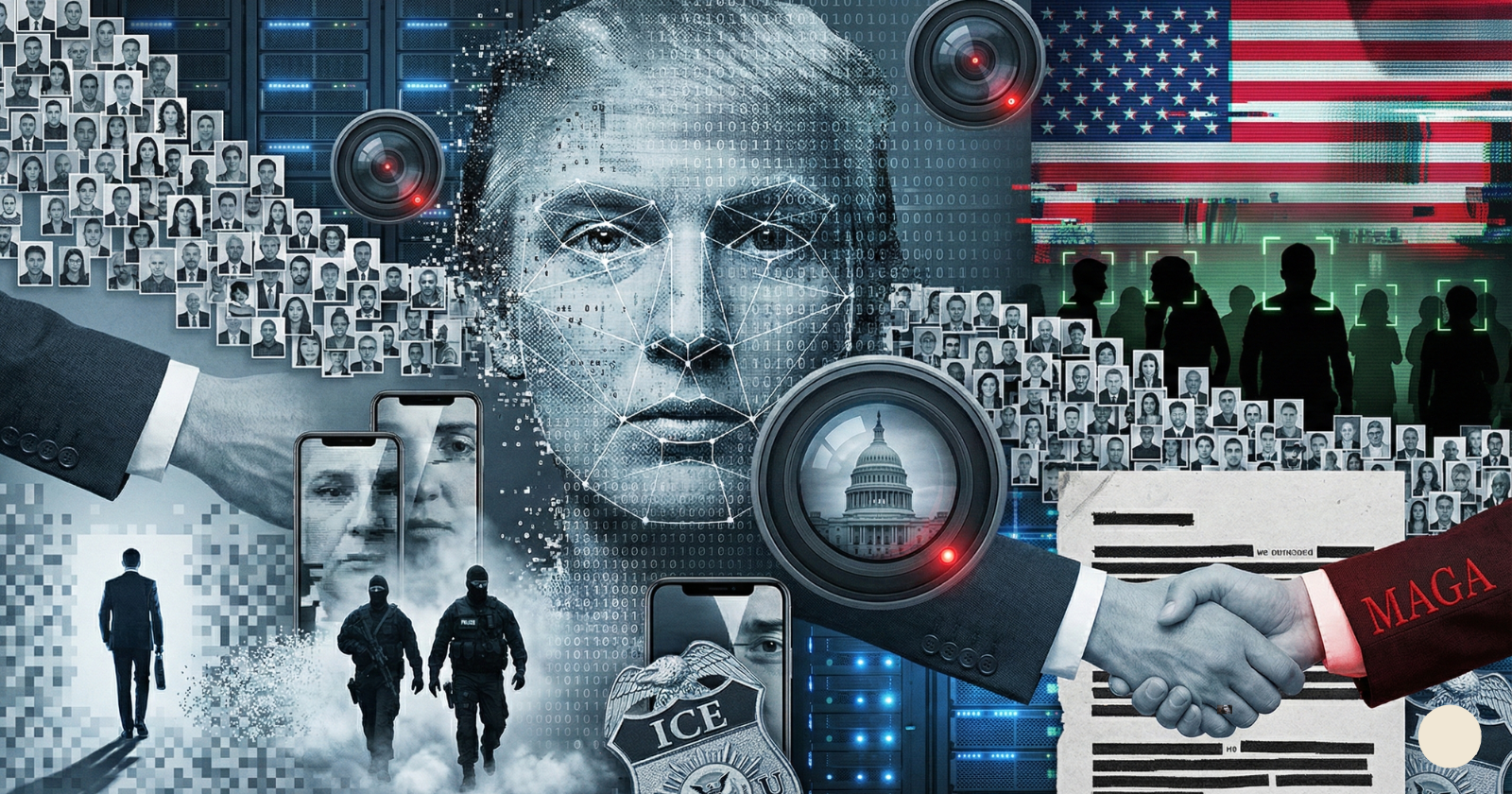
The surveillance state isn’t coming. It’s being assembled in plain sight, one leadership change at a time.
Last week I wrote about selling my Palantir stock after CEO Alex Karp explained, calmly and without embarrassment, that constitutional scrutiny of potential war crimes was a business opportunity for his company. The veil came off. He said what organized violence is actually for.
This week, another veil came off. And this time, nobody said anything at all. They didn’t have to.
Clearview AI — the facial recognition company that scraped billions of photos from the internet without anyone’s consent to build a searchable database of human faces — has new leadership. The tech founder is out. The new co-CEOs are Hal Lambert and Richard Schwartz. Lambert founded the MAGA ETF and served on Trump’s Inaugural Committee. Schwartz was a senior advisor to Rudy Giuliani.
A company spokesperson told TechCrunch that Lambert and Schwartz will “lead the charge to capitalize on emerging opportunities to enhance national security and public safety under the new Administration.”
That’s the whole story, really. But it’s worth understanding what it means.
What Clearview actually is
If you haven’t followed this company, here’s what you need to know: Clearview AI scraped over 30 billion photos from the internet — from social media, news sites, anywhere a face appeared publicly — and built a searchable database. Upload a photo, get a match. Find out who someone is, where they’ve been photographed, what’s linked to their face online.
They did this without asking anyone. Not the people whose faces they collected. Not the platforms they scraped from. Google, Facebook, YouTube, LinkedIn all sent cease-and-desist letters. Clearview ignored them.
In September 2024, the Dutch Data Protection Authority fined Clearview AI €30.5 million and described its database of facial images as illegal. They’ve been sued by the ACLU. They’ve been banned in multiple countries. Kashmir Hill’s book about them is literally titled “Your Face Belongs to Us: A Secretive Startup’s Quest to End Privacy as We Know It.”
Their customers are law enforcement agencies, ICE, the FBI, the Department of Homeland Security. The product is your face, indexed and searchable, sold to the state.
The Thiel connection
Here’s the part that ties this to the pattern I’ve been tracking.
Peter Thiel — co-founder of Palantir, the company I wrote about last week — was one of Clearview’s first investors. He provided the $200,000 in seed money that got the company off the ground in 2017.
This is the same Peter Thiel who wrote in 2009 that he “no longer believed that freedom and democracy are compatible.” The same Thiel who co-founded Palantir, which builds the data analysis systems that tell agencies who to target. The same Thiel who has funded a constellation of surveillance and defense startups.
Palantir is the analysis layer. Clearview is the identification layer. They’re complementary systems. And now both are explicitly aligned with political power — Palantir through Karp’s open embrace of “organized violence” as civilizational strategy, Clearview through handing control to Republican operatives whose explicit mission is to “capitalize on opportunities” under Trump.
When Thiel was asked about surveillance AI in 2021, he called it a “communist totalitarian technology” that governments would use to control people. He said this while holding investments in both Palantir and Clearview. The irony wasn’t lost on observers at the time. What’s clearer now is that the warning wasn’t hypocrisy — it was a business plan. The concern wasn’t that surveillance would happen. It was about who would control it.
The founder exits, the operatives enter
Hoan Ton-That, who built Clearview’s core technology, stepped down as CEO in December 2024 and was fully removed from the board by April 2025. He said he was “leaving on a high note.”
The timing matters. Clearview had struggled to win major federal contracts. Despite its technology being used by thousands of law enforcement agencies, the big government money hadn’t materialized. The company remained unprofitable.
Enter Hal Lambert. His investment firm, Point Bridge Capital, created the MAGA ETF in 2017 — a fund that lets clients “invest in companies that align with your Republican political beliefs.” He served on Trump’s Inaugural Committee. He knows how to move in these circles.
Enter Richard Schwartz. He was a senior advisor to Rudy Giuliani during his time as mayor. He was actually a co-founder of Clearview — he’d been there from the beginning — but now he’s moved into operational control alongside Lambert.
Lambert told Forbes he’s already in discussions with the Pentagon, the Department of Homeland Security, and other federal agencies. In September 2025, ICE awarded Clearview a facial-recognition purchase order with a potential value of $9.225 million and an initial obligation of $3.75 million, according to procurement records reviewed by 404 Media. Separately, Clearview announced in March 2024 that its product had received “Awardable” status in the Department of Defense’s Tradewinds Solutions Marketplace; that status was not the September 2025 ICE award.
The founder built the machine. The operatives are here to plug it into power.
The pattern I keep seeing
I’ve been writing about hidden codes — the invisible rules that govern who rises and who doesn’t, the systems that operate in plain sight while pretending to be neutral. The tech industry has its own version of this: founders build tools, claim they’re neutral platforms, insist the technology itself has no politics. Then the tools get handed to whoever pays.
Clearview followed this script perfectly. Ton-That always insisted the company was just helping law enforcement solve crimes. The technology was neutral. It could be used for good. Sure, there were concerns about privacy, but think of the missing children found, the criminals identified.
Now the founder is gone, and the people running the company are explicit about their intentions. They’re not pretending anymore. They’re here to “capitalize on opportunities” under a specific political administration. They’re already talking to the Pentagon and DHS about expanding contracts.
This is how it works. The “neutral technology” phase gives way to the deployment phase. The founders who insisted they were just building tools step aside when it’s time to aim those tools at specific populations.
Who gets surveilled
This connects to something I wrote about in my class articles: the hidden rules that protect some people and expose others.
Facial recognition doesn’t hit everyone equally. The wealthy don’t have their faces scraped from public databases the same way. They move through spaces designed for privacy — private clubs, gated communities, first-class lounges with fewer cameras. The hidden codes I wrote about work precisely because they’re invisible to systems like Clearview.
Who ends up in the database? Everyone whose face has ever appeared on a public website. But who gets searched? Who gets targeted? That depends on who’s running the system and what they’re looking for.
ICE is a Clearview customer. The Department of Homeland Security is a customer. The FBI is a customer. Amnesty International has documented how AI-powered surveillance tools — including Palantir’s ImmigrationOS — are being used to identify and target people who speak out on political issues. Clearview’s technology slots right into this infrastructure.
When Lambert says he wants to “capitalize on opportunities” under the Trump administration, what opportunities do you think he means? When the company spokesperson talks about “enhancing national security and public safety,” whose safety? From whom?
The infrastructure is assembling
Step back and look at what’s happening.
Palantir builds the systems that analyze data, identify patterns, and tell agencies who to target. Karp openly celebrates “organized violence” as the source of Western power. The company has a $10 billion military contract and is building ImmigrationOS for ICE.
Clearview builds the systems that identify faces — that turn a photograph into a name, a history, a location. The company just handed control to MAGA operatives who are explicitly positioning for expanded federal contracts.
Both companies were funded by Peter Thiel. Both are now explicitly aligned with political power. Both are scaling up their government relationships under an administration that has made clear it intends to use surveillance infrastructure aggressively.
This isn’t speculation about what might happen. It’s documentation of what’s already happening. The surveillance state isn’t a future threat. It’s being assembled right now, in plain sight, one leadership change and one contract at a time.
What the silence tells you
Karp said the quiet part loud. He explained that war crimes scrutiny was a business opportunity. He celebrated organized violence. He was honest about what Palantir is for.
The Clearview transition is the opposite. No controversial statements. No manifestos about civilizational power. Just a quiet leadership change, a press release about “emerging opportunities,” and new executives who know how to work the system.
Which is more unsettling? I’m not sure anymore.
Karp’s honesty at least creates the possibility of response. You can decide, as I did, that you don’t want your money working for that. You can see the system for what it is.
The quiet version is harder to fight. The founder steps aside. The operatives take over. The contracts expand. The infrastructure scales. And because nobody said anything outrageous, nobody sounds the alarm.
But the alarm should be sounding anyway.
A company built a database of 30 billion faces without consent. It just handed control to political operatives who explicitly want to leverage their connections to expand government contracts. The founder who built the technology is gone. The people who know how to work the system are in charge.
That’s not a neutral technology story. That’s a power story. And the power is being assembled right in front of us.
