

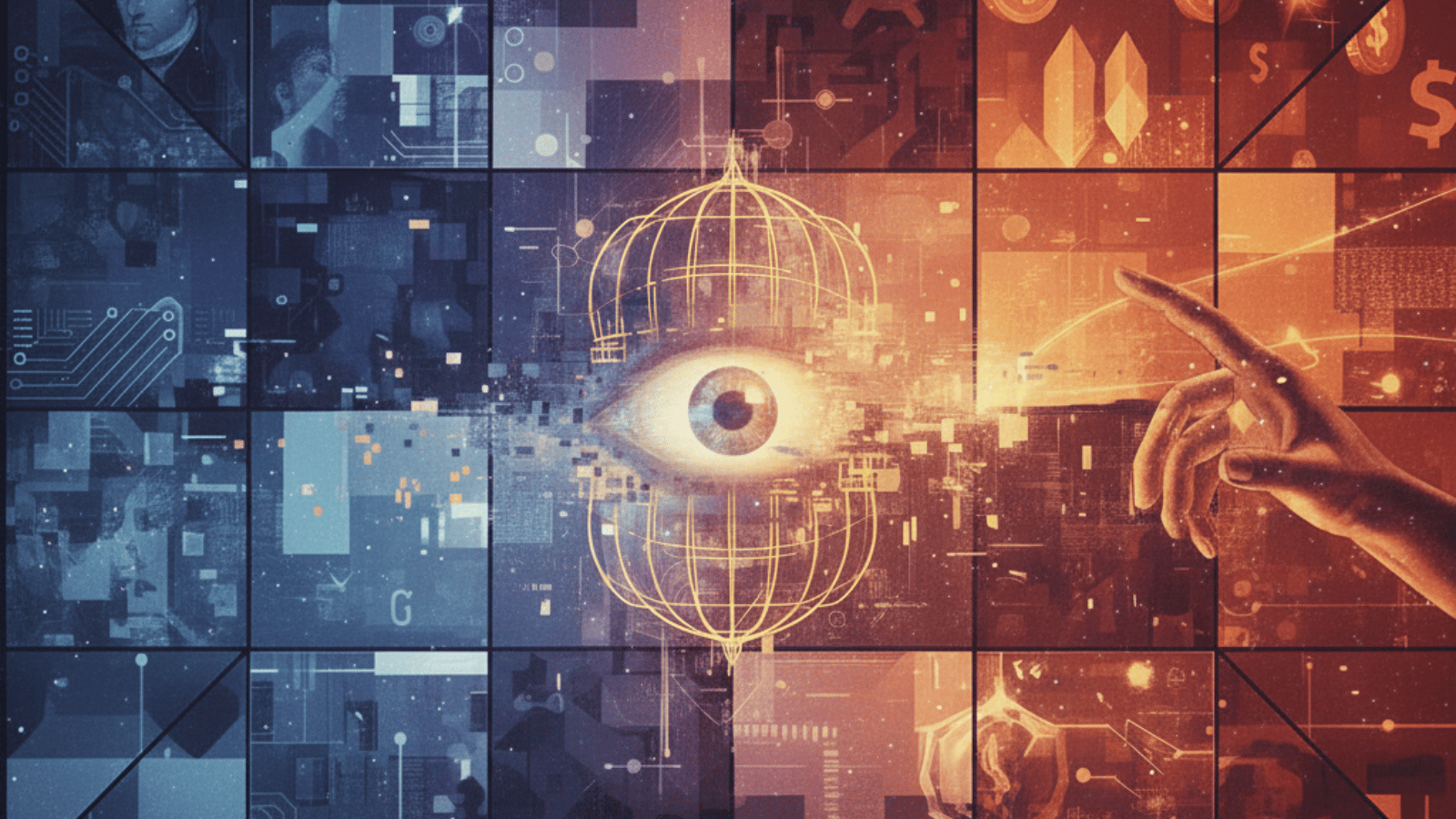
Last month, I sat in a cafe in Singapore—a city that often feels like a scale model for the future—and watched a demo of Sora 2.0. On the screen, a hyper-realistic scene of a 1920s jazz club flickered to life. The lighting was perfect. The smoke curled with a physical accuracy that would have taken a Pixar team months to render. But as I watched, I wasn’t thinking about the pixels. I was thinking about the debt.
We have spent the last decade being told that the “creator economy” was the ultimate liberation. We were told that the internet had democratized the tools of production, allowing anyone with a laptop to build a brand, a business, and a life. But as we move into the final weeks of 2025, it is becoming clear that this was merely a temporary reprieve. A new system is being built, and I believe it could weaken creators’ control over how their work is used and valued.
With the launch of Sora 2.0, OpenAI isn’t just releasing a software update. They are executing a business model transplant on the very concept of intellectual property. In my view, they are building a world in which platforms may capture more of the value created through users’ work.
The Myth of the “Collaborative” Machine
The narrative coming out of San Francisco is one of partnership. Sam Altman speaks often about AI as a “co-pilot,” a tool that augments human potential. The service terms do not by themselves establish that every Sora user loses ownership of every output. My concern is instead about the bargaining power creators have over data use, model improvement and the value produced with these systems.
In previous iterations of generative AI, the harvesting of data was a “backward-looking” process—the machine learned from the past to predict the future. Now, feedback can also be generated through live use. Interactions with creative tools may provide signals that help developers improve their systems, but the cited material does not establish that every storyboard or character design is used as reinforcement-learning feedback to automate a specific user’s niche.
This is what I call the Default-to-Harvest Economy. Where a service uses interaction data unless a user changes a setting or opts out, the burden of protection can shift toward the individual. The applicable settings and terms should be checked for the specific product and account rather than assumed from this essay. It is a digital enclosure of the commons, reminiscent of the 18th-century land grabs in England, where common grazing land was fenced off for private profit. Except this time, the “land” being fenced off is the interior landscape of the human mind.
The Rise of the Creative Aristocracy
If you want to understand where the power truly lies in this new system, you only have to look at who is being invited to the table and who is being left in the cold.
Earlier this year, we saw the announcement of a landmark partnership between OpenAI and Disney. On the surface, it’s a standard licensing deal. In reality, it is the creation of a digital aristocracy.
We are moving toward a tiered reality of ownership:
- The Elite: Multibillion-dollar conglomerates like Disney, News Corp, and Vox Media, who have the legal firepower to demand billion-dollar payouts and “hard” barriers around their IP.
- The Middle Class: Professional creators who are currently “optimizing” their workflows with AI, unaware that they are training their own replacements.
- The Serfs: The general public, whose “publicly available” data is treated as raw ore—mined for free, refined by a machine, and sold back to them as a finished product they no longer control.
This mirrors the class dynamics I explored in The Definitive Guide to Identifying Which Class You Belong To. Just as the wealthy focus on legacy and ownership while the middle class focuses on credentials and “working hard,” the new tech elite is focused on owning the generative capacity, while the rest of us are focused on the individual output. In a systems-thinking view, the output is irrelevant; the capacity to generate the output is everything.
The Legal Fortress of “Transformative Use”
Why is this allowed to happen? Because the machine has a very powerful ally: a legal system that is fundamentally ill-equipped to handle the scale of algorithmic extraction.
In recent high-stakes court cases like Kadrey v. Meta and Bartz v. Anthropic, judges have consistently leaned into the doctrine of “Transformative Use.” The argument is seductive: because the AI doesn’t “copy” your image or your text, but instead converts it into a series of mathematical weights and biases, it is “learning” rather than “stealing.”
This is a legal loophole the size of a data center. It treats a machine with the processing power of 10,000 H100 GPUs as if it were a student in a library taking notes. But a student doesn’t devalue the original author by their existence. A machine that can replicate a style in seconds at zero marginal cost fundamentally destroys the market value of the human original.
By framing AI training as a national competitiveness issue, tech leaders have effectively convinced the state that protecting individual copyright is a hindrance to progress. It is the same logic used to justify the surveillance state: “If you have nothing to hide, you have nothing to fear.” In the creative world, the mantra is: “If you have nothing to contribute to the model, you have no value to the economy.”
The Palantir Precedent: Control at the Edge
I’ve spent a lot of time analyzing Palantir’s role in the surveillance state, and the parallels here are impossible to ignore. In my piece on why I sold my Palantir stock, I focused on Alex Karp’s admission that his company is the “nervous system” of the American military-industrial complex.
OpenAI is positioning itself as the nervous system of the creative-industrial complex.
Just as Palantir integrates disparate data sources to provide “asymmetric advantages” to the state, OpenAI is integrating the sum total of human creativity to provide an asymmetric advantage to the corporation. Both systems rely on a “black box” architecture. You know what goes in (your data, your photos, your soul), and you know what comes out (the product), but you are never allowed to see the “weights” in the middle.
This is the ultimate form of power: the ability to define the rules of a system while remaining invisible within it. When the machine “hallucinates” a character that looks suspiciously like one you created, there is no “undo” button. There is no “delete from memory” command. Once the machine has learned you, it owns you.
The Psychological Cost of Creative Gaslighting
Beyond the economics and the law, there is a deeper, more insidious “Human System” at play here. It is the psychological toll of being told that your work is “collaborative” while feeling it is “extractive.”
We see this in the viral “psychology” content that dominates social media—the 8 habits of successful people, the signs of emotional intelligence. These articles are popular because people are desperate for a sense of control in a world that feels increasingly automated. But the irony is that the more we “optimize” ourselves to be more efficient, the more we resemble the very machines that are replacing us.
If we define our value by our productivity, we will always lose to the machine. If we define our value by our “creative output,” we are now losing to OpenAI. The only thing the machine cannot replicate—yet—is the intent. The why behind the work.
But as I watched that Sora demo in Singapore, I realized that intent doesn’t pay the rent. If the machine can produce the “what” at a 99% discount, the “why” becomes a luxury item for the ultra-wealthy.
Conclusion: Reclaiming the System
So, where does this leave us?
At Silicon Canals, we aren’t just here to report the news. We are here to decode the power structures that drive it. The “Great Creative Enclosure” is not an inevitability; it is a choice. It is a choice made by developers who prioritize scale over ethics, by judges who prioritize “innovation” over individuals, and by a public that has been lulled into a state of “algorithmic convenience.”
If we want to reclaim our creative future, we have to start by seeing the system for what it is. It is not a tool. It is not a co-pilot. It is a massive, centralized infrastructure for the extraction of human intellectual wealth.
The social contract of the internet was supposed to be: “You give us your data, and we give you a platform.”
The new contract is: “You give us your data, and we give you the privilege of competing against a machine that has already memorized your best ideas.”
I, for one, am not ready to sign that contract. We need a new “Systems Thinking” for the AI era—one that places the human at the center of the equation, rather than as a training set for a corporate ghost. Until then, remember: every time you “collaborate” with the machine, you aren’t just making something new. You are giving away the only thing that was ever truly yours.
