

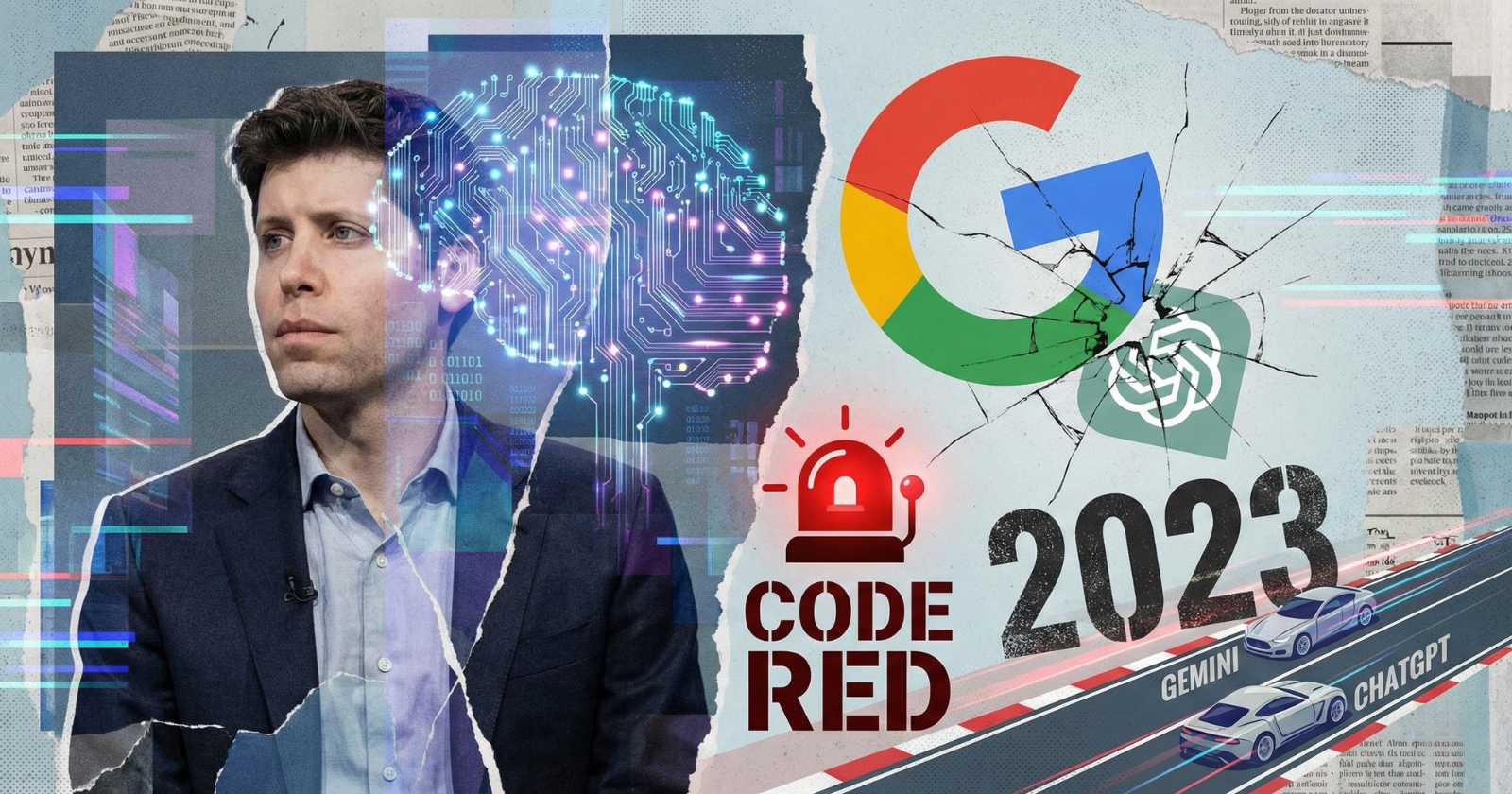
The OpenAI CEO admits Google could have “smashed” his company in 2023, revealing just how precarious the AI race has become.
In a remarkably candid admission that underscores the brutal realities of the artificial intelligence wars, OpenAI CEO Sam Altman has acknowledged that his company came dangerously close to being crushed by Google before it ever had a chance to establish itself as a major force in the industry.
“If Google had really decided to take us seriously in 2023, let’s say, we would have been in a really bad place,” Altman said in a conversation with Alex Kantrowitz on the Big Technology Podcast, published December 18. “I think they would have just been able to smash us.”
The confession comes at a particularly turbulent moment for OpenAI. Earlier this month, Altman declared a company-wide “Code Red” after Google’s Gemini 3 model began outpacing ChatGPT across multiple benchmarks and user growth metrics. The irony is unmistakable: three years ago, it was Google that sounded its own internal alarm in response to ChatGPT’s explosive debut. Now the tables have turned, and Altman finds himself playing defense.
What saved OpenAI in those precarious early days, according to Altman, was Google’s own missteps. “Their AI effort at the time was kind of going in not quite the right direction,” he explained. “Product-wise, they didn’t—you know, they had their own code red at one point, but they didn’t take it that seriously.” It was a narrow escape, the kind of near-miss that shapes the trajectory of entire industries.
The threat from Google has hardly diminished. Gemini’s monthly active users have surged from 450 million in July to 650 million by October, according to Datamation, a 44 percent increase in just three months. Salesforce CEO Marc Benioff publicly announced he was abandoning ChatGPT for Gemini 3, declaring “the leap is insane.” OpenAI, meanwhile, has been forced to delay its advertising plans and a personal assistant feature called “Pulse” to focus on shoring up ChatGPT’s core experience.
Altman remains defiant about OpenAI’s prospects, but his language betrays the pressure. “Google is still a huge threat. Extremely powerful company,” he told Kantrowitz. He pointed to what he sees as Google’s fundamental weakness: the search giant’s reluctance to cannibalize its enormously profitable advertising business model. “Bolting AI into web search—I don’t know, maybe I’m wrong, maybe I’m drinking the Kool-Aid here—I don’t think that’ll work as well as reimagining the whole thing.”
This is the bet OpenAI is making with its future: that building AI-native products from the ground up will ultimately prove superior to retrofitting artificial intelligence onto existing platforms. It is a high-stakes wager that assumes Google’s distribution advantages across billions of devices and touchpoints can be overcome by superior product design.
The financial stakes are staggering. OpenAI has committed to approximately $1.4 trillion in data center infrastructure over the coming years, according to Fortune, even as the company remains unprofitable. Revenue is projected to reach $20 billion this year, but Altman has told investors he envisions that figure ballooning into the hundreds of billions by 2030. The gap between those numbers and current reality represents either visionary ambition or dangerous overreach, depending on whom you ask.
For now, Altman is treating competitive threats with what he describes as pandemic-level urgency. “There’s a saying about pandemics, which is something like when a pandemic starts, every bit of action you take at the beginning is worth much more than action you take later,” he explained. “I sort of think of that philosophy as how we respond to competitive threats.”
The company released GPT-5.2 last week in direct response to Gemini 3, and Altman claims it has gone over “extremely well.” Whether that will be enough to reclaim the momentum remains an open question. What is certain is that the comfortable lead OpenAI once enjoyed has evaporated, and the company that nearly got smashed by Google in 2023 now finds itself locked in a fight for survival against the very competitor it once outmaneuvered.
