

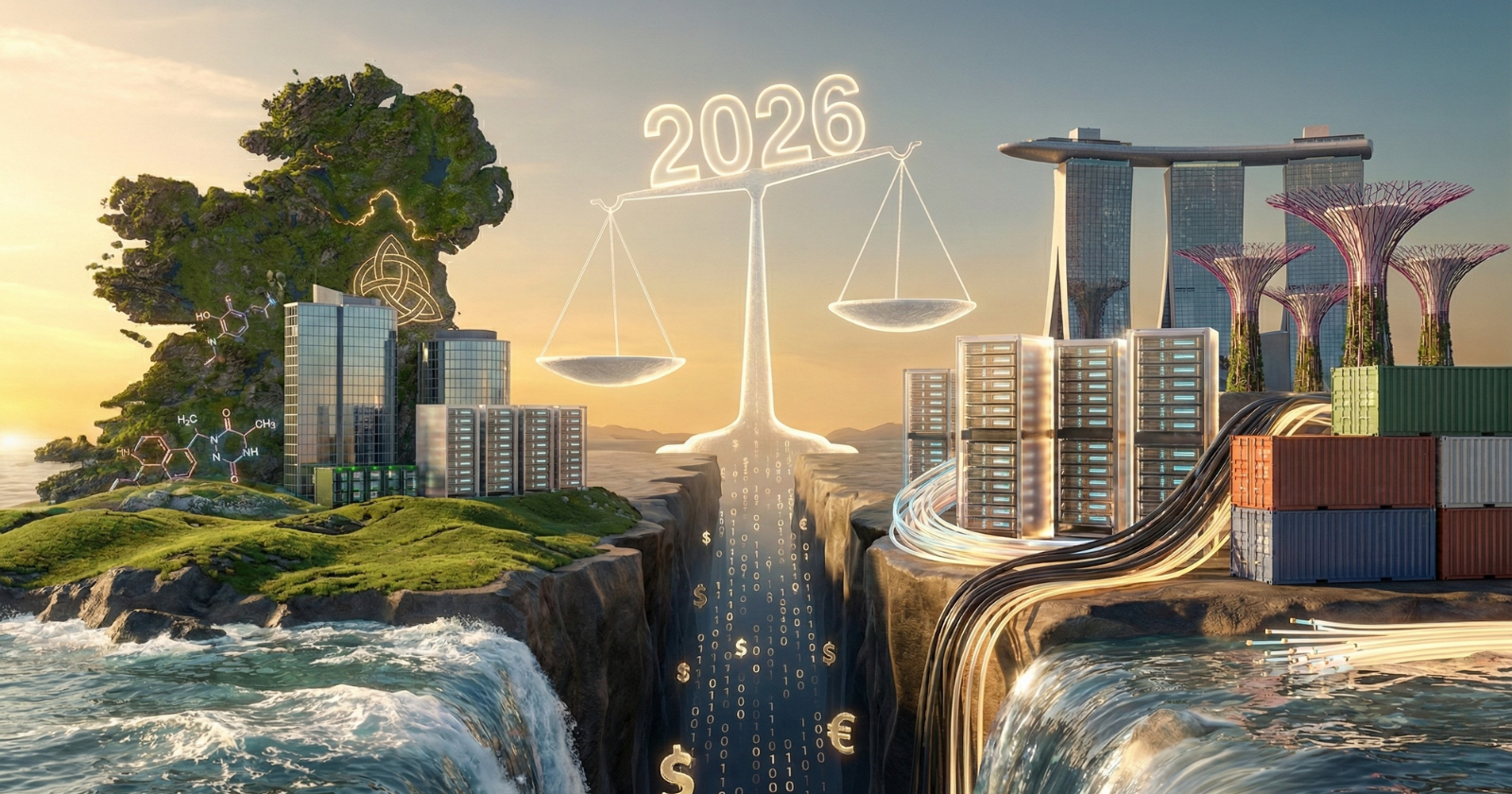
On one IMF measure for 2025, Ireland’s nominal GDP per capita exceeded Singapore’s. Purchasing-power comparisons reverse that order, which is why the series has to be named before calling either country richer.
According to the IMF’s October 2025 World Economic Outlook database, its 2025 estimates for GDP per capita at current prices were about $129,132 for Ireland and $94,481 for Singapore. These are nominal US-dollar figures, not purchasing-power-parity values. By this measure, an average Irish citizen produces more economic value than almost anyone on Earth. But spend a week in Dublin and a week in Singapore, and you’ll notice something the statistics don’t capture: the Irish are not living like they’re 40% wealthier than Singaporeans.
The reason is that both countries have become masters of a particular kind of economic illusion—one that inflates their official wealth while revealing something deeper about how global capitalism actually works.
Start with what these two nations have in common, which is more than geography might suggest. Both are small, English-speaking, and positioned as gateways to larger markets. Both transformed themselves from economic backwaters into gleaming success stories within a single generation. And both have built their prosperity on the same foundation: convincing multinational corporations that routing money through their territory is worth the trouble.
Singapore’s story is the more honest of the two, if only because its transformation was more brutal and transparent. When the city-state was expelled from Malaysia in 1965, its founding prime minister Lee Kuan Yew announced the separation with tears. The country had no natural resources, no hinterland, and a GDP per capita of roughly $500. Unemployment hovered around 14%. Most of the population lived in slums.
What followed was arguably the most successful economic engineering project in modern history. Lee’s government built the Economic Development Board to court foreign manufacturers, created industrial estates from swampland, and invested relentlessly in education. By the time Lee stepped down in 1990, Singapore’s GDP per capita had multiplied nearly thirty-fold. The country had leapfrogged from the third world to the first in a quarter century.
Ireland’s path was messier. The country spent most of the twentieth century haemorrhaging its population to emigration, economically dependent on Britain, and politically consumed by the aftermath of partition. The transformation came later—beginning in the 1990s with what economists called the “Celtic Tiger”—and rested on a simpler proposition than Singapore’s. Ireland offered multinational corporations a 12.5% corporate tax rate, an educated English-speaking workforce, and access to the European single market.
The corporations came. Google, Apple, Meta, Pfizer, and hundreds of others established their European headquarters in Dublin’s gleaming “Silicon Docks.” By the early 2000s, Ireland had transformed from a country people fled into one they moved to.
Here’s where the stories diverge in revealing ways.
Singapore’s wealth, while certainly boosted by its status as a financial hub, is more genuinely productive. The government owns two sovereign wealth funds—GIC and Temasek—that have accumulated hundreds of billions in national reserves. The money flowing through Singapore largely stays in Singapore, funding world-class infrastructure, housing, and public services. When you land at Changi Airport, you’re experiencing wealth that Singaporeans actually possess.
Ireland’s situation is more complicated. In 2015, the country reported GDP growth of 26.3%—a number so absurd that the Nobel Prize-winning economist Paul Krugman labelled it “leprechaun economics.” The growth was real in an accounting sense: it reflected Apple’s decision to restructure its Irish subsidiary and relocate intellectual property assets to the country. But it had almost nothing to do with what Irish people actually produced or earned.
The problem became so severe that Ireland’s Central Statistics Office invented a new metric—”modified GNI,” or GNI*—specifically to measure the real Irish economy rather than the one that exists on corporate balance sheets. By this measure, Ireland’s economy is roughly 55-57% the size of its official GDP. Strip away the phantom assets, the aircraft leasing companies, and the intellectual property that generates profits but not jobs, and Irish prosperity looks much more like Germany’s than Luxembourg’s.
This isn’t a criticism unique to Ireland. An IMF investigation found that approximately 40% of global foreign direct investment is “phantom”—financial flows passing through empty corporate shells with no real economic activity. The eight major pass-through economies, which include both Ireland and Singapore, host more than 85% of the world’s investment in special purpose entities set up primarily for tax reasons.
But the comparison between these two countries illuminates something beyond tax policy. It reveals two fundamentally different models of national wealth.
Singapore chose to be genuinely rich. Its government invested the proceeds of foreign capital into domestic capacity—housing, education, infrastructure, and sovereign wealth that compounds over generations. The state owns significant stakes in major national enterprises. Housing policy doubled as social engineering, mixing ethnic groups in planned communities to prevent the racial tensions that had torn apart the region. The trade-off was political: Singapore’s famous authoritarianism, its restrictions on speech and assembly, its paternalistic social policies. Wealth, in the Singaporean model, was something the state built for its citizens.
Ireland chose to be wealthy on paper. Its governments, particularly those led by Fianna Fáil and Fine Gael, prioritised attracting foreign capital over building domestic capacity. The proceeds of corporate tax revenues were often spent on short-term priorities rather than long-term infrastructure. Today, Dublin is Europe’s most expensive city for renters, large parts of the country have no train service, and the housing crisis has fuelled social tensions that erupted in street violence. The wealth exists, but much of it flows through rather than to the Irish people.
The contrast became stark during the 2008 financial crisis. Ireland’s property bubble—inflated partly by the optimism that foreign investment encouraged—collapsed spectacularly. The government guaranteed bank debts that would cripple public finances for a decade. Singapore, with its sovereign wealth buffers and stricter financial regulation, weathered the same storm with barely a stumble.
Both countries now face uncertain futures, though for different reasons. Ireland’s tax advantage is eroding as the OECD’s global minimum corporate tax rate of 15% takes effect, narrowing the gap between Dublin and other European capitals. The European Commission warns that Ireland’s public finances remain “vulnerable to international developments,” particularly shifting US trade and tax policies, with revenues dangerously concentrated in a handful of pharmaceutical and technology companies.
Singapore faces a different challenge: maintaining relevance in an era of US-China rivalry when its entire model depends on being neutral ground between competing powers. The IMF’s 2025 assessment notes that trade tensions have already slowed growth significantly, with projections dropping from 4.4% in 2024 to just 1.7% in 2025.
So which country is actually richer?
If you’re measuring the number that appears in international rankings, Ireland wins. If you’re measuring what citizens actually experience—the infrastructure, the housing, the accumulated national wealth—Singapore wins convincingly. If you’re measuring which model produces more durable prosperity, the jury is still out, but Singapore’s sovereign wealth funds suggest a country thinking in generations while Ireland’s housing crisis suggests one that’s been thinking in quarters.
The deeper lesson is that GDP per capita—the metric we use to rank nations—has become increasingly meaningless in a globalised economy where corporations can choose where profits appear. Both Ireland and Singapore have gamed this system brilliantly. But only one has converted the game into something its citizens can actually live in.
Perhaps the most telling difference is this: Ireland had to invent new statistics to measure its real economy because the standard ones had become fiction. Singapore never needed to. The wealth you see there is the wealth that exists.
In the end, the question isn’t which country is richest. It’s which kind of richness you’d rather have—the kind that shows up on spreadsheets, or the kind that shows up in lives.
