

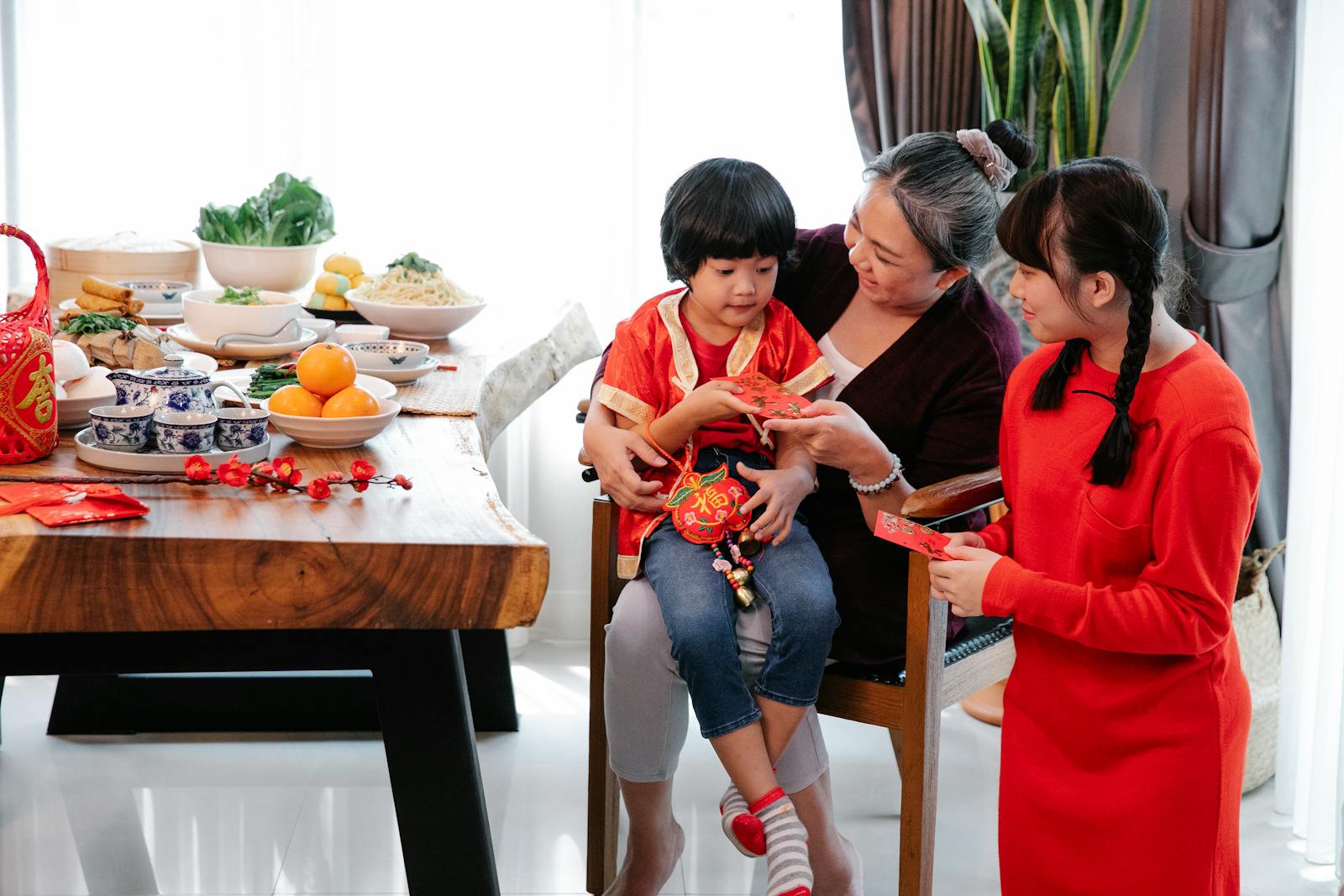
A friend of mine told me something last month that I haven’t been able to stop thinking about. Over coffee in Tiong Bahru, he mentioned that during Chinese New Year dinner this year, he’d decided to stop doing something he’d done for decades: pretending to be grateful when he wasn’t.
It sounds like a small decision. It wasn’t. What followed—the awkward silences, the recalibrated family dynamics, the unexpected conversations—revealed something I suspect happens in family gatherings everywhere, but rarely gets acknowledged: we’re all performing. We’re all following an unspoken script, and the moment someone steps out of character, the entire structure becomes visible.
He’s a software engineer in his late forties. His family has held the same CNY dinner ritual for decades—the same restaurant, the same table, the same uncomfortable forced expressions of gratitude for blessings that, frankly, many of them don’t feel have manifested in meaningful ways.
This year, when his mother asked the family to share what they were grateful for, he paused. Then he said: “I’m struggling. Work stress is high. My marriage feels distant. I’m not in a grateful headspace, and I don’t think it’s helpful for any of us if I pretend to be.”
The scripts we follow
What I find fascinating about his story isn’t the drama that followed. It’s what his honesty exposed about the function of family rituals themselves.
Family gatherings—whether Chinese New Year dinners, Thanksgiving, or Christmas—aren’t primarily designed to tell the truth. They’re designed to maintain cohesion. The gratitude circle, the “what went well this year” round, the forced toasts: these are all mechanisms for enforcing a particular emotional tone. They’re not bugs in the system; they’re features.
Research on emotional labor shows that when we suppress authentic feelings to fit social expectations, we don’t just feel worse emotionally—we physically feel worse. Cortisol levels increase. Sleep quality decreases. The long-term cost to our nervous systems is measurable and significant.
Yet we keep performing, year after year. Why? Because the alternative—authentic emotional expression in family contexts—threatens the entire structure. If everyone starts saying what they actually feel, the carefully maintained facade collapses. And for many families, that facade is the only thing holding them together.
What happened after he spoke
The initial response was uncomfortable. His mother fell silent. His father looked away. His younger sister tried to smooth it over with a joke that landed badly.
But then something unexpected happened. His younger brother—someone he’d barely spoken to in two years—said quietly, “I’m not grateful either. I’ve been pretending too.”
His sister admitted she’d spent the previous three CNY dinners crying in the bathroom afterward.
His father, after a long pause, said he’d been depressed for months and had no idea how to talk about it with his family.
Within thirty minutes, the entire emotional temperature of the gathering had shifted. They stopped reading from the script. They started talking like humans instead of characters in a play.
His mother left the table upset. She has two strategies for dealing with difficult emotions: ignore them or manage them away. An hour later, she returned and said she didn’t understand why honesty had to ruin CNY, but she was willing to listen.
The real cost of performing
Here’s what strikes me most: this family had spent decades maintaining emotional distance while physically sitting at the same table. They’d perfected the performance so completely that they’d stopped seeing it as performance. It felt like normal family life.
But research on authenticity and mental health is clear: living inauthentically—pretending to feel things you don’t feel, hiding your struggles, performing contentment you don’t experience—is one of the strongest predictors of depression, anxiety, and relationship dissatisfaction.
What’s more, performing for family members teaches a specific lesson to yourself and to younger generations: your actual feelings don’t matter. What matters is maintaining the image. This becomes internalized. You start doing it at work, in relationships, with friends. The family dinner is just the training ground.
I’ve noticed that the most authentic people I know are often the ones whose families somehow broke the performing pattern—sometimes through crisis, sometimes through one person deciding they were done with the script.
The harder work
Here’s where I should tell you that this story has a neat ending—that his family now has perfect, authentic dinners where everyone shares their deepest feelings and feels fulfilled.
That’s not what happened.
The dinners are still awkward. His mother still occasionally lapses into the old performance mode. His father still struggles to articulate emotions. But there’s something different now: permission. Permission to not be fine. Permission to admit struggle. Permission to be human instead of a character.
Research on family systems theory shows that sustained authenticity in family contexts requires ongoing negotiation. It’s not a one-time breakthrough. It’s a continuous choice to stay real when the system pushes back toward performance.
What he did—what any of us can do—was interrupt the pattern. He didn’t fix his family’s issues. But he stopped participating in the pretense that there were no issues.
What this means for your family gatherings
I’m not suggesting you go to the next family dinner and unload every unprocessed emotion. That’s not authenticity; that’s weaponized honesty.
But I am suggesting that if you notice yourself performing—smiling when you feel sad, expressing gratitude you don’t feel, suppressing a perspective you actually hold—pause. Notice it. Ask yourself what you’re protecting by staying in character.
Sometimes the answer is: important relationships require some degree of social polish. Fair enough. That’s different from lying.
But sometimes the answer is: I’m protecting a family system that requires me to be less than fully human. And that cost is too high.
His insight—that decades of pretending had created more distance than one dinner of honesty could—stuck with me because it applies everywhere. We perform at work, in dating, with colleagues, in friendships. We’ve become so skilled at the performance that we often can’t distinguish it from authenticity anymore.
Family gatherings are where this pattern usually began. Maybe that’s where we should start questioning it.
