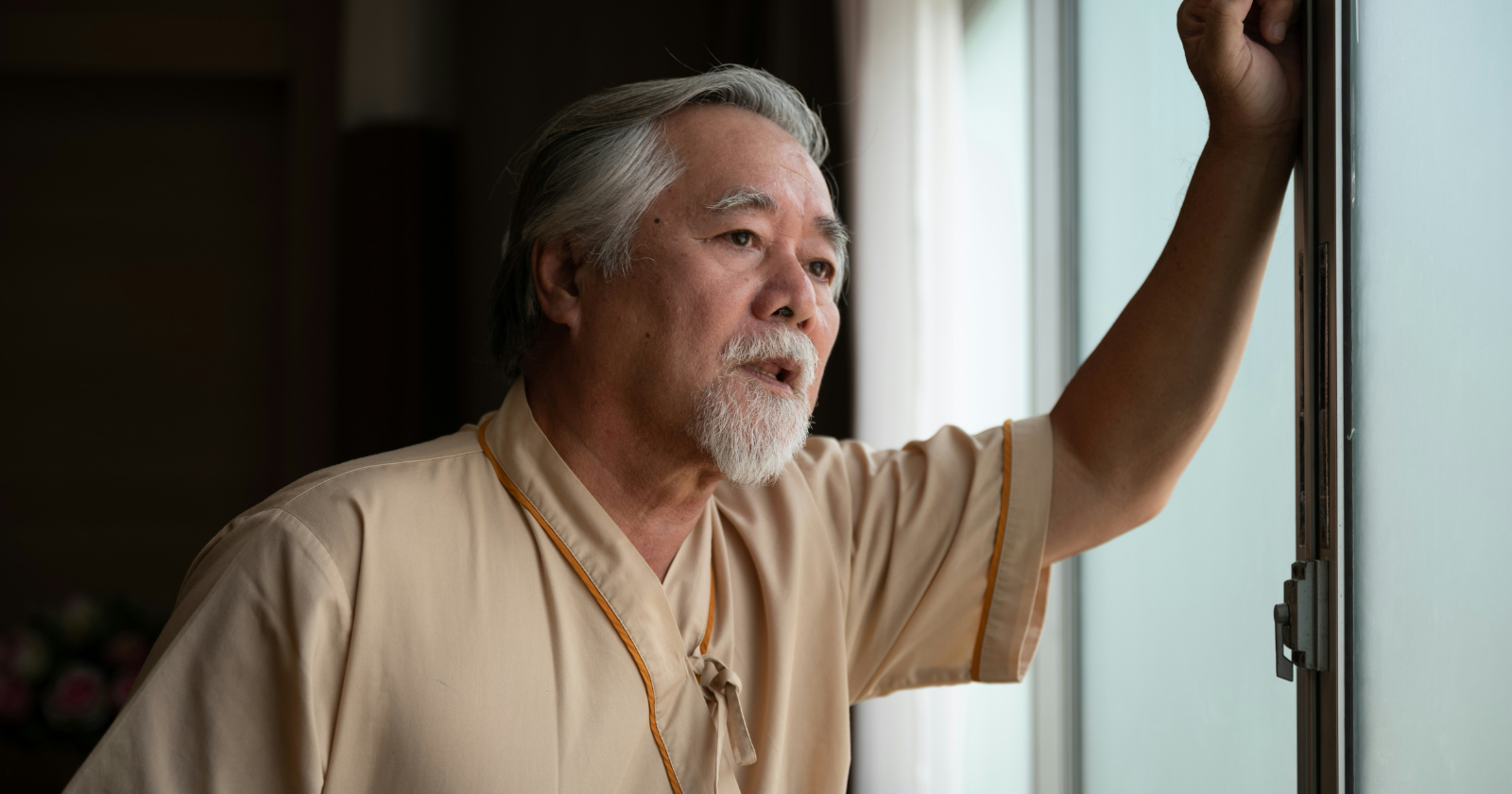
Surveys of older adults consistently surface a quiet pattern: people who spent decades building lives around providing, caregiving, and obligation often report difficulty naming what they actually enjoy once those roles loosen. Researchers studying aging and identity describe it as a kind of internal silence, not depression exactly, more like a vocabulary that was never developed. The generation now in their seventies and eighties is arriving at this point in unusually large numbers, and many of them are doing it without a script.
I started thinking about this seriously because of a man who lives on the ground floor of my building. Every afternoon, around the same time I come downstairs to let my daughter run around the common area, he’s already there, sitting on the bench outside his door, taking the air. We started nodding at each other, then exchanging a few words, and then one day the conversation turned into something real.
He is in his late seventies. He spent forty years in a role he did not choose but accepted because it paid well and his family needed stability. He married young, raised three children, helped his wife through a long illness, buried her six years ago, and watched his children move to different cities and different lives. He is not bitter about any of this. He tells me it was a good life. But lately, he says, he finds himself sitting in silence and wondering: what do I actually like? Not what his family needed him to like. Not what was practical or affordable or sensible. Just him, at the core of it. He says he has almost no idea how to answer that.
I’ve thought about that conversation a lot.
A generation raised on sacrifice as identity
The people who are asking this question now, quietly and mostly to themselves, belong to a generation that was shaped by an entirely different relationship to selfhood. They grew up in households where the individual was secondary to the collective. You worked hard so your family could eat. You stayed in the marriage because leaving would have hurt too many people. You buried your preferences because preference felt like a luxury. You were useful, and being useful was the point.
This was not selfishness suppressed. For many of them, it genuinely wasn’t a sacrifice in the dramatic sense. It was just how life worked. You did what was needed. You kept going. And somewhere along the way, the question of what you wanted for yourself simply stopped feeling like a valid thing to ask.
Psychologist Laura Carstensen at Stanford’s Center on Longevity has spent decades studying how people experience meaning as they age. Her research consistently shows that older adults become more focused on what feels emotionally significant to them, not because they become selfish, but because their sense of time shifts. They begin to prioritize. The problem is that prioritizing requires knowing what you value. And for a generation that spent fifty years deprioritizing themselves, that is not a straightforward thing to access.
The question nobody prepared them for
It sounds simple from the outside: what do you enjoy? What do you want your days to look like now? What kind of person do you want to be in this final chapter?
But for someone who structured their entire identity around being needed, those questions can land like a wall. If you were a provider, what are you when you no longer have to provide at the same level? If you were a caregiver, what fills the hours when the caregiving is done? If your sense of worth came from your usefulness to others, who are you now that the others have grown up and moved on?
These are not small questions. And the disorienting thing is that most of this generation had no framework for them. Their parents did not model self-exploration. Their culture did not prize it. The language of therapy and inner work and personal authenticity that younger generations grew up swimming in was largely absent from their formative years. So they arrive at this point in life with real curiosity, and sometimes real confusion, and very few tools.
What getting lost in duty actually costs
I want to be careful here because I am not suggesting this generation made the wrong choices. Many of them look back on what they built and feel proud of it. The stability, the children raised well, the homes kept running. That counts for something real.
But there is a particular kind of quiet grief that can settle in when a person realizes they are a stranger to their own preferences. Not dramatic grief. More like a low-level disorientation. You walk into a room and don’t know what you’d choose if you could choose anything. You feel vaguely restless but can’t name what’s missing. You’ve spent so long asking what everyone else needs that the question aimed at yourself feels almost foreign.
Dr. Jonice Webb’s research on emotional neglect offers a lens here, even though her work is typically applied to childhood rather than to aging. Her core argument is that when people grow up without having their emotional needs recognized or validated, they develop a disconnection from their own inner life. Something similar can happen over decades of prioritizing external obligation above personal experience. The internal compass gets quiet. Not broken, just quiet from disuse.
It is not too late to ask the question honestly
The man downstairs told me something that stayed with me. He said he started doing something small. Every morning he makes his coffee and he sits with it and he tries to notice what he’s looking forward to that day. Not what he has to do. Not what would be responsible. Just: what sounds good?
Some days the answer is nothing in particular. Some days it surprises him.
He picked up a hobby he dropped in his thirties because it felt impractical. He started saying no to obligations that left him feeling hollow. He began to notice which conversations gave him energy and which ones drained him, and then he started spending his time accordingly. These are not grand gestures. But he is building something, slowly, that belongs to him.
The Harvard Study of Adult Development, one of the longest-running studies on human happiness, found that the quality of a person’s relationships in later life was one of the strongest predictors of wellbeing, not their achievements or wealth or productivity. But the study also suggests that this kind of relational richness comes from people who know themselves, who bring genuine presence rather than performed role. Knowing yourself is not a vanity project. It is foundational.
What younger generations can learn from watching this
I think about this a lot as someone raising small children while also building a career. The version of adulthood I grew up observing was one where personal identity got worn down slowly, without anyone quite noticing, in the service of keeping everything running. I don’t want to arrive at seventy-five not knowing what I enjoy.
That isn’t an argument for selfishness. It’s an argument for self-awareness. Knowing what you like, what you need, what genuinely replenishes you, doesn’t make you less capable of loving or caring for the people around you. It usually makes you better at it. The people who burn out quietly are often the ones who gave without ever knowing what they needed back.
Watching my neighbor navigate this question with curiosity rather than bitterness has been quietly instructive. He isn’t performing a midlife reinvention or announcing a new version of himself. He’s just paying attention. Finally, unhurriedly, with real interest.
There is something generous about that.
Final thoughts
Here is the part that is harder to say cleanly. A life spent being useful to other people is not automatically a life you knew how to live. Those can be two different things, and a person can do the first beautifully while never quite getting around to the second.
The man on the bench is not a cautionary tale. He is also not a tidy redemption arc. He is somebody who is, at seventy-something, just beginning to meet himself, and there is no guarantee he will get enough time to finish the introduction. That is the cost nobody itemizes when we talk about duty as virtue. You can be loved by everyone in your life and still be a stranger to the only person who was there for all of it.