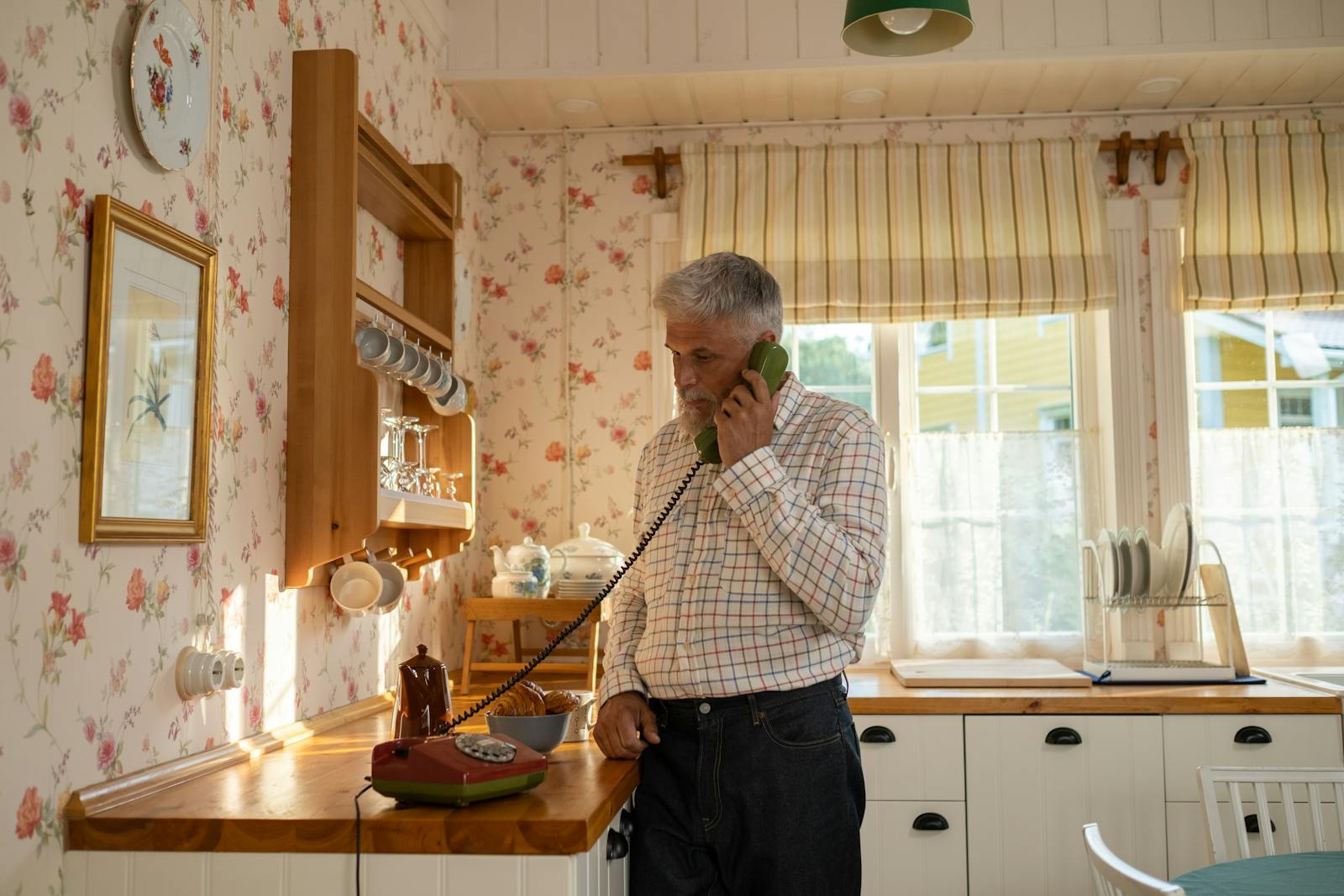
Picture a narrow hallway in a small apartment. A single phone is bolted to the wall, and a teenager twists the cord around her finger while her whole family pretends not to listen. If the call went quiet, she had nowhere to hide. She stood there, in full view of everyone, and waited for the conversation to find its rhythm again.
I grew up close enough to that world to remember the edges of it. In my family there was one phone for the whole household, and the idea of slipping away into a private screen did not exist yet. When a moment went still, you sat inside the stillness with whoever happened to be in the room. You had no other option, and that turned out to matter.
The phone that everyone had to share
For most of the last century, a phone was a shared object in a shared space. You took your turn. You kept the call short because someone else was hovering nearby, and you learned to read the patience of the people around you. Boredom, back then, was a public event. If the talk stalled or the room went flat, there was no pocket-sized exit, so you stayed and let the dull stretch pass.
That arrangement trained something quiet into people. They grew comfortable being unstimulated next to others, which is a stranger and more useful skill than it sounds. You could sit at a table long after the food was gone and the topics were used up, and nobody felt the need to reach for anything. The lull was simply part of being together, and everyone understood it would lift on its own.
Where I grew up, hospitality ran on this kind of unhurried time. People dropped by without texting first, and you sat with them whether or not you had anything clever to say. The visit itself was the point, and a slow patch in the middle of it carried no shame. You learned early that being together did not require constant entertainment.
The escape hatch in our pockets
Today the phone belongs to one person and lives in a pocket, ready the instant a moment turns flat. The exit is always within reach, so we almost never find out what would happen if we stayed. We have become very good at leaving a room without standing up. My daughter is not even two, and she already notices when my eyes drop to a screen.
Researchers have tried to measure how hard it is for us to sit with nothing at all. In a set of studies published in Science, psychologist Timothy Wilson and his colleagues found that participants “typically did not enjoy spending 6 to 15 minutes in a room by themselves with nothing to do but think,” and that many “preferred to administer electric shocks to themselves instead of being left alone with their thoughts.” This was a controlled laboratory experiment rather than a verdict on all of human nature, but the picture stays with you. Given a choice between their own company and a jolt of pain, a lot of people reached for the pain.
The researchers ended on a line I keep thinking about: “the untutored mind does not like to be alone with itself.” A phone is the easiest way in the world to stay untutored. It hands us a reason to never practice.
What boredom in front of others teaches
Sitting bored beside other people is not wasted time. It is where small talk turns into real talk, where a child learns to entertain herself, where two people get comfortable enough to share a silence. Sherry Turkle, who studies our relationship with technology at MIT, warns that the habit of always being partly elsewhere is “undermining our capacity to have the conversations that count.” When the dull moment arrives and everyone reaches for a screen at the same time, we skip the very part that used to deepen things.
There is a quiet tenderness in choosing to stay. I think about older relatives sitting together through a long afternoon, saying very little for an hour, and how that hour built a trust that quick, constant pinging never quite manages. The silence was the relationship doing its slow work. Nobody called it a skill, because back then it came free with the furniture.
The difference I notice now
When my family flies to Santiago to see my husband’s parents, the days slow down in a way that feels almost foreign at first. There are long lunches that drift into long afternoons, and stretches where the adults run out of things to say and just sit with their coffee while the baby naps. The grandparents do not fill those gaps with their phones. They have kept the older comfort with doing nothing in good company, and watching them, I notice how much of it I have to relearn.
My own parents live far away in Central Asia, and we see them about once a year. When we are finally in the same room, the last thing any of us wants is to be half-present. Those visits have taught me that attention is the actual gift, and that a boring, unremarkable hour together is worth more than a dozen lively video calls.
What I want to keep for my daughters
I am raising two girls in a world where the escape hatch is everywhere, and I will not pretend the old hallway phone was better in every way. It was not. What I do want is for them to learn the thing it taught almost by accident, which is how to be bored next to another person without reaching for a way out.
So we protect a few unglamorous stretches of the day. Breakfast at the kitchen island with no screens, even when the conversation thins to nothing. Walks where my daughter studies the street instead of a cartoon. Slow evenings where the four of us are simply in the same room, with nobody performing for anyone. I do not believe the balance argument the way I used to. The pocket exit is too easy, and easy things win by default unless something pushes back.
What I cannot tell yet is whether the small rituals will hold. My daughters will grow up inside a current that pulls steadily the other way, and the hallway phone is not coming back to do the teaching for me. Maybe they will learn to sit inside a lull and meet whoever is there. Maybe they will only remember a mother who kept asking them to look up. I do not know which one I am building, and I am not sure I get to.