

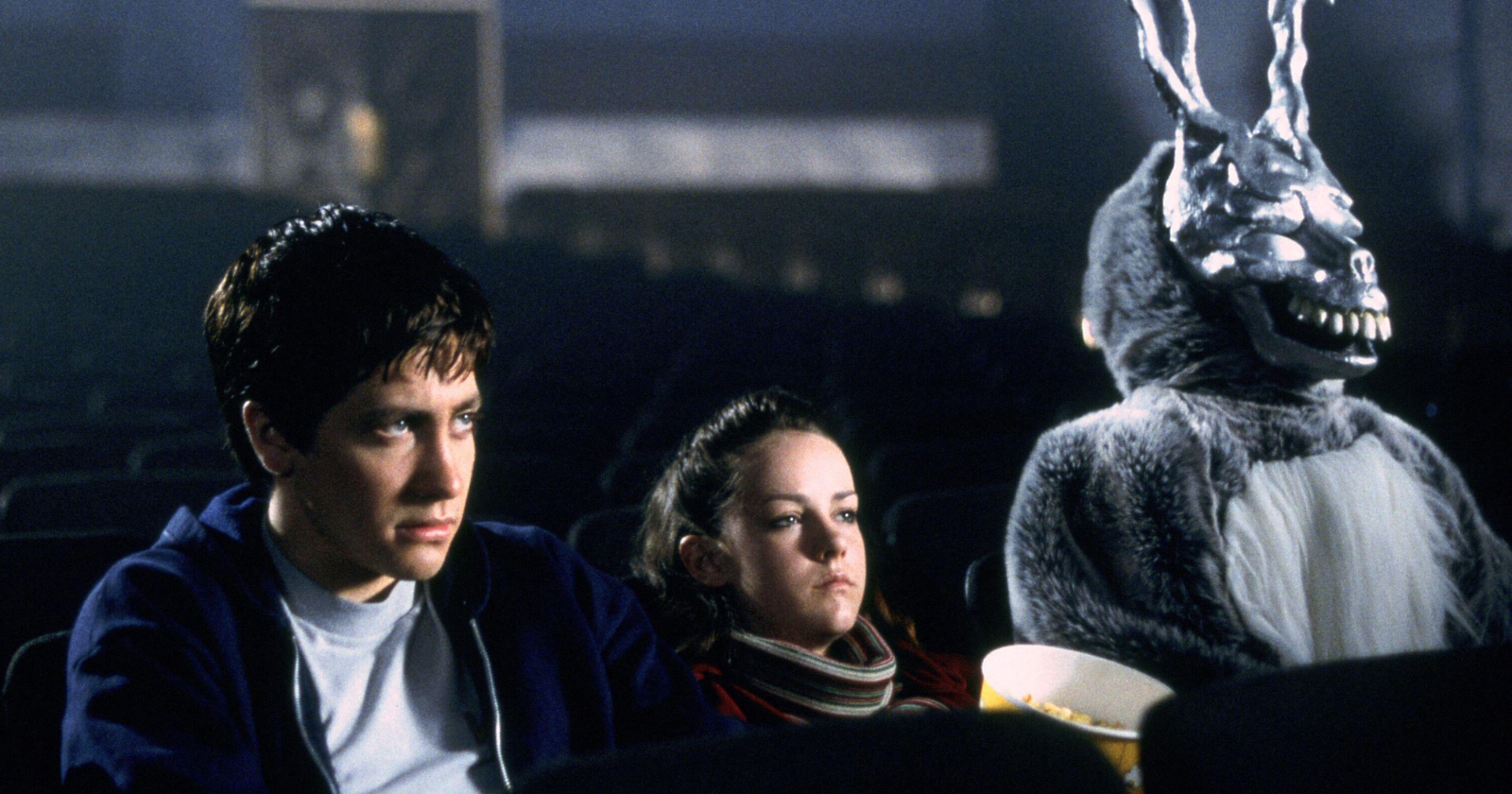
Some movies are ahead of their time. “Donnie Darko” managed something stranger: it arrived at precisely the worst moment in modern history for its own plot.
Richard Kelly’s debut — a moody, time-bending story about a troubled teenager, a six-foot rabbit named Frank, and a jet engine that falls out of an empty sky into a suburban bedroom — hit American theaters on October 26, 2001. Six weeks earlier, the country had watched aircraft fall out of the sky for real. Nobody was buying tickets to see it happen as entertainment, and the film’s own trailer, engine crashing through a roof, was essentially unmarketable. The timing wasn’t the film’s fault. It was just catastrophic.
Nobody wanted it — except Christopher Nolan
The heartbreak is that “Donnie Darko” was already a survivor before 9/11 finished it off. Kelly was a 25-year-old first-timer whose script was so strange that the project only got made because Drew Barrymore fell for it — her production company backed it, she took a supporting role as an English teacher, and her name helped attract a cast that somehow included Patrick Swayze, Jake Gyllenhaal (then a largely unknown 20-year-old), and, in his very first film role, a teenage Seth Rogen.
Then came Sundance in January 2001, where the film premiered to critical admiration and total commercial silence. Every major distributor passed, according to director Richard Kelly. Buyers called it inaccessible and unmarketable — a sci-fi teen drama that was also a family satire that was also about time travel and fate. After months without a deal, it was days from being dumped straight to video.
The save came from an unexpected corner: Christopher Nolan, whose own puzzle-box film “Memento” had just become a hit for tiny Newmarket Films, encouraged the company to take a chance on Kelly’s movie. They did. And then the world changed, and the brave little release never stood a chance: about $110,000 in its opening weekend and roughly $517,000 in its original domestic run — a small return against the $4.5 million production financing Kelly described.
The DVD that became a password
What the theaters could not do, home viewing did. The film gradually found an audience on DVD, helped by word of mouth and the conversations its ambiguous ending invited.
That was the secret of “Donnie Darko” as a phenomenon: it demanded a second viewing and a long conversation, which made it poorly suited to opening weekends and well suited to word of mouth. It became a generational password. Owning the DVD, quoting Frank, and having a theory about the tangent universe became part of the film’s cult following. The film found a much larger audience on home video than it had during its original theatrical run.
The film’s reputation also grew internationally, and its expanding cult following eventually supported a director’s cut and later theatrical revivals.
The world caught up
If you want one image for how completely the world came around, look at the music. The film’s devastating final montage was scored with a stripped-down piano cover of Tears for Fears’ “Mad World,” recorded cheaply by Kelly’s college friend Gary Jules because the original was too expensive to license everywhere they wanted.
In December 2003, that little cover — the theme song of a movie almost nobody saw in theaters — became the UK Christmas No. 1, beating the pop machine at its own game. The film that couldn’t sell tickets had produced the biggest song in Britain.
Donnie Darko the character spends the movie learning that being out of step with your timeline isn’t the same as being wrong. Somewhere, a generation of teenagers with worn-out DVDs understood exactly what he meant.
