

Lausanne-based Corintis raises new funding and expands collaborations to address growing challenges in AI infrastructure.
Contentlockr
Lausanne-based Corintis, a Swiss startup focused on cooling computer chips, came out of stealth mode and announced a $24M (nearly €20.43M) Series A funding round.
The round was led by BlueYard Capital, with participation from Founderful, Acequia Capital, Celsius Industries, and XTX Ventures. With this round, the Swiss company’s total funding now stands at $33.4M.
As part of this deal, Lip-Bu Tan, chairman of Walden International and incoming Intel CEO, joined Corintis as a board director and investor. Geoff Lyon, former CEO and founder of CoolIT, also joined the board. These appointments aim to strengthen the connection between semiconductor design, manufacturing, and chip cooling.
Lip-Bu Tan mentions, “Cooling is one of the biggest challenges for next-generation chips. Corintis is fast becoming the industry leader in advanced semiconductor cooling solutions to address the thermal bottleneck, as made evident by its growing customer list.”
Corintis’ clients include technology companies such as Microsoft, with whom the company achieved a threefold improvement in chip cooling.
The Swiss company also announced that it will open multiple offices in the United States for its American customers, along with an engineering office in Munich, Germany.
Enabling the next generation of sustainable computing
Corintis focuses on solving the heat problem created by increasingly powerful computer chips used in artificial intelligence.
According to the company, as AI models become more advanced and widely accessible, they require chips that consume more power. Higher power usage generates more heat, which can limit chip performance and efficiency.
For example, early versions of OpenAI’s ChatGPT were trained on NVIDIA chips using 400 watts of power. Four years later, newer GPUs and AI accelerators aim for up to ten times that power, which requires advanced cooling solutions such as liquid cooling. NVIDIA’s adoption of liquid cooling for its latest data centre GPUs highlights the growing need for effective thermal management.
Corintis uses AI technology to improve chip cooling. Instead of treating AI and computational requirements as opposing forces, the company applies AI to manage heat more efficiently, allowing chips to operate at higher power levels without overheating.
Remco van Erp, co-founder & CEO of Corintis, says, “Every chip is unique. It’s like a cityscape with hundreds of billions of transistors, connected by countless wires. Cooling today is not adapted to the chip, relying on simplistic designs where several parallel fins are carved into a block of copper with a blade.”
“But just like in nature, the optimal design for each chip is a complex network of precisely shaped micro-scale channels that are adapted to the chip and guide coolant to the most critical regions. Finding the right design per chip to create increasingly better cooling systems under short timelines is a challenge that will only get harder.”
Brief about Corintis
Based on research conducted at the Federal Institute of Technology in Lausanne (EPFL) in Switzerland, Corintis was co-founded by Dr. Remco van Erp, Sam Harrison and Prof. Elison Matioli.
Corintis develops microfluidic cooling technology, which uses micro-scale liquid channels to remove heat from computer chips in data centres. These data centres perform advanced computations, including generative AI.
Corintis works with several American technology companies and maintains a partnership with Microsoft.
Earlier this week, Microsoft announced that, in collaboration with Corintis, it developed an in-chip microfluidic cooling system capable of cooling a server running core services. Tests showed that this system removed heat three times more effectively than the most widely used existing technology.
Co-founder Remco van Erp says, “Thermal engineers need to pull a rabbit out of a hat on a daily basis to make sure chips don’t overheat and break, and that’s where Corintis comes in. Our mission is to unlock 10x better cooling to enable the future of compute, in a short cycle time, and while leveraging the existing infrastructure investments in a data centre today.”
“As our recent collaboration with Microsoft highlights, there’s an industry-wide push to advance the limits of cooling to enable a future of compute that’s not limited by heat.”
Husam Alissa, director of systems technology in Cloud Operations and Innovation at Microsoft, adds, “The thermal margin is translated at the software layer to yield more performance and overclocking potential. It also enables new 3-D architectures for chips that are not possible today due to thermal limitations of stacking high-power SOC’s without inner layer cooling.”
The technology and how it works
Corintis’ solution relies on two main elements to improve chip cooling.
The first is “co-designed microfluidic cooling”. The company develops simulation and optimisation software along with new manufacturing methods to design micro-scale liquid cooling tailored to individual chips. This cooling can be supplied as a drop-in replacement for existing liquid cooling systems or integrated with the chip as “co-packaged cooling”, which allows higher cooling performance. The technology also reduces water consumption in data centres.
The second element is Corintis’ platform that connects chip design with cooling design. This platform includes several tools and facilities:
- Glacierware, software that automates the design of cooling systems.
- Copper microfluidic manufacturing facility, which produces cold plates with features as small as a human hair at scale.
- Therminator, a system that allows chip companies to emulate next-generation chips on test silicon with millimetre-level accuracy to validate cooling solutions before production.
Corintis has already manufactured over ten thousand cooling systems, deployed in data centres running AI chips.
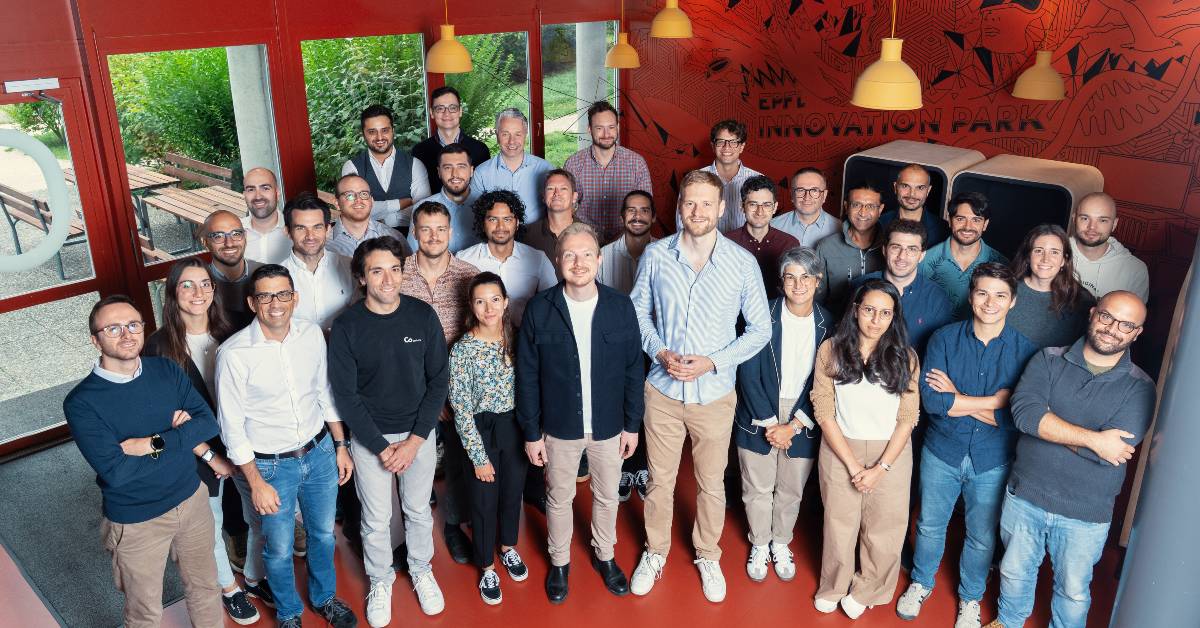
The company has achieved eight-digit cumulative revenue since its founding and plans to expand its team from 55 to over 70 employees by the end of the year.
Manufacturing capacity is expected to exceed one million microfluidic cold plates annually by 2026, supporting future AI and computational workloads.
