

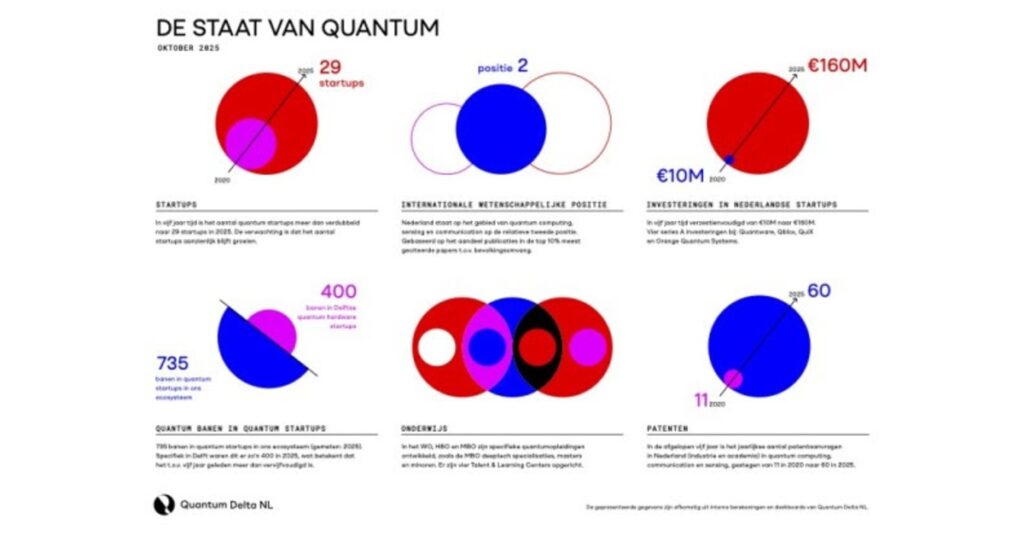
Quantum Delta NL’s 2025 factsheet places the Netherlands second on a population-adjusted quantum-publication measure and reports a sixteenfold increase in private investment in Dutch quantum startups.
Contentlockr
Quantum Delta NL’s factsheet ranks the Netherlands second in quantum computing, sensing and communication on a measure based on highly cited scientific publications relative to population size.
Private investment in Dutch quantum startups rose from €10M to €160M, according to The State of Quantum 2025. That is a sixteenfold increase, or 1,500 per cent growth. The factsheet labels the comparison as 2020–2025, while the accompanying press release dates the €10M baseline to 2019.
Delft-based Quantum Delta NL, the Netherlands’ national ecosystem for quantum innovation, published The State of Quantum 2025.
The report showcases key figures on scientific output, entrepreneurship, employment, and patents in the Dutch quantum ecosystem. Here are the key takeaways:
Dutch ecosystem showcased maturity in a short time
According to the report, the Dutch ecosystem has increased in size and maturity in a short time.
In 2025, Dutch quantum startups accounted for 735 jobs, about 400 of which are in Delft, more than four times as many as in 2020.
The number of startups grew over five years to 29.
Innovation capacity is accelerating
Innovation capacity is also accelerating, confirms the report.
The number of quantum-related patent applications rose from 11 in 2020 to 60 in 2025.
Recent Series A rounds at, among others, QuantWare, Qblox, QuiX, and Orange Quantum Systems underscore that international investors know how to find the Netherlands, adds the report.
Applications are emerging
The report indicates that the first applications of quantum technology are beginning to emerge.
In the Port of Rotterdam, there is a functioning quantum-secure Quantum Key Distribution (QKD) connection that is part of a scalable multi-user network designed for critical communications.
In the healthcare sector, quantum sensors are being utilised to produce sharper MRI scans.
Additionally, quantum random number generators are enhancing the security of mobile phones.
Collectively, these examples demonstrate that the transition from laboratory research to practical application is becoming increasingly achievable.
International competition is fierce
However, the report also throws light on the fact that the international competition is strong.
China is putting a lot of public money into technology, while the United States depends on private investments from companies like Google, IBM, Microsoft, and Nvidia.
Europe is also working together to stay competitive, adds the report.
According to McKinsey, the market for quantum computers, networks, and sensors could reach about $97B by 2035. Those who act quickly will influence future supply chains, exports, and quality jobs.
For this reason, Quantum Delta NL is calling for additional funding after 2028 to help Dutch companies grow and secure their position in production, exports, and strategic independence.
Requires stable investment beyond 2028
According to Quantum Delta NL, maintaining and capitalising on this lead requires stable, multi-year investments, including beyond 2028.
“We face a simple choice: watch while others call the shots, or build it here with our people, companies, and facilities,” says Philippe Bouyer, Chair of the Board of Quantum Delta NL. “In the coming years, we must turn knowledge into production, export, and strategic autonomy. That requires predictable, long-term investments in talent, manufacturing capacity, and the step from lab to factory.”
Quantum Delta NL: Developing a quantum ecosystem
Founded in 2020, Quantum Delta NL links the Netherlands’ key knowledge institutions in the field of quantum technology and implements the Dutch National Agenda for Quantum Technology.
Its goal is to further develop the Dutch quantum ecosystem so that it can dominate Europe.
Quantum Delta NL claims that the Netherlands has tremendous knowledge and advanced resources in quantum technology.
The knowledge and innovation environment of the Netherlands is supported by five specialised, yet linked, innovation hubs – QDNL Delft, QDNL Amsterdam, QDNL Leiden, QDNL Eindhoven, and QDNL Twente.
According to Niels Bultink, CEO of Qblox, “The Netherlands has the chance to create dozens of ‘ASML moments’ in the quantum value chain over the coming decades—provided that capital and regulation scale with the ambitions.”
Correction — 4 October 2026: The earlier version described €10M to €160M as 1,600 per cent growth; it is sixteenfold, or 1,500 per cent growth. The scientific ranking has been specified, and the difference between the source factsheet’s and press release’s baseline dates is now explicit.
