

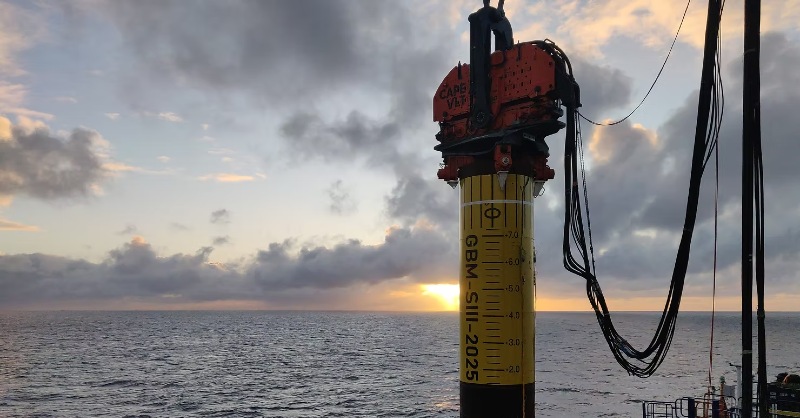
Amsterdam-based GBM Works, a company developing Vibrojet, a silent installation technique for offshore wind monopiles, announced the second close of its seed funding round at €6.2M.
The round was backed by new investor Invest-NL in addition to existing investors such as the European Innovation Council (EIC) Fund and Rotterdamse Havendraken.
Out of the total, Invest-NL invested around €2M.
“Offshore wind is a vital pillar of the energy transition, and GBM Works’ Vibrojet technology makes this possible in a much more sustainable way. At a time when the offshore wind sector is facing cost pressure and environmental regulations are becoming stricter, we believe it’s crucial to support innovations that remove these barriers. That’s why we’re proud to help GBM Works scale up their groundbreaking solution,” says Wouter van Westenbrugge, senior investment manager at Invest-NL.
Fund utilisation
The funding will enable GBM Works to demonstrate the technology in practice at Ecowende (Hollandse Kust West VI) in early 2026.
At the same time, GBM Works will improve its techniques for different soil conditions globally, which is important for widespread adoption and establishing GBM as a leader in silent offshore wind installation.
The announcement comes around a year after raising €6M in a seed funding round.
What does GBM Works solve?
The offshore wind market is growing rapidly, and monopiles, the foundations of wind turbines, are getting bigger.
However, traditional pile drivers generate a lot of underwater noise, which is harmful to porpoises and other marine life.
As a result, developers are increasingly only allowed to build if they use quieter installation techniques.
Here’s where GBM Works comes into play!
GBM Works: Pioneering silent installation methods
Founded as a spin-off from Delft University of Technology, GBM Works has developed Vibrojet technology, which combines vibrations with water jets to drive monopiles into the seabed.
This reduces noise by up to 63 per cent and can also save time and money in wind farm construction.
The company does so by collaborating with DEME Offshore and Deltares to focus on the controlled fluidisation of soil through methods like water jetting and vibrations.
This expertise is being applied in the offshore wind industry, where they work with equipment suppliers and contractors to design systems and establish machines based on solid prediction models.
Their knowledge also extends to other areas, including the decommissioning of (mono)piles, installation of jacket piles, mooring, and various infrastructure or harbour projects.
