

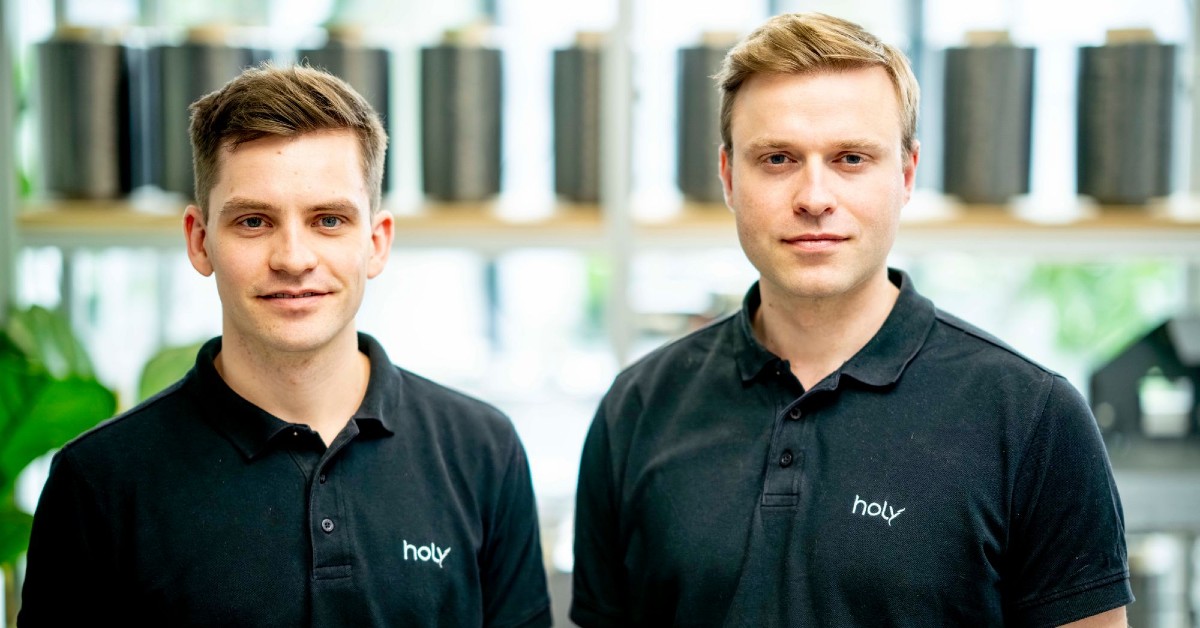
Germany-based Holy Technologies has secured funding to develop AI-driven autonomous manufacturing for lightweight components in Europe.
Contentlockr
Europe faces challenges in industrial innovation as manufacturing continues to depend on older processes and offshore production models. Hamburg-based Holy Technologies is focusing on lightweight manufacturing to address these issues.
The company announced that it has secured €4.3M to launch what it says is the world’s first autonomous factory for lightweight components in Hamburg.
The facility will use AI and robotics to produce components at an industrial scale. Lightweight components are used to reduce fuel consumption, extend range, and improve efficiency across multiple industries, including mobility, logistics, and energy.
Bosse Rothe Frossard, CEO and co-founder of Holy Technologies, says, “The race to restore Europe’s industrial edge is on. This funding helps us scale our system to deliver what our customers need most: radically better components, at the highest speed.”
Investors supporting Holy Technologies
The funding round drew support from Rockstart, Vanagon, SANDS, Innovationsstarter Fonds Hamburg, and EIT Manufacturing.
Angel investors included Adrian Locher (Merantix AG), Matthias Dantone (Ellipsis Ventures), Christian Vollmann (C1), Markus Kerkhoff (Poppe+Potthoff), Kai Müller (PowerCo), and Timm Moll (Moll Gruppe), among others.
Gem Kua, Investment Manager, Rockstart, says, “In industries where cost, materials, speed, and quality define competitiveness, Holy Technologies is changing the game. Their platform enables lightweight components at scale, with applications from aerospace to energy.”
“Since our first investment, we have been impressed by the team’s rapid progress and ability to turn cutting-edge tech into real industrial impact. We are excited to double down as Holy sets a new standard for manufacturing.”
Susanne Fromm, General Partner, Vanagon Ventures, adds, “Holy Technologies’ approach is a paradigm shift: They are building the AI-driven future of manufacturing. Holy’s operating system transforms standard hardware into highly scalable, flexible autonomous production lines–cost-competitive with overseas production, while delivering higher product performance and enabling full material circularity. Such innovations are vital for Europe’s long-term competitiveness.”
Making composite manufacturing autonomous
Composite materials are central to products that reduce weight, increase strength, and support sustainability. Yet most composite components are still made through manual processes, which slows production and raises costs. Holy Technologies is working to change this with autonomous manufacturing.
Founded in 2022, the company has developed a platform that automates the production of lightweight components through an AI-driven robotic system. The system includes closed-loop recycling, allowing full material recovery for reuse in equivalent applications.
By shifting production from manual to digital control, the platform enables faster development cycles, flexible scaling, and circular material use. It is built to handle carbon fibre, glass, aramid, and natural fibres, and to support new production lines over time.
Since its founding, Holy Technologies has established a pilot line, secured offtake agreements for thousands of components, and formed partnerships with OEMs and Tier 1 suppliers in automotive, motorsports, industrial tools, and orthopaedics. In a collaboration with a Formula 1 team, the company validated a 20 per cent weight reduction compared with incumbent parts, demonstrating measurable performance gains.
Holy Technologies frames its work as part of Europe’s effort to strengthen industrial competitiveness through advanced manufacturing systems that combine autonomy, scale, and resource efficiency.
Moritz Reiners, CTO and co-founder, says, “Autonomous manufacturing is not just about efficiency. It enables a new category of components that outperform on weight, performance, and sustainability. But the path to autonomy is complex. It requires systems built from scratch to deliver it. That is exactly what we are building.”
