

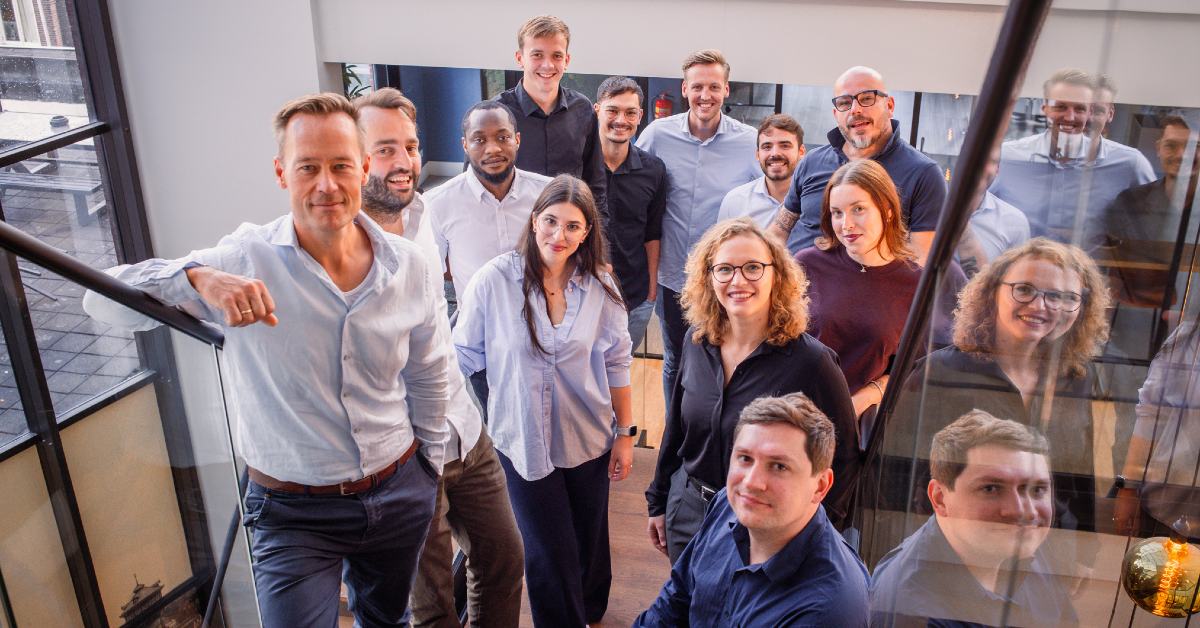
HULO, a Dutch watertech startup, has raised a new round of funding to support its growth and technology development.
Contentlockr
Leeuwarden-based HULO, a Dutch watertech startup that applies AI to detect leaks in water infrastructure, has raised €2.3M in a seed funding round. The funding will support the company’s global expansion.
The round was led by VP Capital and co-led by LUMO Labs, with participation from Vanagon, Rabobank, the Frisian Development Fund (FOM), and the NEW-TTT program.
Erica van Eeghen, Senior Manager Ventures, VP Capital, says, “Water scarcity is emerging as one of the world’s most pressing environmental constraints, with around 30 per cent of treated water lost globally, often through ageing water network infrastructure.”
She continued, “HULO’s ability to detect leaks early, using advanced AI rather than expensive sensors, is exactly the kind of lean, scalable innovation that fits our investment lens. This is a domain where measurable environmental impact and efficiency go hand in hand. We’re glad to join forces with such thoughtful co-investors and a technically sharp founding team.”
In December 2023, HULO raised a €800K pre-seed round led by LUMO Labs. And in October 2024, the company won the VDS Startup Competition at the Valencia Digital Summit.
A real-time leak localisation in water distribution networks
Founded in 2021 by Robbert Lodewijks and Frank van der Hulst, HULO.ai focuses on reducing global water loss. The company addresses the issue of drinking water leaks, which account for nearly 30 per cent of annual losses worldwide.
“Our vision is simple but urgent: to save millions of litres of water and build more resilient communities,” says the company.
HULO.ai’s software platform uses existing pressure and flow data from water utilities to detect, localise, and prioritise leaks and anomalies. The system combines AI with physics-based models to analyse the dynamic behaviour of water networks.
The platform operates as a SaaS solution that integrates into utility systems without requiring new hardware or district metered areas. By converting existing data into actionable insights, HULO.ai enables utilities to identify leaks, reduce detection time, and improve operational decision-making. “What used to take weeks now takes minutes,” mentions HULO.
Dagmar van Ravenswaay Claasen, Senior Partner LUMO Labs, says, “Based on the measurable environmental impact they are already making: the company is on track to help save the equivalent of over 4 million Olympic-size swimming pools every year by 2030.”
Sybo Zijlstra, Investment Manager FOM and NEW-ttt, adds, “NEW-ttt and FOM have a focus on accelerating innovation in water technology, and we are proud to be part of the success of HULO, a great example of Dutch innovation capacity originating from Wetsus, the institute for Sustainable Water technology in Leeuwarden. We believe HULO has both the team and the technology to make a lasting impact in saving water globally.”
Capital utilisation
HULO, which currently operates in Europe, will use the funds to expand into Latin America. The new proceeds will support growth in key markets and strengthen its capabilities in AI, network analytics, cybersecurity, and customer success.
Robbert Lodewijks, co-founder of HULO, says, “The future of water infrastructure requires that digital innovation integrates with the operational reality of today’s networks. We’re building solutions that are both powerful and practical — enabling water utilities to take action without overhauling their systems.”
Axel Roitzsch, co-founder & General Partner at Vanagon, adds, “Water systems are critical infrastructure — and a resilient Europe depends on transparency and fast reaction to prevent malfunctions or even attacks. With 30 per cent of drinking water in the EU lost due to leakages, the need for AI-powered monitoring is urgent.”
“At Vanagon, we invest in AI-native DeepTech teams tackling exactly these challenges, and HULO is a great example: a team using cutting-edge digital tools to solve one of Europe’s most pressing infrastructure problems.”
