

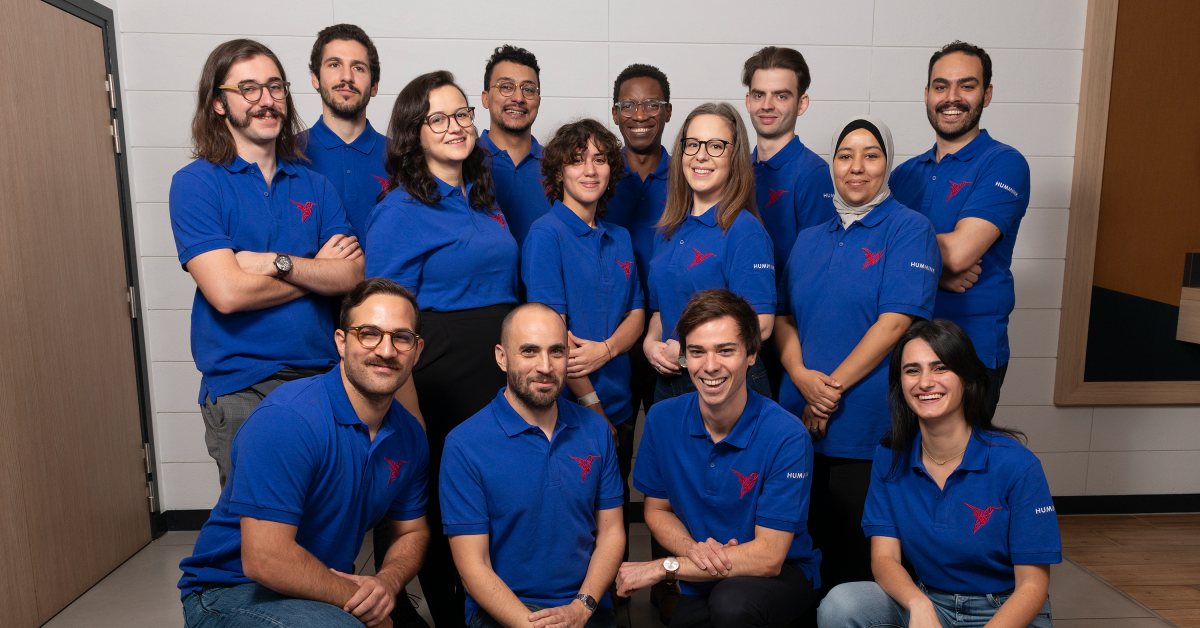
French deeptech company Hummink has secured €15M in funding to expand its sub-micron printing technology for microelectronics production.
Contentlockr
Paris-based Hummink, a deeptech company, has raised €15M in a round co-led by KBC Focus Fund, Cap Horn and Bpifrance. The company plans to extend the use of its High-Precision Capillary Printing (HPCaP) process across microelectronics production lines.
HPCaP allows the printing of metals and functional materials at the sub-micron scale and supports real-time repair of defects during chip and display production. The company promotes the method as a way to address faults that can halt entire batches in microelectronics manufacturing.
Currently, Hummink operates with teams in the US, Taiwan, Japan, and South Korea. The company plans to double its workforce by 2026 and aims to double revenue by the end of the year, driven by demand for its printing modules and conductive inks.
The funding round included participation from existing investors Elaia Partners, Sensinnovat, and Beeyond, along with the French Tech Seed fund managed by Bpifrance under France 2030. The European Innovation Council Fund also joined the round.
The capital will support the development of Hummink’s industrial printing module and advance its integration into semiconductor and display fabrication sites.
Nuno Carvalho, Investment Director at KBC Focus Fund, says, “Hummink stands out as an exceptional deeptech company that bridges academic excellence with industrial relevance. Their HPCaP technology is not only a breakthrough in nanofabrication—it’s a game-changer for defect repair in OLED and semiconductor manufacturing, where sub-5 micron precision is critical and unmet.”
“We’re proud to support Hummink’s journey from lab to fab, and believe their scalable business model and strong team position them to become a key enabler of next-generation electronics manufacturing.”
Transforming the future of microfabrication
Began in 2020 as a spin-off from the École Normale Supérieure – PSL and the CNRS, Hummink was founded by materials scientist Amin M’Barki and hardware startup operator Pascal Boncenne.
The team developed a method that deposits material through a nano-scale tip with controlled flow, operating like a fountain pen at extremely small dimensions. This process enables circuit formation and circuit repair at scales beyond the reach of conventional tools, creating options for work in semiconductor packaging, memory systems, and display production.
Electronics production continues to rely on lithography, but its steps produce faults that reduce yield and increase waste. To address these points of failure, Hummink introduces tools that identify faults and rewrite affected circuit paths at the micronic scale, creating a path toward higher usable output, lower scrap rates, and reduced environmental impact across the industry.
This capability shapes the company’s first industrial focus: OLED display production for smartphones and laptops. A large share of panels is discarded each year due to faults that appear during fabrication, resulting in financial losses and material waste. Hummink’s process can repair many of these faults and return panels to the production flow.
The company’s revenue comes from sales of NAZCA, its first-generation printing machine built for R&D labs. NAZCA brings Hummink’s high-precision printing into research environments and supports sub-micron fabrication and repair. The company also produces conductive inks designed for use with its system.
Co-founder Amin M’Barki says, “Our mission is to bring precision where it has never been possible before. Microelectronics is at the heart of the AI revolution, and every micron matters.” “With HPCaP, we give manufacturers a practical way to improve yields, cut waste, and make advanced technologies more sustainable,” adds co-founder Pascal Boncenne.
Hummink’s NAZCA system
Hummink’s NAZCA system is now in use across laboratories and research centres in Europe, Asia, and the US. One deployment is at Duke University, where teams recently used the platform to create fully recyclable, sub-micrometre printed electronics reported in Nature Electronics.
The company is also in qualification with display manufacturers in Asia that discard significant volumes of output because of flaws that arise during fabrication. Early trials show that NAZCA can recover part of this output, with initial data indicating a possible yield gain of around 10 per cent.
As chips and displays grow in scale and structural detail, production lines require tools that operate at the same level of precision. Hummink plans to place its sub-micron printing process inside manufacturing lines worldwide, enabling the formation and repair of circuit features during production.
Francois Charbonnier, Investment Director at Bpifrance, says, “Yield improvement is becoming one of the most critical levers in advanced manufacturing. Hummink’s combination of precision, speed, and scalability makes it a foundational technology for the next generation of microelectronics.”
“Breakthroughs like Hummink’s redefine what’s possible in manufacturing,” adds Flora Coppolani, Partner at CapHorn. “Their ink-based nanoprinting platform unlocks a new paradigm of control and scalability, bridging the gap between research and industrial scale, a true cornerstone for the next wave of deeptech innovation.”
Brief about Bpifrance and the French Tech Seed fund
Bpifrance provides financing through loans, guarantees, and equity to support companies at all stages. It helps firms pursue innovation, international expansion, and export activity, and offers guidance, training, networks, and acceleration programs for startups, SMEs, and mid-sized companies.
The French Tech Seed Fund, managed by Bpifrance for the French government, holds €500M to back the fundraising efforts of young tech-driven companies less than three years old. The fund is part of the national investment program known as the Programme d’investissements d’avenir (PIA), now included in France 2030.
The French Tech Seed Fund collaborates with certified contributors who identify projects, assess their technical strength, and connect them with private investors. Public investment can take the form of Convertible Bonds up to €400M, with an additional €100M available for equity.
France 2030 is a national investment plan that supports innovation across research, development, and industrial deployment. It allocates €54B to help French companies, research institutions, and universities advance in strategic sectors, with specific goals for decarbonisation and support for emerging players. The programme is coordinated by the Secrétariat Général pour l’Investissement and implemented by ADEME, ANR, Bpifrance, and the Caisse des Dépôts.
