

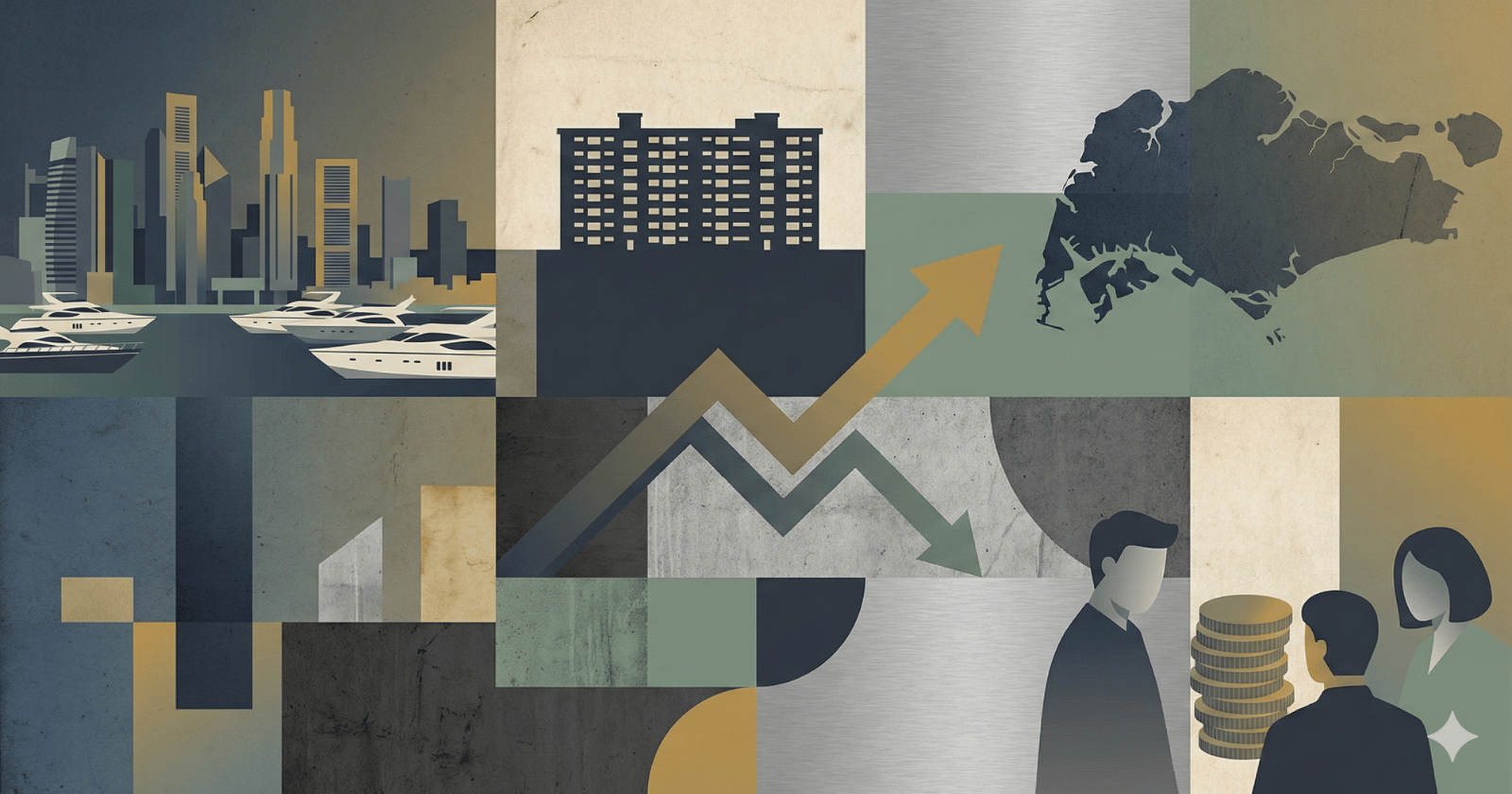
I’ve lived in Singapore for three years. The wealth is real. So is the disconnect.
I’m sitting in a café in Sentosa Cove—the kind of place where Maseratis idle in driveways and housekeepers walk designer dogs past yacht berths—and I’m reading a headline that should make me feel like I’ve landed in the right place.
Singapore just ranked fourth wealthiest city in the world. According to the latest Henley & Partners report, 242,400 millionaires now live here—a 62% jump in just ten years. That growth rate outpaces Tokyo, outpaces Hong Kong, outpaces pretty much everywhere except the Gulf states that are actively buying billionaires with zero-tax golden visas.
The city also hosts 333 centi-millionaires—people worth over $100 million—and 30 billionaires. Singapore is expected to overtake Tokyo as Asia’s wealthiest city within the next few years.
So why does none of this feel like good news?
The number everyone ignores
Here’s what the celebratory headlines leave out: while Singapore’s average wealth per adult climbed 116% since 2008, the median wealth actually fell by about 2% over the same period.
If you’re not familiar with the distinction, it matters—a lot. Average wealth gets skewed by billionaires at the top. Median wealth tells you what the person in the middle actually has. And in Singapore, that middle person has been going backwards while the city sprints up global rich lists.
According to the UBS Global Wealth Report 2025, Singapore’s average wealth per adult sits at a gleaming $441,000. But the median? Just $113,000. That’s a gap of over $300,000—and it tells you exactly where the gains have been concentrating.
This isn’t abstract. You can see it in the property market, where 1,035 HDB flats—public housing, mind you—sold for over a million dollars last year. That’s more than double the year before. Public housing. Seven figures. Let that sink in.
The millionaires keep coming
I moved to Singapore three years ago, partly for the stability, partly for the business environment, partly because—let’s be honest—it’s one of the most functional cities on Earth. The infrastructure works. The rule of law holds. You can build something here.
But I’ve watched the city change in that short window. Global millionaire migration hit a record 128,000 relocations in 2025, and Singapore pulled in 3,500 of them—ranking third globally as a destination for the ultra-wealthy. These aren’t tourists. They’re setting up family offices, buying property, enrolling kids in international schools.
Meanwhile, the UK is hemorrhaging 16,500 millionaires this year after abolishing its non-dom tax status. China is losing thousands more. And where do they go? Dubai, Singapore, Switzerland—wherever the taxes are low and the questions are few.
Singapore wins that game. No capital gains tax. No inheritance tax. Top personal income tax rate of 24%, and that only kicks in at very high incomes. For globally mobile wealth, it’s a near-perfect jurisdiction.
But here’s the question nobody seems to ask: what does it mean for a city when its primary growth strategy is attracting people who are already rich?
The locals I talk to aren’t celebrating
I run a media company here. I employ Singaporeans. I talk to young professionals trying to figure out how to afford a home, start a family, build a life in one of the world’s most expensive cities. And the mood is not triumphant.
BTO flats—the government’s build-to-order public housing that’s supposed to keep homeownership accessible—now come with multi-year waiting times. Young couples who can’t wait are pushed into the resale market, where prices have been climbing relentlessly. And for those who don’t qualify for public housing—maybe they earn just over the income ceiling, or they’re permanent residents rather than citizens—the private market is brutal.
A one-bedroom condo in a decent location? $2,500 to $4,000 a month to rent. A three-bedroom HDB for a family? North of $3,500 in many areas. For context, the median monthly income in Singapore is around $4,500 before CPF deductions. Do the math.
The Singapore Business Federation’s 2025 survey found that 40% of businesses now expect the economy to worsen over the next 12 months—nearly double the figure from late 2024. One in four businesses faces a moderate to severe credit crunch. And 35% of those struggling businesses don’t have enough cash to operate for more than six months.
This is the other Singapore—the one that doesn’t show up in wealth reports.
A social contract under strain
What’s always made Singapore work is a social contract: the government delivers stability, efficiency, and upward mobility; citizens accept constraints on political expression and trust the system to be fair. For decades, that bargain held. People could see their lives getting better. Homeownership rates hit 90%. The HDB system became a global model.
But contracts fray when one side stops delivering.
Lawrence Wong won the May 2025 election with 65.6% of the vote—the PAP’s best result since 2011. Analysts credited the victory to Singaporeans seeking stability amid global uncertainty, particularly the chaos of Trump-era tariffs and trade wars. But stability is not the same as progress. And voting for the known quantity doesn’t mean you’re happy—it might just mean you’re scared of the alternative.
The Bloomberg headline from earlier this year said it plainly: Singapore’s world-famous public housing system is coming under strain.
Who is this wealth actually for?
I don’t have a neat conclusion here. I’m not arguing against attracting capital or creating a business-friendly environment—I benefit from both. But I’m increasingly uncomfortable with the narrative that Singapore’s wealth rankings are unambiguously good news.
When average wealth rises and median wealth falls, that’s not prosperity—that’s concentration. When public housing enters seven-figure territory, that’s not success—that’s a system being pulled apart by forces it wasn’t designed to handle. When young locals watch millionaires pour in while their own path to homeownership stretches further into the distance, that’s not winning—that’s a social contract being tested.
The 242,400 millionaires are real. The 62% growth is real. Singapore’s position as a global wealth hub is undeniable.
But so is the growing gap between the headlines and the lived experience of people who were born here, who built their lives here, and who are now wondering what exactly all this wealth is for—and who it’s actually serving.
I don’t think Singapore is broken. Not even close. But I do think it’s at a crossroads, and the choices made in the next few years will determine whether this remains a city that works for everyone—or just a very pleasant, very efficient, very expensive place for the global rich to park their money.
From where I’m sitting in Sentosa Cove, the view is lovely. But the view isn’t the whole story.
