

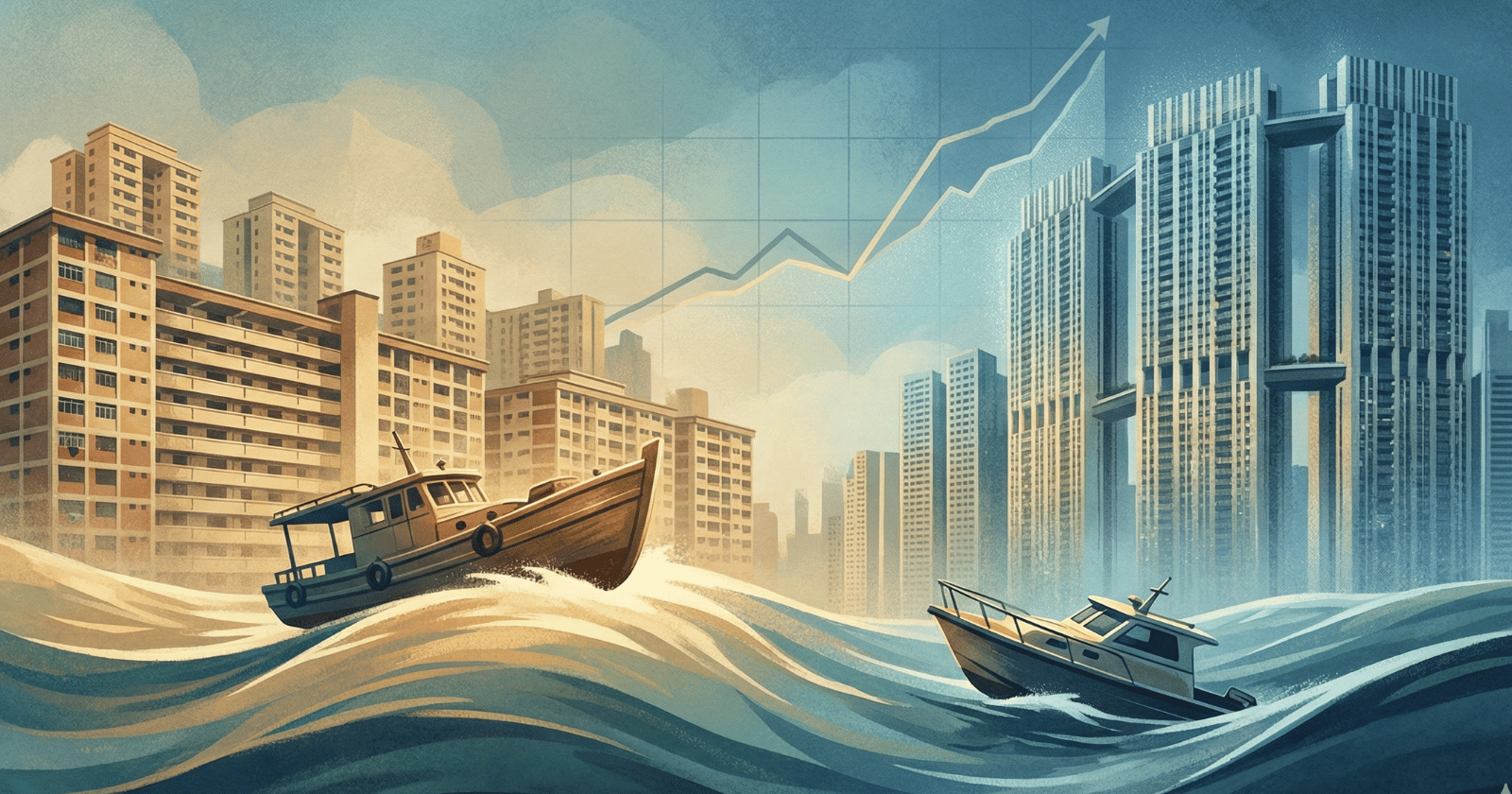
Lee Kuan Yew built a system where “all boats rise as the tide rises.” Sixty years later, some boats are sinking.
In 1964, Singapore made a promise.
The country had just gained self-government. Slums dotted the landscape. More than a million people—out of a population of 1.9 million—lived in squatter settlements and overcrowded shophouses. No running water for many. No modern sanitation. No expectation of a better future.
Lee Kuan Yew’s government responded with something radical: the Home Ownership for the People Scheme. Public housing wouldn’t just be for rent—it would be for purchase. Every Singaporean family would own their home. And they’d buy it at cost, or below cost, with heavy government subsidies.
“This was the plan which we had from the very beginning,” Lee said years later, “to give everybody a home at cost or below cost and as development takes place, everybody gets a lift, all boats rise as the tide rises.”
It worked. Within a generation, Singapore went from a city of squatter camps to a nation of homeowners. By the 1980s, 85% of the population lived in HDB flats. Today it’s over 80%, with roughly 90% of those residents owning their homes. The Housing and Development Board received a United Nations Public Service Award. Urban planners around the world studied the Singapore model as a blueprint.
But somewhere between then and now, something changed.
The million-dollar HDB
In July 2012, a flat at 149 Mei Ling Street in Queenstown sold for just over a million dollars. It was the first HDB flat to ever cross that threshold. Headlines treated it as an anomaly—a curiosity, maybe even a one-time outlier.
Fast forward to September 2025: 172 HDB flats sold for a million dollars or more. In a single month. A new record. Million-dollar flats now make up nearly 8% of all resale transactions.
The trajectory is relentless. In 2022, there were 369 million-dollar transactions for the entire year. In 2023, that jumped to 470. In 2024, it hit 1,035—more than double the previous year. And PropNex projects 2025 will exceed 1,300.
Let me be clear about what this means: we’re talking about public housing. Subsidized apartments. The system Lee Kuan Yew built specifically to give ordinary Singaporeans “a home at cost or below cost.”
Seven figures. For a 99-year lease on a government flat.
The streak nobody celebrates
HDB resale prices have now risen for 20 consecutive quarters—setting a new record. If you include the flat 0.0% change in early 2020, it extends to 23 quarters. The previous longest streak was 20 quarters, from 1991 to 1996.
That’s five years of uninterrupted price growth. Five years where every quarter, flats got more expensive. Five years where the gap between what public housing costs and what ordinary incomes can afford kept widening.
And it’s not just the top end. Data from 2024 shows prices for two-room flats rose 45.4% and three-room flats climbed 41%. Meanwhile, private residential property prices increased just 3.9%. The most affordable public housing is appreciating faster than luxury condos.
Think about what that means for a young couple earning median income, trying to get their first home.
The response that isn’t landing
In January 2025, Prime Minister Lawrence Wong addressed these concerns at a dialogue with NUS students. His message: don’t worry, housing is still affordable.
“We are able, through heavy government subsidies, through what we do on the HDB side, to provide assurance to all of you, both now and in the future, that we will always keep public housing affordable for Singaporeans,” Wong said.
He pointed out that over 80% of first-time flat buyers can service their mortgages using CPF savings alone, without additional cash. He noted that million-dollar flats are “one part of the equation” and that rising incomes should be factored into affordability calculations.
The response online was not kind. Comment after comment accused the government of making the same promises for decades while prices kept climbing. Some questioned whether million-dollar public housing flats represent “a deviation from the original purpose of HDB.”
There’s a gap here—between what the government says and what people feel. And that gap is becoming harder to ignore.
What the numbers actually show
The Demographia International Housing Affordability report for 2025 ranked Singapore 17th globally for affordability—not bad, all things considered. The report noted a median multiple (price-to-income ratio) of 4.2 for resale HDB flats, which it classified as “seriously unaffordable” but relatively reasonable by international standards.
But here’s what those rankings miss: Singapore’s housing-price-to-income ratio is now seemingly at one of its highest levels ever. And wage growth hasn’t kept pace with property appreciation.
The 2025 Demographia report looks at one snapshot. The trend line tells a different story.
Bloomberg put it bluntly earlier this year: “Singapore’s world-famous public housing system is coming under strain.”
The cooling measures that cooled the wrong thing
The government hasn’t been passive. Since 2021, four rounds of property cooling measures have targeted rising prices. A notable intervention was the 15-month wait-out period introduced in 2022 for private property owners seeking to purchase HDB resale flats.
It worked—sort of. The proportion of private property downgraders buying million-dollar flats fell from 34% in early 2022 to 12% by late 2024.
But the broader affordability challenge persists. The loan-to-value cap was reduced from 80% to 75% in August 2023, which increased down payment requirements. That helps cool speculation at the top. It also makes it harder for young buyers to scrape together their first purchase.
As one commentator noted: while fewer million-dollar flats “may suggest a shift towards more affordable transactions, it could also reflect constrained budgets rather than enhanced access to housing.”
In other words, the market may be cooling because people can’t afford to buy—not because prices have come down.
The original purpose
I keep coming back to Lee Kuan Yew’s words from that 2009 speech, when he handed over keys at The Pinnacle@Duxton—ironically, one of the developments that now regularly produces million-dollar transactions:
“I wanted a home-owning society. I had seen the contrast between the blocks of low-cost rental flats, badly misused and poorly maintained, and those of house-proud owners, and was convinced that if every family owned its home, the country would be more stable.”
The vision was clear. Homeownership would give citizens a stake in the nation. It would forge rootedness in an immigrant society. It would ensure that as Singapore prospered, ordinary families would share in that prosperity through the appreciating value of their homes.
“Home ownership,” Lee wrote in his memoirs, “helped to quickly forge a sense of rootedness in Singapore. It is the foundation upon which nationhood was forged.”
That promise—that deal—was the bedrock of Singapore’s social contract. Work hard, play by the rules, and you’ll be able to afford a home. Your home will appreciate. Your family will build wealth. All boats rise.
When the rising tide lifts only some boats
Here’s what I see from where I sit.
I’m an Australian who moved to Singapore three years ago. I run a business here. I employ Singaporeans. I talk to people across the income spectrum—from young professionals stressed about BTO wait times to executives who view property as just another asset class.
The system still works brilliantly for some. If you bought your flat 20 years ago, you’ve watched your wealth multiply. If your parents own property, you have a safety net and potentially an inheritance. If your household income clears the upper brackets, you have options.
But for young Singaporeans starting from scratch—no parental property, no inheritance, median income—the math is getting harder. BTO wait times stretch for years. The resale market demands cash over valuation. Private housing is out of reach. And every quarter, the target moves further away.
The government points to subsidies, grants, and the fact that most buyers can service mortgages with CPF. That’s true. But it obscures a more fundamental shift: the system designed to create universal homeownership is increasingly stratified by when you got in and what your starting position was.
That’s not “all boats rising.” That’s some boats rising faster than others can paddle.
The question Singapore doesn’t want to ask
I don’t think Singapore’s housing system is broken. It’s still more functional, more accessible, and more equitable than what exists in most global cities. Try buying in London, Sydney, or San Francisco, and you’ll appreciate what HDB gets right.
But there’s a difference between “better than elsewhere” and “fulfilling its original promise.”
Lee Kuan Yew didn’t build the HDB system so Singapore could rank 17th in an international affordability index. He built it so every Singaporean family could own a home at cost or below cost. He built it to create shared prosperity, not tiered access based on timing and parental wealth.
The question Singapore needs to confront—and the one I hear younger Singaporeans asking more often—is whether that original promise still holds. Not whether housing is technically affordable by some metric. But whether the system is still doing what it was designed to do.
172 million-dollar flats in a single month suggests the answer isn’t as simple as the government would like it to be.
The tide is rising. But not all boats are coming with it.
