

UK’s marine carbon capture company secures grant from the UK government to eliminate the crucial aspect to advance the shipping industry.
Contentlockr
London-based Seabound, a company specialised in marine carbon capture, secured £1.1M (approximately €1.2M) through Round 6 of the UK Government’s Clean Maritime Demonstration Competition (CMDC6).
“This is the first time in the world that carbon and air pollution capture will be combined and deployed at full commercial scale in a port,” says Alisha Fredriksson, CEO and Co-Founder of Seabound.
“We’re thrilled to be working with visionary partners like ABP and STAX to deliver a solution that we see reshaping port operations worldwide,” adds Fredriksson.
Fund utilisation
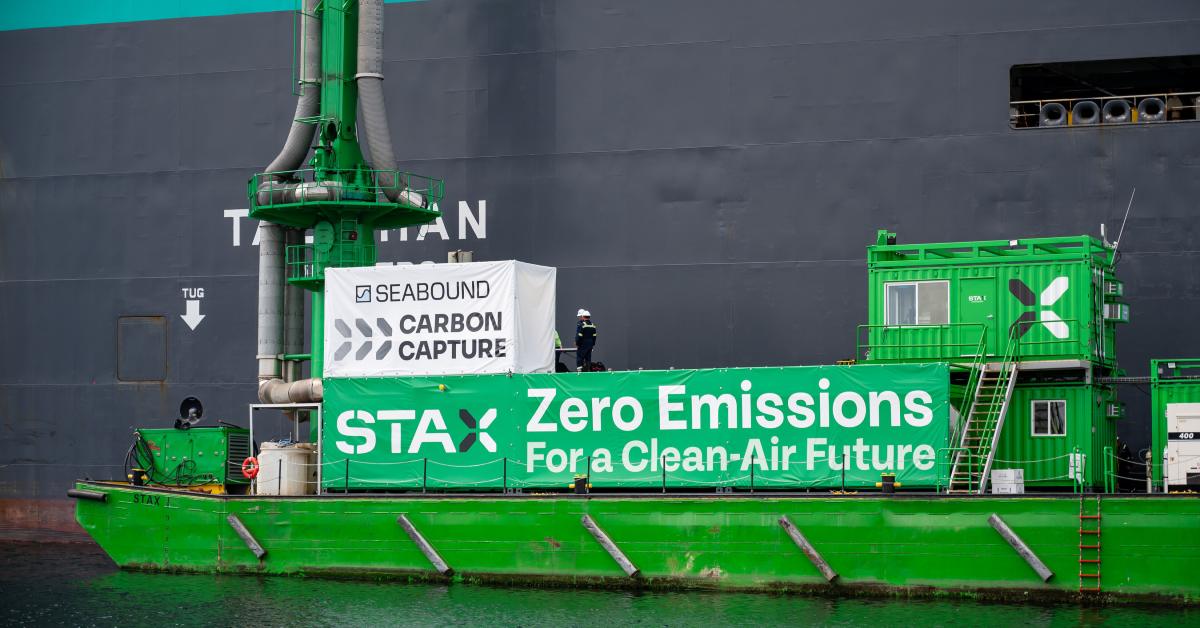
This funding will support a first-of-a-kind project that involves collaboration between Seabound, STAX Engineering, and Associated British Ports (ABP).
The project aims to integrate Seabound’s carbon capture technology with STAX’s emission capture and control system at the Port of Southampton.
The companies had previously announced their plan to deploy these barges in partnership with ABP during the inaugural Maritime UK Solent Coastal Powerhouse Summit.
The funding will also support crucial pre-deployment work for this project in Southampton.
It includes testing container swapping logistics, refining Seabound’s next-generation carbon capture system, and establishing the groundwork for a fleet of barges capable of covering key berths across the port.
Beyond emissions reductions, the project is said to generate new skilled jobs at the Port of Southampton, from barge operations and maintenance to carbon capture servicing and logistics.
ABP intends to expand and scale this solution to other ports across the country, offering a replicable model for other ports worldwide.
ABP is the largest port operator in the UK. It aims to reach net-zero emissions across its operations by 2040.
The company launched the Energy Ventures Accelerator programme in 2024 to support a variety of early-stage clean energy innovators.
“Sustainability and innovation are key themes as ABP helps its customers to adapt to the changing environment”, says Max Harris, Head of Strategy and Sustainability at ABP. “We are excited to explore the potential of this innovative solution as we pursue ever better air quality at our ports and support maritime decarbonisation”.
Southampton port stands tall
This project makes Southampton the first UK port to use a complete system that captures carbon dioxide (CO₂) and other pollutants, like sulfur oxides (SO₂) and nitrogen oxides (NOₓ), from ships while they are docked.
How does it work?
The company’s carbon capture units are designed to fit into standard 20-foot containers and will be used with STAX’s barge system for capturing emissions.
According to the company, the system has been tested successfully at the Port of Long Beach.
It connects directly to a ship’s exhaust, removing up to 99 per cent of particulate matter and 95 per cent of nitrogen oxides.
The cleaned gas then goes into Seabound’s unit, which captures and stores up to 95 per cent of carbon dioxide and 98 per cent of sulfur dioxide (SO₂) before releasing the cleaned exhaust.
“Ports are in immediate need of sustainable solutions that don’t cause disruptions, and that’s exactly what we’re providing: a viable and effective alternative to shore power that can be deployed to any ship without retrofits, new infrastructure, or upfront costs in any port around the world,” says STAX CEO Mike Walker. “Through this project with Seabound and ABP, we’re one step closer to making clean air accessible and practical for all maritime operations.”
This project builds on Seabound’s earlier win in CMDC Round 3, where the company achieved 78 per cent CO2 capture efficiency and over 90 per cent SO₂ removal during a world-first shipboard carbon capture demonstration on the MV Sounion Trader.
The UK company also said it continues to work with Lomar Shipping to deploy its carbon capture solution across the company’s fleet.
LomarLabs pitches in
LomarLabs, a maritime venture lab, is helping Seabound grow and commercialise its services.
Launched in March 2023 by Lomar, the UK-based ship owner and management company, lomarlabs was created to collaborate with ambitious deep-tech startups to catalyse the deployment of solutions that address some of the maritime industry’s biggest challenges, including the transition to net-zero emissions.
“This project is a breakthrough moment for ports and for the maritime decarbonisation landscape,” says Stylianos Papageorgiou, Managing Director of lomarlabs.
“By integrating carbon and emissions capture in a scalable, barge-based system, we’re unlocking a practical path to cleaner port operations without retrofitting ships. At lomarlabs, we’re proud to support Seabound in translating vision into deployment — and proving what’s possible when maritime innovation is driven by real-world experience.”
Seabound: Provides a modular carbon capture system
Founded in 2021, Seabound is a modular carbon capture system for ships.
The company’s modular carbon capture units, sized to match standard 20-foot containers, will be integrated onto STAX’s barge-based emissions capture and control system.
The UK company recently completed the world’s first port-based CO₂ capture demonstration at the Port of Long Beach with STAX Engineering.
Previously, the company completed a world-first pilot with lomarlabs and Hapag-Lloyd, capturing CO₂ at ~80 per cent efficiency on a container ship in the Middle East.
“It’s so exciting to see investment in green fuels and technologies spurring on skills, innovation and manufacturing across the UK, delivering on our Plan for Change missions to kickstart economic growth and become a clean energy superpower,” adds UK Maritime Minister Mike Kane. “We’ve charted a course to net zero shipping by 2050, and this £30 million will be crucial in supporting the green fuels and technologies of the future, so we can clean up sea travel and trade.”
To date, Seabound has raised $6.8M from world-class investors, including Lowercarbon Capital, Y Combinator, Eastern Pacific Shipping, Elemental Impact, and Collaborative Fund, and received £2.3M in grant funding from the UK Government through the Clean Maritime Demonstration Competition.
