

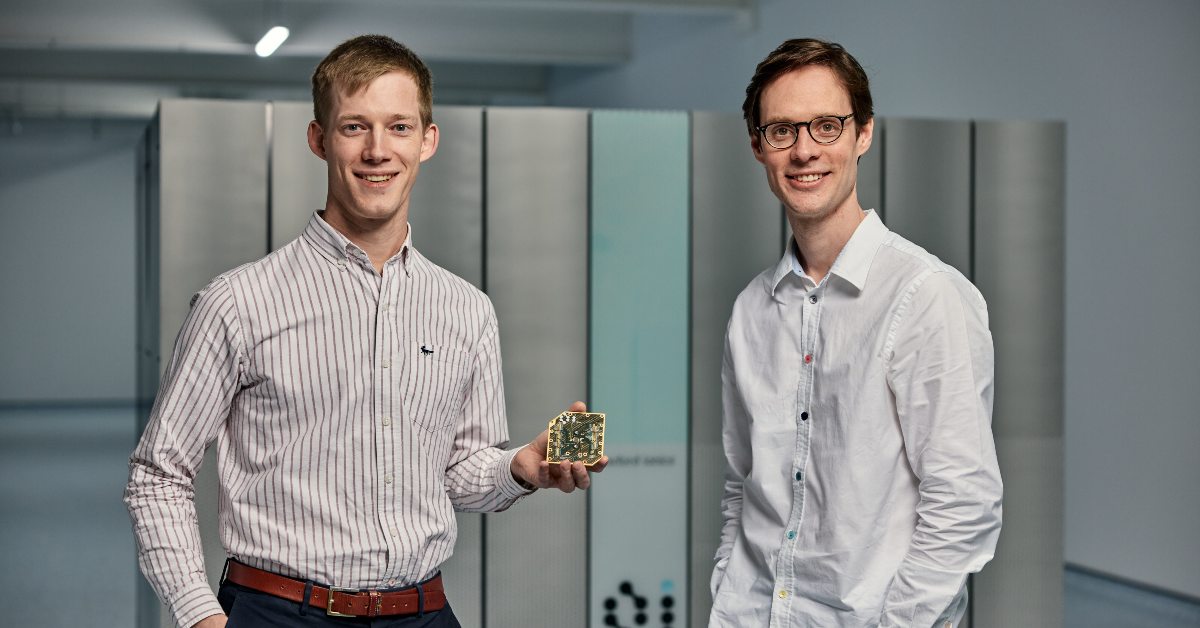
A couple of months after the acquisition by US-based IonQ, this UK quantum computing company delivered and installed a full-stack quantum computer on this campus.
Contentlockr
Oxford-based Oxford Ionics, a company specialised in trapped-ion quantum computing, announced that it has delivered and installed a full-stack quantum computer — called Quartet in the UK’s National Quantum Computing Centre (NQCC).
The announcement comes a couple of months after US-based IonQ, a company specialising in quantum computing and networking, acquired Oxford Ionics for $1.075B.
The National Quantum Computing Centre (NQCC) is the UK’s main lab for quantum computing, focusing on important research with partners from industry, universities, and government.
As part of its testing program, the NQCC has funded a new quantum computer from Oxford Ionics in collaboration with Innovate UK.
This computer will help explore key commercial applications for quantum computing. The QUARTET quantum computer is now set up at the NQCC’s data centre at the Harwell campus.
What is QUARTET?
QUARTET is a trapped-ion quantum computer that uses Oxford Ionics’ Electronic Qubit Control technology, which relies on electronics rather than lasers.
This technology integrates all the necessary components to trap and control qubits onto a standard electronic chip made in regular semiconductor factories.
As a result, QUARTET is currently the highest-performing quantum platform in the world, with Oxford Ionics holding records for two-qubit gate fidelity, single-qubit gate fidelity, and quantum state preparation and measurement (SPAM).
Field upgradeable
All Oxford Ionics quantum computers can be upgraded in the field. This means that the system at the National Quantum Computing Centre (NQCC) can easily be updated to match the best systems by simply swapping out the small Quantum Processor Unit (QPU).
This allows the NQCC to improve its performance and computing power quickly, without needing to change anything else in its setup.
Oxford Ionics and the NQCC will also use QUARTET for important research and development as part of the UK’s Quantum Missions program.
This program funds projects that help make quantum technologies more commercially viable.
Earlier this year, Oxford Ionics, along with Riverlane and Bay Photonics, was chosen for a Quantum Missions pilot for its Q-Surge project, which will upgrade QUARTET to add 2D qubit connectivity.
Dr. Michael Cuthbert, Director of the UK’s National Quantum Computing Centre, comments, “The successful installation of the QUARTET trapped-ion quantum computer by Oxford Ionics marks a pivotal step forward in the NQCC’s quantum computing testbeds initiative. The proprietary architecture of the system is designed to tackle the scalability challenges of quantum computing. We are really excited to start the testing and validation of the system for the development of algorithms and new applications.”
Oxford Ionics: Solving quantum computing’s difficult problems
Founded in 2019 by Dr. Chris Ballance and Dr. Tom Harty, Oxford Ionics designs and scales one of the most promising quantum computing technologies – trapped ions.
According to the company, trapped-ions have long been shown to be superior as many technologies compete for dominance to drive toward a quantum future.
Currently, the team includes 90 global experts across physics, quantum architecture, engineering and software.
The company expects to triple headcount over the next 18 months as the business scales internationally.
To date, the UK company has raised £37M to date with investors including Braavos, OSE, Lansdowne Partners, Prosus Ventures, 2xN, and Hermann Hauser (founder of chip giant ARM).
Dr. Chris Ballance, co-founder and CEO of Oxford Ionics, comments, “Installing Quartet at the NQCC marks a major milestone – not just for our company, but for unlocking a future powered by quantum computing. Quartet represents a significant step forward in making commercially valuable quantum computing a reality, ensuring we are equipped with the computing power to solve some of the world’s most pressing challenges. We’re proud to support the NQCC as they explore and develop transformative applications capable of delivering real-world impact.”
