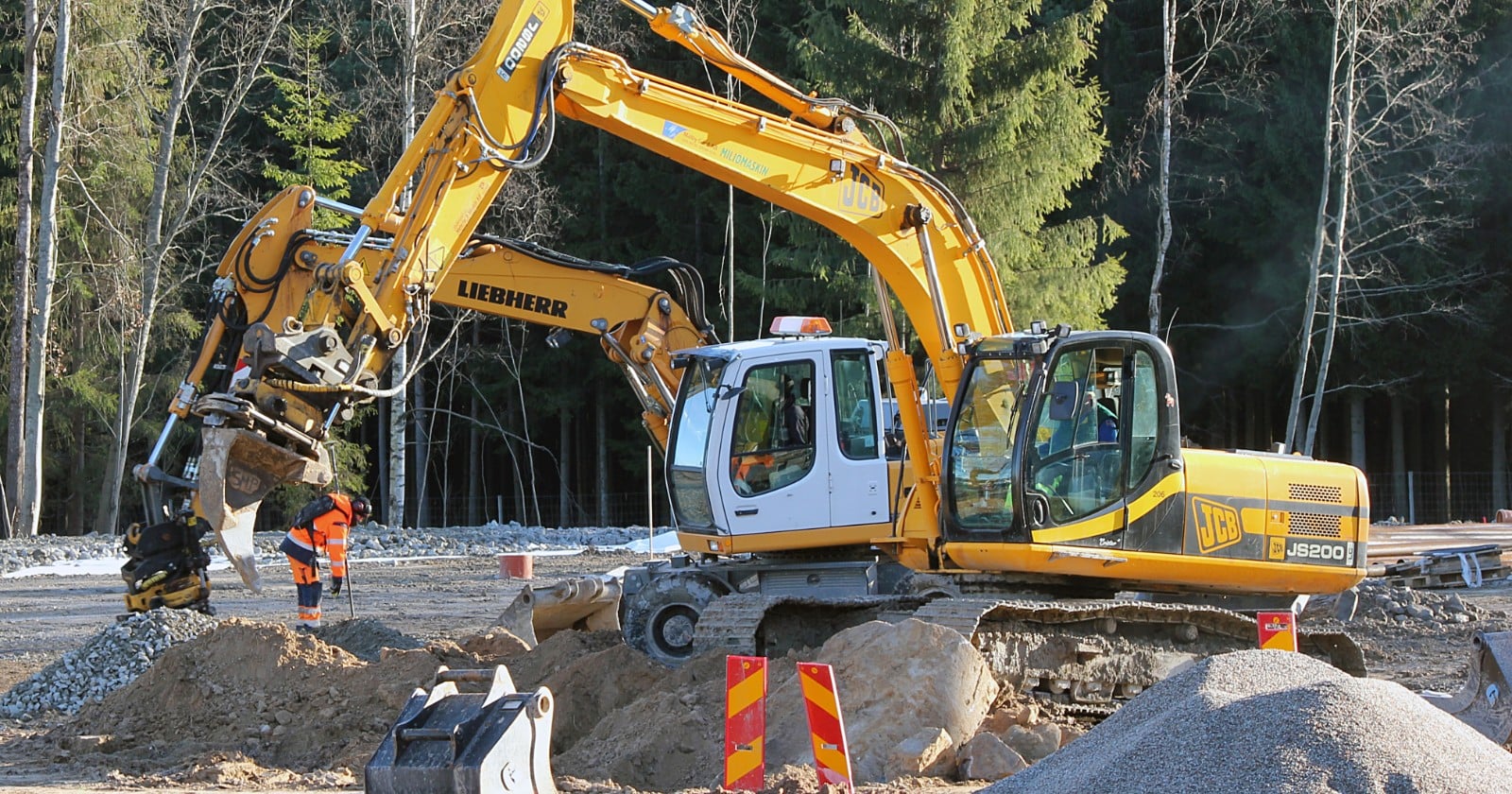
Gravis Robotics, a Zurich company that bolts autonomy onto excavators built by other manufacturers, announced on 17 August that SoftBank is investing $200 million in its Series A. SoftBank is the only investor named or quoted in the release. Inc., which labelled its story an exclusive, reported the investment as coming at a $1 billion post-money valuation. Gravis’s own announcement states no valuation and does not use the word unicorn.
What the money is buying is a claim about productivity, and that claim went out in two forms on the same day.
One figure, two wordings
The written version is hedged twice. The release says the company’s understanding of its machines has “allowed us to squeeze productivity from these systems—delivering up to a 30% boost in jobsite productivity compared to peak manual operation.” That is a ceiling rather than a typical result, and the comparison is against peak manual operation — a term the release never defines. It could mean the best a skilled operator manages, or a machine’s best throughput under manual control. Those are not the same benchmark, and nothing in the release says which is meant.
The version Gravis gave a reporter is looser in both places. Inc. records that the company “says its machines have delivered productivity improvements of about 30 percent on multiple projects compared with human-operated equipment.” Approximately rather than up to. Achieved on multiple projects rather than reachable at the top end. And any human-operated equipment rather than peak operation.
There are older renderings too, and they are the company’s own. Gravis’s November 2025 announcement said the technology was “boosting output 30%, reducing rework, and improving safety” — no ceiling, no comparator, no benchmark. Its March 2026 US-expansion announcement said partners had benefited “by up to a 30% increase in operator productivity”, a third subject for the same figure, alongside “97% bucket fill rates” and “estimated annual net savings of up to $74,000+ per machine”. When this site covered the 2025 round in November, it reported the figure the same flat way — “increases output by 30 per cent”, no ceiling, no comparator — because that is the way the company issued it. The point is not that anyone is lying. It is that a single number has been in circulation for the better part of a year, attached to output, to operator productivity and to jobsite productivity, and no version of it has ever arrived with a method attached.
What a specialist would want beside it
Vineet Kamat, a University of Michigan professor who researches construction automation, told Inc. he would want to see more context before judging what the figure means. A meaningful comparison, he said, needs similarly sized equipment, experienced operators, comparable site and soil conditions, and the full workflow rather than machine cycle time alone. It should also account for “setup, supervision, rework, downtime, fuel use, maintenance, and safety performance,” ideally across several sites and operating conditions.
What Gravis has published is more numbers, not a method. Reading the company’s own announcements from November 2025, March 2026 and August 2026, and the news reports on them, there is no baseline definition, no project count, no measurement period and no named measurer. Nor does any customer or third party put a figure of its own on the record. Morgan Sindall Construction, quoted in the 2025 announcement, called the robotic excavator “as productive as a skilled machine driver – and in some instances, enhanced team efficiency”, which is an impression rather than a measurement. The closest thing to corroboration is an investor: Archie Muirhead of IQ Capital, which backed the 2025 round, told EU-Startups that Gravis’s technology is “already delivering measurable productivity gains on live projects across four continents” — measurable, without the measurement.
Kamat’s view of the technology is not dismissive. He told Inc. that excavation is a harder robotics problem than moving goods through a controlled warehouse, because it happens in “an unstructured, constantly changing environment” where soil, weather, slopes, buried utilities, workers and other machines shift fast enough to force safety-critical decisions in real time.
Chief executive Ryan Luke Johns is also explicit that emptying the cab is not the pitch. “It’s not about taking operators out of the machine,” he told Inc. “It’s about getting machines to be 30 percent more productive, to get an operator to drive multiple highly productive machines.” One person supervising a fleet is still a labor story. It is a different one from no person at all.
What Gravis sells
The product is the Gravis Rack, a kit of sensors and computing hardware fitted to machines a contractor already owns, plus the software that runs it. The release names nine manufacturers whose machines have carried it — Caterpillar, Case, Develon, John Deere, JCB, Hitachi, Sumitomo, Yanmar and Volvo — and then adds “and more.” Johns told Inc. the Rack has been adapted across more than a dozen brands, makes and models. The company’s case for retrofitting rather than manufacturing is partly commercial and partly normative: the release puts roughly two thirds of global demand for heavy equipment outside the top three makers, and argues that contractors “shouldn’t be forced into a closed, single-brand ecosystem.”
Gravis was spun out of ETH Zurich in 2022. Johns is chief executive and co-founder, Dominic Jud is chief technology officer and co-founder, and Marco Hutter, a robotics professor at ETH, is a co-founder and board member. Inc. puts the company at roughly 75 people and its systems on four continents, and quotes Johns saying digging accounts for about 70 percent of what the machines do. Inc. also reports Gravis expecting to be live in seven countries by November. Both sides of that are the company’s own: its November 2025 announcement said it was “live in seven countries across the UK, EU, US, LATAM and Asia”, and its March 2026 announcement said machines were “already deployed across infrastructure and materials projects in seven countries”. Seven is where Gravis has said it is since November 2025, and also where Inc. reports it expects to be by November 2026.
Under Gravis Copilot the operator stays in the cab with live 3D guidance and hazard detection. Under full autonomy the operator steps out. Johns’s example of sustained autonomous work: machines recently in Texas “working from the start of the day until the lunch break without any intervention at all.”
In July, SoftBank was weighing an acquisition
Twenty-four days before the announcement, on 24 July, Bloomberg reported that SoftBank was considering acquiring Gravis, in a deal that “could ultimately value” the company at more than $500 million. No final decisions had been made on the size or the structure of a deal, according to people familiar with the discussions. Sifted and Inc. both carry the acquisition report; the no-decisions detail is Sifted’s alone. The Bloomberg original is paywalled and we have not read it.
What was announced instead was a minority investment at a reported $1 billion post-money. The temptation is to read that as the valuation doubling in three and a half weeks, and it is worth being careful about why that arithmetic does not work. “More than $500 million” is a floor rather than a point estimate, and it describes what a deal “could ultimately” reach, not a price anyone agreed. The $1 billion is a post-money figure, so it includes the investor’s own $200 million. Neither number came from Gravis, and no clean multiple can be derived from them.
The record it broke was 34 days old
Gravis describes this as the largest Series A in construction robotics history. Superlatives are the easiest claim in any release to break, so it is worth reporting what a search finds: nothing that contradicts it. The largest prior Series A locatable in the field is TerraFirma’s $100 million led by Kleiner Perkins, announced on 14 July 2026 inside a roughly $115 million total — some outlets treat the whole $115 million as the Series A, which does not change the record but does change the sector total below. Bedrock Robotics came out of stealth in July 2025 with $80 million across seed and Series A combined. Built Robotics has raised $112 million. Teleo’s Series A, in 2022, was $12 million. The claim stands, and it displaced a record set just 34 days earlier.
The category is doing some work, though. Bedrock Robotics, founded by former Waymo employees and developing a retrofit kit to turn standard excavators into autonomous ones, raised $270 million in February 2026 at a $1.75 billion valuation, co-led by CapitalG and the Valor Atreides AI Fund. More money, a higher valuation, six months earlier, for a near-identical product description. Round letters are bookkeeping, not size, and the record is drawn narrowly enough to exclude the best-funded company doing the same thing. Counting headline rounds only, those three companies have raised about $570 million between February and August, or $585 million if TerraFirma’s full $115 million is counted — our sum either way, and deliberately round-only, since adding cumulative totals would double-count. Caterpillar, whose machines Gravis retrofits, has meanwhile unveiled autonomous excavators, loaders, dozers, haul trucks and compactors of its own.
The demand behind all of it is not in dispute. Global construction produced about $13 trillion of output in 2023 according to McKinsey, while construction productivity rose roughly 10 percent between 2000 and 2022 against about 90 percent in manufacturing. Labor is another constraint: Associated Builders and Contractors estimates the US industry needs 349,000 additional workers in 2026. Johns says Gravis now has “quite a few” machines on data-center projects, alongside highways, utilities, oil and gas work and quarries. Kamat expects autonomy to spread through repetitive, clearly defined operations first and reach complicated mixed-fleet sites later, which is roughly that order.
What is checkable here, and what is only announced
Some of this is firmer than the coverage suggests. The kit exists and is fitted to named manufacturers’ machines. The customers and partners are named. And a public funder is behind a trial: Flannery Plant Hire, one of Britain’s largest heavy-equipment rental firms, and Gravis were awarded funding under the UK government’s first CAM Pathfinder: Enable competition, for a project trialling the system across six excavators on trenching, bulk excavation and truck loading. Gravis puts the project at $8 million and says it leads it; the programme’s own announcement on 10 August gives no figure and describes the project as led by Flannery and Gravis Robotics. Either way it is money for a demonstration rather than a purchase, and it is separate from the commercial arrangement the two companies also have, under which contractors can rent excavators already carrying the Rack.
Three things are looser. Whether the round has closed: the release’s headline says Gravis “Raises” $200 million while the body of the same release says SoftBank “is investing” it, Inc. says Gravis “is raising” the money, and Engineering News-Record headlined the round as being set for the company though its own text says Gravis “has secured” it. Announced, signed and funded are three different states and no source on the record separates them.
The valuation: the $1 billion is press reporting, not company disclosure, and the EUR 862 million figure in European coverage is a currency conversion of it — a number that clears a billion in dollars and does not in euros. Gravis links to the Inc. piece from its own announcement page, so it is not disowning the figure. It has not published it either.
And the productivity figure, which is where this started. It is company-reported, it went out in two wordings on one day, it has a third and flatter life in older coverage including our own, and the only specialist on the record has set out what a credible version would have to account for. There is an obvious candidate to supply an outside number and it is compromised: Holcim, named among Gravis’s customers and partners, is also an investor. Taylor Woodrow and HD Hyundai do not appear on any Gravis investor list we could find, and either could say what the Rack did to a schedule. Until one of them does, or the UK trial reports, the 30 percent remains a figure with three faces and no arithmetic behind any of them.