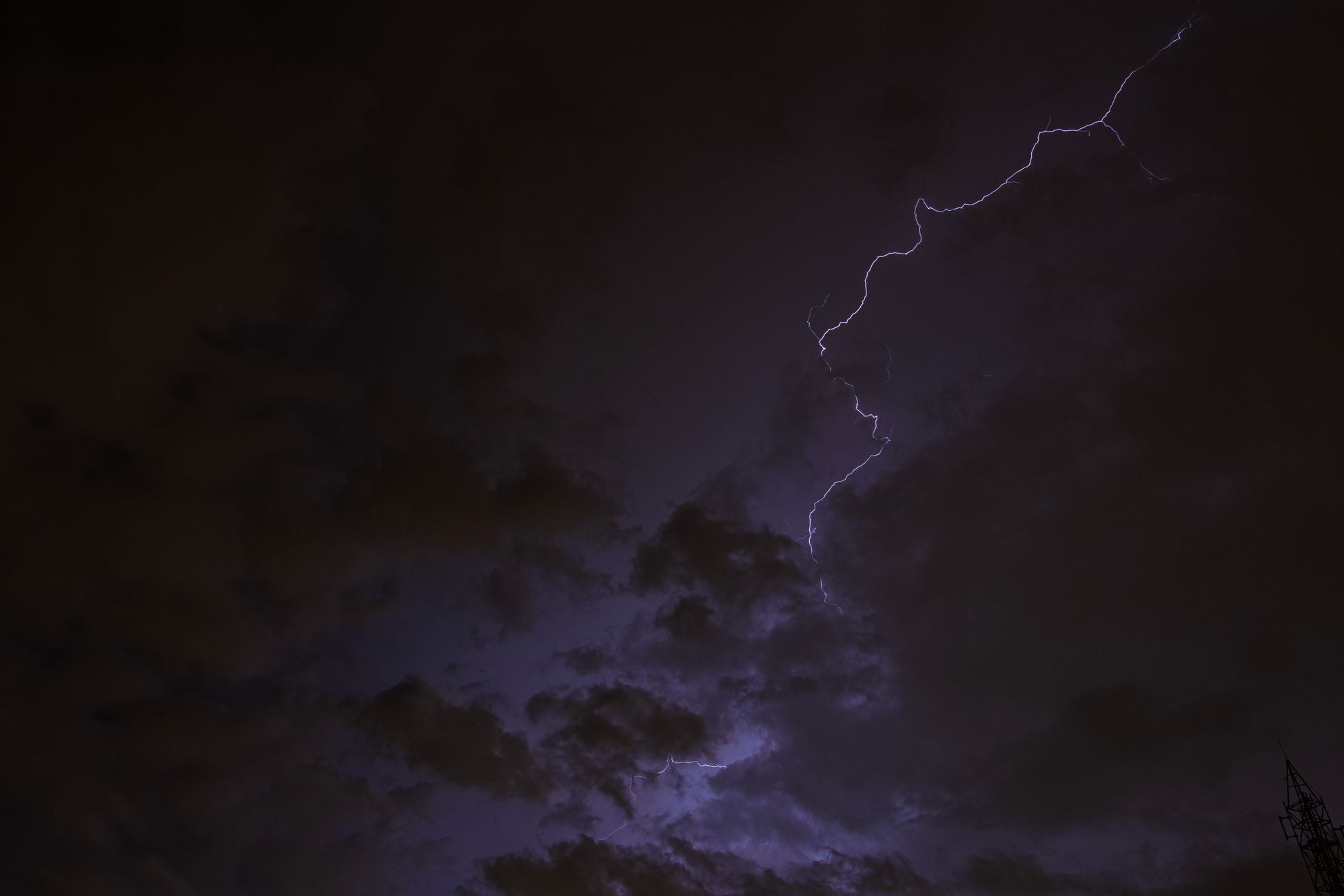
The lightning channel that flashes across a summer sky is, for a few millionths of a second, one of the hottest things on Earth. When a bolt punches through the atmosphere, it superheats the narrow corridor of air it travels through to roughly 30,000 degrees Celsius — about five times hotter than the visible surface of the Sun, which sits closer to 5,500°C. The thunder that follows is not a separate event. It is that column of air violently expanding outward, faster than sound itself, in a shockwave you hear as a rumble.
The flash and the boom are the same event. One reaches you at the speed of light. The other trudges in at roughly 343 metres per second, which is why counting seconds between them tells you how far away the storm is.
What actually happens inside the channel
A cloud-to-ground stroke is a narrow plasma channel carrying a current that can peak above 30,000 amperes. The energy dumped into that thin tube of air in a fraction of a second is enormous, and the air responds the only way it can: it ionises, glows, and expands.
The temperature figure — around 30,000°C, sometimes cited as 54,000°F — is derived from analysis of the light emitted by the channel. Meteorologists at WAVE 3 in Louisville put it plainly: lightning reaches five times the temperature of the Sun’s surface, and thunder is the acoustic shockwave that heat produces.
The surface of the Sun, the photosphere, hovers around 5,500°C. A lightning bolt beats it by a factor of five. The catch is duration. The Sun holds its temperature continuously. A lightning channel reaches 30,000°C briefly before it starts to cool.
Why the air explodes
Air heated that violently cannot simply warm up and drift. It expands supersonically. The channel wall pushes outward faster than the surrounding air can get out of the way, and the pressure discontinuity that forms is a shockwave. Within a few metres, the shock slows to the ordinary speed of sound and becomes what your ear registers as thunder.
The initial crack you sometimes hear from a very close strike — the sharp rifle-shot before the rumble — is that supersonic phase reaching you before it has had time to soften into a normal acoustic wave. The long rolling grumble that follows is the same shockwave, but arriving from different points along a bolt that may be several kilometres long. Sound from the near end reaches you first. Sound from the far end arrives seconds later.
The bolt that stretched 515 miles
Most lightning flashes are a few kilometres long. Some are absurdly longer. The World Meteorological Organization certified a new record (announced in 2025): a single megaflash that travelled more than 500 miles across the central United States, from eastern Texas to near Kansas City, in October 2017.
The exact length was 515 miles, roughly the driving distance from Paris to Frankfurt. It happened in October 2017 but was only confirmed years later after satellite data was reanalysed with better mapping techniques. The flash itself lasted several seconds — long enough for the discharge to snake horizontally along the underside of a massive mesoscale convective system.
Anyone standing under any point of that bolt would have heard thunder. Anyone standing near the middle would have heard it rolling in from both directions for the better part of a minute.
Heat lightning is a misnomer
On humid summer nights, distant flashes sometimes flicker at the horizon without any audible thunder. Folk tradition calls this heat lightning and treats it as a separate phenomenon caused by warm air alone.
It is not. As meteorologist Mike Moss explains at WRAL, heat lightning is ordinary lightning from a thunderstorm too far away for its thunder to reach you. Sound waves refract and attenuate as they travel through the atmosphere, and beyond a certain distance, the rumble usually fades below the level of ambient noise. The flash, being light, still makes it over the curvature of the horizon by reflecting off high cloud.
You are seeing the same 30,000°C channel that anyone under the storm is hearing. The physics is identical. The distance is what changed.
How to time a storm
Light travels at roughly 300,000 kilometres per second. Sound crawls at about one-third of a kilometre per second. The gap between them at storm distances is essentially the entire travel time of the sound, since the light arrives instantly by comparison.
Count the seconds between flash and thunder, divide by three, and you have the distance to the strike in kilometres. Divide by five for miles. A five-second gap means the bolt struck a little over a mile away. A one-second gap means it is close enough that the next one could be on top of you.
Meteorologists use the same principle at scale with lightning detection networks, triangulating the arrival times of radio-frequency emissions from strokes at multiple ground stations to fix each bolt to within a few hundred metres.

When two bolts collide
The 30,000°C figure applies to a normal stroke. Some events push further. In 2017, researchers monitoring a tall broadcasting tower in Japan recorded two lightning leaders colliding directly above the structure. The collision produced a burst of gamma radiation and neutrons — a signature usually associated with nuclear reactions — over a fraction of a second.
The team, whose findings were reported by ZME Science, argued that the electric fields inside a thunderstorm can accelerate electrons to relativistic speeds, and when those electrons slam into air molecules, they emit high-energy photons capable of knocking neutrons out of atomic nuclei. Lightning, in other words, occasionally does small-scale nuclear physics in the sky above you.
Lightning on other worlds
Earth is not the only planet that makes thunder. Jupiter has weather too, and its lightning is on a different scale entirely. Data from NASA’s Juno mission, which has been orbiting Jupiter since 2016, indicates that Jovian lightning bolts can be up to 500 times more powerful than typical terrestrial strokes.
Juno’s instruments have picked up whistler waves and radio emissions from storms deep in Jupiter’s atmosphere, including flashes near the poles where Earth’s own lightning is rare. The Great Red Spot, a storm larger than Earth itself, sits inside a system that has been churning for at least 150 years and possibly much longer.
The physics is recognisable — charge separation in convective clouds, discharge along an ionised channel — but the ingredients differ. Jupiter’s clouds contain water, ammonia, and hydrogen, and the pressures involved dwarf anything in a terrestrial thunderhead.
The channel cools in milliseconds
Back on Earth, the plasma channel that reached 30,000°C does not stay hot for long. The current falls away quickly, and the channel cools to a few thousand degrees and stops glowing. The visible flash you perceive as a single event is often a rapid sequence of return strokes — three or four in quick succession is common — each re-heating the same corridor before it fades.
What lingers is the shockwave, still expanding outward, decaying into the acoustic thunder that will reach ears kilometres away over the next 30 or 60 seconds. By the time the last rumble dies out on the horizon, the channel itself has been cool, dark air for nearly a minute.
Frequency across the planet
Dozens of lightning flashes occur every second worldwide, most of them over land in the tropics. Lake Maracaibo in Venezuela, where warm humid air from the Caribbean piles up against the Andes, generates lightning almost every night for much of the year, producing the highest strike density on Earth.
Each of those flashes, from the ordinary short bolt over a Kansas cornfield to the 515-mile megaflash that set the record in 2017, does the same thing. It carves a narrow channel of air, heats it past 30,000°C, and leaves behind a shockwave that spreads out into the night.
The next time thunder rolls in slowly, several seconds after a flash, count the gap. The sound arriving at your window left the bolt as an explosion of air hotter than the surface of the Sun, and it has been travelling toward you, at roughly the speed of a passenger jet, ever since.