

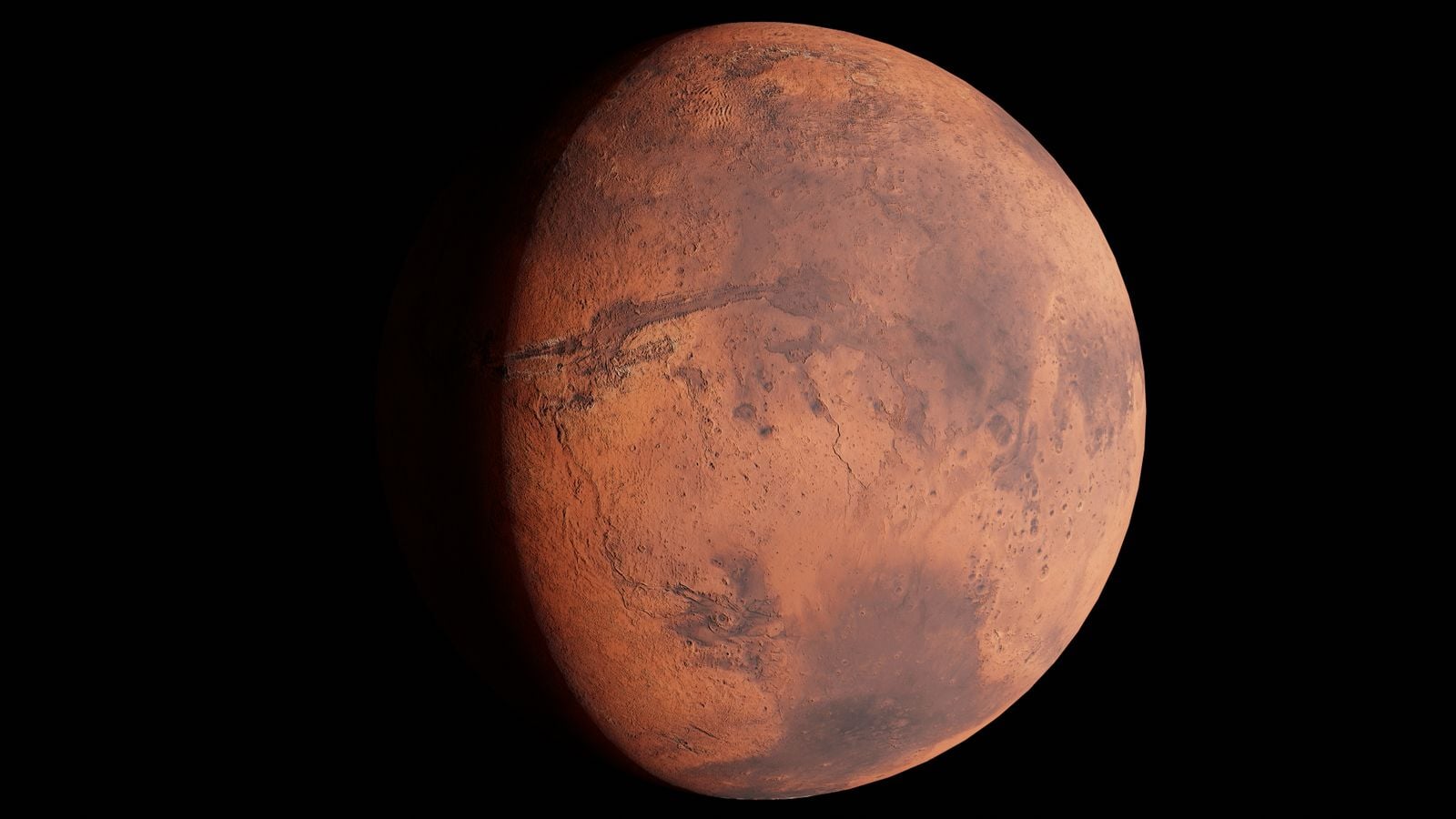
For most of the space age, Olympus Mons has been filed under a single word: extinct. The largest volcano in the solar system, a shield of hardened basalt roughly the size of Arizona and nearly three times the height of Everest, was understood as a monument to a Mars that no longer exists. A planet that ran out of heat, lost its atmosphere, and went still billions of years ago. The mountain was the tombstone.
Two discoveries in 2024 complicated that obituary. One found water frost forming on its summit on cold-season mornings. The other found evidence that the ground beneath it is still, very slowly, being pushed upward. Neither means the volcano is about to erupt. Both suggest that “extinct” was always too tidy a word for it.
The frost that wasn’t supposed to be there
In June 2024, an international team publishing in Nature Geoscience reported patches of water frost sitting in the summit calderas of the Tharsis volcanoes, Olympus Mons among them. The discovery marked the first time frost of any kind had been detected near the Martian equator, a region planetary scientists had long assumed was simply too warm and too dry to hold it.
The reasoning had been straightforward. Near the equator, the mix of direct sunlight and a paper-thin atmosphere keeps daytime temperatures relatively high at both the surface and the mountaintops, nothing like the frozen peaks of Earth. Frost there seemed physically implausible. The team, led by Adomas Valantinas, who carried out the work as a PhD student at the University of Bern and is now a postdoctoral researcher at Brown University, found it anyway, buried in tens of thousands of high-resolution colour images from the European Space Agency’s Trace Gas Orbiter and confirmed against Mars Express data.
A mountain that breathes
The frost is astonishingly slight, about as thick as a human hair, and it does not last. It settles in the shadowed hollows of the summit calderas overnight, holds for a few hours around sunrise, then evaporates as the sun climbs. Yet the scale is enormous. During the cold seasons, researchers estimate that on the order of 150,000 tonnes of water shuttle between surface and atmosphere across the Tharsis region each day, freezing out at dawn and lifting off by noon, the rough equivalent of dozens of Olympic swimming pools cycling through the air every morning.
The mechanism appears to be local rather than volcanic. Winds run up the immense slopes, carrying relatively moist air from lower down to the cold summits, where it condenses in the calderas and settles as frost. In effect, the biggest mountains on the planet generate their own weather, a microclimate distinct from the dry plains around them. It is a small, repeating exhalation on a mountain that was supposed to have stopped doing anything at all.
Something pushing from below
The second finding came from an entirely different direction: gravity. At the Europlanet Science Congress in Berlin in September 2024, Bart Root of Delft University of Technology presented a new global gravity map of Mars, assembled from minuscule wobbles in the orbits of spacecraft circling the planet and combined with interior measurements from NASA’s InSight lander.
The map turned up something strange under Tharsis. The whole region sits far above the Martian average and is ringed by a band of unexpectedly weak gravity that the crust alone cannot account for. Root’s team argues the best explanation is a vast, buoyant mass, a light mass around 1,750 kilometres across and roughly 1,100 kilometres down, slowly rising through the mantle and lifting the entire Tharsis bulge, Olympus Mons included, from beneath.
That is not a picture of a planet that has cooled into inertness. Mars might still have active movements happening inside it, Root suggested, potentially shaping new volcanic features at the surface over timescales far longer than human history.
Dormant, not dead
None of this makes Olympus Mons an active volcano in the everyday sense. Its major eruptions ended an immense span of time ago, and its flanks have been cold for a very long while. But some individual lava flows on those slopes have been dated to as recently as a couple of million years ago, essentially yesterday in geological terms, and a plume still nudging the crust upward is not the signature of a system that has fully shut down. Increasingly, planetary scientists describe the volcano as dormant rather than extinct, and few will flatly rule out that it could stir again in the distant future.
The real shift is less about Olympus Mons the object than about Mars the planet. A world long treated as geologically finished keeps offering evidence that it is not: frost forming and vanishing at the equator each morning, a plume shouldering up the largest mountain in the solar system, flows young enough to unsettle the timeline. The tombstone, it turns out, may still have a pulse beneath it. When the first crews eventually stand on the Tharsis plateau, they will not be visiting a fossil. They will be standing on a planet that is still, on its own glacial schedule, rearranging itself.
