

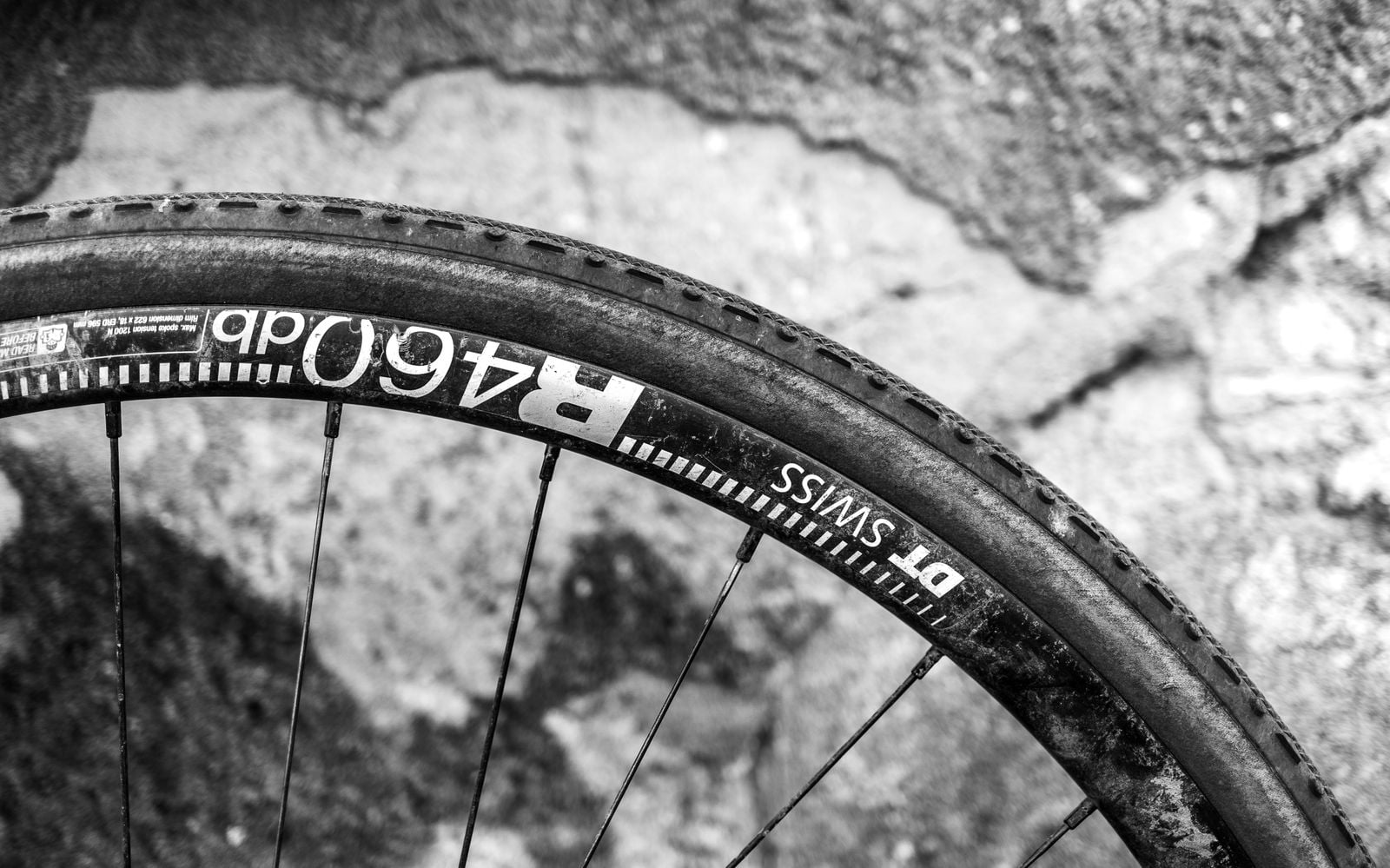
Johnnie Dunlop was pedalling his tricycle across the granite setts of a Belfast yard when he told his father the ride was giving him headaches. The father was a veterinary surgeon from Dreghorn in Ayrshire, running a busy practice in Belfast, and he did not dismiss the complaint. That evening, John Boyd Dunlop began cutting strips of rubber sheet in his garden shed and gluing them into a crude tube that could hold air.
By the following spring, that tube — inflated with a football pump, wrapped around a wooden disc, and tacked to the tricycle’s rear wheels — was rolling silently on the same cobbles that had rattled his son’s skull the year before.
A boy, a tricycle, and a headache
The story of the pneumatic tyre begins not in a laboratory but in a father listening to a child. Johnnie Dunlop was small for his age and prone to complaint, and the tricycle he had been given ran on solid rubber tyres bonded to iron rims — the standard fitting of the 1880s. Belfast’s streets were paved with dressed granite blocks, laid in tight rows with hard mortar joints. A solid-tyred wheel bouncing across those joints delivers a shock straight up the frame, into the seat, and through the spine to the base of the skull.
Vibration carried through a hard support surface — a saddle, a seat, a rigid frame — is tiring and uncomfortable, and enough of it can leave a rider rattled and sore. Adults who spend hours on unsprung vehicles over rough ground have always complained of aching backs and jarred joints. A nine-year-old on a rigid tricycle across Belfast granite was, in miniature, subjecting himself to the same punishment.
The family doctor had suggested cycling as gentle exercise. The cycling was making the child ill.
The night in the garden
Dunlop’s own account describes the improvisation in plain terms. He took a length of sheet rubber, folded it into a tube, sealed the seam with liquid rubber solution, fitted a non-return valve made from a scrap of leather, and inflated it. He wrapped this tube around a wooden disc roughly the diameter of the tricycle wheel, held it in place with linen tape, and tacked the whole assembly to the rim.
Then he rolled it across the yard alongside a solid-tyred wheel. The pneumatic disc rolled further, faster, and made almost no sound.
The patent was filed in 1888. Dunlop was not a rubber chemist, not a mechanical engineer, not a cyclist. He was a vet who had built up one of the largest veterinary practices in Ireland, and whose only qualification for the problem was that he was the one being asked about it.
Why the mechanism worked
The physics that Dunlop stumbled into is straightforward. A solid tyre transmits the profile of the road directly to the rim: every ridge in the cobble becomes an impulse fed up the frame. A pneumatic tyre replaces that rigid coupling with a column of compressed air, which deforms locally where the wheel meets the ground and springs back once past the obstacle. The tyre absorbs the high-frequency shocks that carry the most energy to the rider’s body.
Rolling resistance drops too, because the tyre conforms to the surface rather than bouncing off it — every bounce is energy lost to the air and to heat in the wheel bearings. A pneumatic-tyred cycle on cobbles is measurably faster than a solid-tyred one on the same route, even before the rider’s comfort is considered.
Dunlop had, without knowing the term, arrived at a passive suspension that worked at the tyre-road interface rather than at the axle. Every car, motorcycle, bicycle, aircraft, and heavy-vehicle wheel built since has used the same principle.
The constraint that shaped the solution
What makes the story unusual, beyond its outcome, is the shape of the problem Dunlop was handed. He was not asked to reinvent transport. He was asked, in effect, to stop his son getting headaches. The brief was small, domestic, and specific — and it is exactly the sort of narrowly framed problem that produces inventive responses.
Innovators who deliberately add their own constraints to a presented problem often produce solutions that work precisely because they’re addressing specific, tangible limits rather than abstract possibilities.
Dunlop’s added constraints were mundane. The tyre had to fit a specific tricycle in his yard. It had to be buildable with materials on his workbench: sheet rubber, solution, tacks, canvas. It had to work on Belfast granite. And it had to eliminate his son’s headaches, not merely reduce them. That last constraint — the child’s testimony as the pass/fail criterion — was uncompromising.
From yard to racetrack
The tricycle experiment convinced Dunlop the idea would scale. He had a Belfast cycle-maker, Edlin and Company, build a bicycle fitted with the new tyres. The rider was Willie Hume, captain of the Belfast Cruisers Cycling Club — not a celebrated champion, and by contemporary accounts an ordinary club racer. On 18 May 1889, at the Queen’s College Sports in Belfast, Hume rode on Dunlop’s tyres and won all four races he entered.
Weeks later at a Liverpool meeting, Hume did it again against a stronger English field, taking all but one of the events he rode. The racing community, which had dismissed the tyres as ridiculous fat sausages, went silent, then went shopping. Within a couple of seasons, solid tyres were disappearing from the winners’ enclosures across Britain.
The Pneumatic Tyre and Booth’s Cycle Agency was incorporated in Dublin in 1889, with Dunlop taking shares in the new company. The business would grow into the Dunlop Rubber Company, and — after a century of mergers, splits and acquisitions — its name still runs across tyres on assembly lines from Birmingham to Hanau to Nagoya.
The patent that wasn’t
Dunlop’s patent turned out to be worthless. In 1890, two years after he filed, an earlier patent came to light: it had been granted to a Scottish civil engineer named Robert William Thomson. Thomson had described hollow India-rubber tubes filled with air for horse-drawn carriages more than four decades before Dunlop’s tricycle experiment. He had even built and tested them successfully on a brougham carriage in Regent’s Park in London.
The idea had simply died. There were no bicycles worth fitting them to in the 1840s, no mass market for personal wheeled transport, no cycling clubs whose members would pay for a comfortable ride. Thomson moved on to steam traction engines. His patent lapsed. His aerial wheel was forgotten by everyone except, eventually, the lawyers who used it to invalidate Dunlop’s claim in 1890.
Dunlop lost the patent but kept the company. The market was already his: by the time Thomson’s prior art surfaced, thousands of cyclists across the British Isles were riding on pneumatic tyres, and the Dunlop name was on almost all of them.
The child at the centre
What is easy to lose, in the industrial history, is Johnnie. He was the reason. His headaches, and his willingness to keep telling his father about them, are woven into the reason a global rubber industry took the shape it did. Adults often respond to a child’s distress rather than to the actual severity of the injury — and children whose complaints are taken seriously tend to keep voicing them, while those who are brushed off learn to stay quiet.
Dunlop heard the signal. He treated a nine-year-old’s headache as information rather than complaint. The tricycle in the yard became a test rig, the cobbles a controlled surface, the rubber tube a fix that also happened to be one of the most consequential engineering improvisations of the nineteenth century.
What the tyre carried forward
By 1895, pneumatic tyres had migrated from bicycles onto the earliest motor cars. André and Édouard Michelin fitted them to a Peugeot for the Paris-Bordeaux-Paris race that year — the tyres punctured constantly, but the principle was established. The Wright brothers built their first aircraft in the back of their bicycle shop, the Wright Cycle Company, borrowing spokes, chains and wheel-building know-how from the trade. By 1908, the first Model T cars were rolling out of Ford’s Piquette Avenue plant in Detroit on four pneumatic tyres apiece.
The direct line runs from a Belfast garden shed in the 1880s to every set of wheels currently in motion on the planet. Silicon Canals has written before about the strange density of nineteenth-century backyard invention — the way Clyde Cessna taught himself to fly on the plains by crashing again and again because no one nearby could show him how, and how Greek sponge divers hauled up a 2,000-year-old geared computer off Antikythera and had no framework to understand what they were holding. The Dunlop tyre belongs to that same category: a solution that arrived because someone amateur enough to try it was also determined enough to finish.
What survives
Dunlop sold out of the tyre business in the mid-1890s for a sum that left him comfortable but not spectacularly wealthy. He settled in Dublin, kept an interest in a local drapery, and died there in October 1921.
His first pneumatic tyre survives. Dunlop donated it himself, in 1910, to what is now the National Museum of Scotland in Edinburgh, where it is still held — an inflated tube of sheet rubber fixed to a wooden disc, the workshop object from which a global industry grew. It is smaller and plainer than the scale of what followed would suggest: a hand-built thing of rubber, tape and tacks, made one evening in a Belfast yard so that a nine-year-old boy could ride to school without his head aching.
