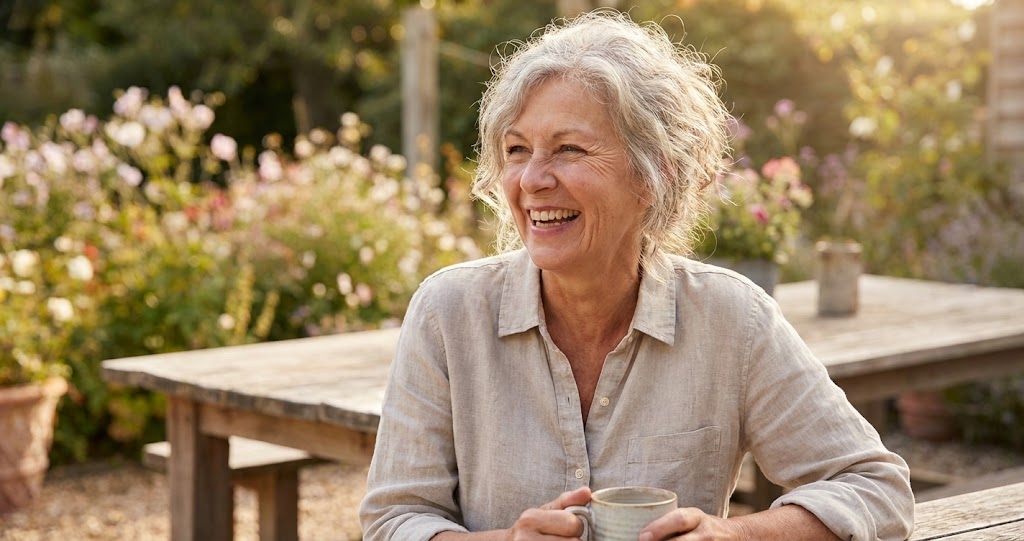
Ask a room of thirty-year-olds to describe a happy old age and the answers arrive as a shopping list. Paid-off house. Working knees. Grandchildren who visit without being bribed.
The research points somewhere less purchasable. People who report high wellbeing in their seventies are not reliably the ones who drew the easier hand. A great many of them are the ones who got very good, somewhere along the way, at wanting what they already had.
Which reads like a fridge magnet. The evidence underneath it is stranger than the slogan, and considerably less tidy.
The trouble with getting what you wanted
Happiness researchers have spent fifty years documenting a nuisance: good things stop feeling good. The pay rise becomes the salary. The new flat becomes the flat. Economists call this the hedonic treadmill, and the engine driving it is appetite, which climbs at roughly the speed of income.
A study of rural households in China put numbers on the idea, finding that aspiration income rises alongside actual income, and that while real money lifted wellbeing, rising aspirations dragged it back down. One country. One sample. And even then, the authors called the treadmill effect partial. The shape will still be familiar to anyone who has ever upgraded anything.
Even the field’s own giants have wobbled here. Daniel Kahneman spent years attached to a version of this idea before publicly giving it up when the data stopped cooperating. Happiness research is not settled science, and treating it as settled is how self-development gets silly.
Something happens to appetite when the runway shortens
Laura Carstensen’s socioemotional selectivity theory offers a mechanism. The argument, built across three decades, is that people quietly track how much time they have left, and that this arithmetic reorganises what they want. When the horizon looks long, the pull is towards acquiring: skills, contacts, options, all the things that pay off later. When it shortens, priorities swing towards emotional payoff now.
Older adults also tend to show what researchers call the positivity effect, a measurable tilt towards processing positive information over negative. Same world, different filter.
The theory has taken hits. During the pandemic, a team including Carstensen herself tested it against roughly 1,100 people across every age group. A shortened sense of future time predicted worse emotional wellbeing, the opposite of what the theory expected. It was one study, under conditions nobody would call typical, but it’s a useful corrective. Shrinking horizons do not hand out serenity automatically. Something has to be learned first.
Gratitude, minus the marketing
Every wellness app has a version of this pitch: write down what you’re grateful for and watch the wanting quiet down. In 2003, Robert Emmons and Michael McCullough tested it directly, running three experiments on counting blessings, randomly assigning people to log gratitudes, hassles or neutral events. The gratitude groups came out ahead on several measures, though not all of them. Positive affect was the most robust gain.
Then the field kept testing. A 2021 meta-analysis pooling 27 trials and 3,675 participants found effects on depression and anxiety that were modest at best, and larger against waitlist controls than against genuine alternative activities. The authors’ advice was blunt: anyone dealing with clinical symptoms should use something with stronger evidence behind it.
So the journal is no substitute for treatment. It looks more like a rehearsal, a repeated exercise in noticing whatever is already in the room. That’s a smaller claim than the wellness industry makes, but it’s the one the evidence actually backs.
What nearly ninety years of data keeps pointing at
The Harvard Study of Adult Development has been following the same families since 1938, starting with 724 men and growing to around 2,500 as spouses and descendants joined. Its director, Robert Waldinger, has spent years telling anyone who asks that relationship quality predicts, more reliably than money does, how well people age in body and in brain.
Caveats are real here. The original cohort was entirely male and entirely American, and the study watches rather than intervenes, so it shows what travels together without proving what causes what.
Look at the shape of the finding, though. Relationships cannot be acquired late and installed like a stairlift. They are whatever was already there, maintained or neglected across forty years of ordinary Tuesdays.
What this looks like on a Tuesday
None of this means ambition is a mistake, or that contentment can be summoned on request. Wanting less is not a switch anyone gets to flip.
The practical version is smaller than that. Notice when an upgrade has quietly become the new baseline. Ask which of this week’s wants were actually chosen and which were absorbed from whoever happens to be standing nearby. Spend the free hours on people already in the address book rather than the ones who might be in it later.
It doesn’t require a shortened horizon to work, either. All of it is available at thirty-five, which is the genuinely encouraging part.