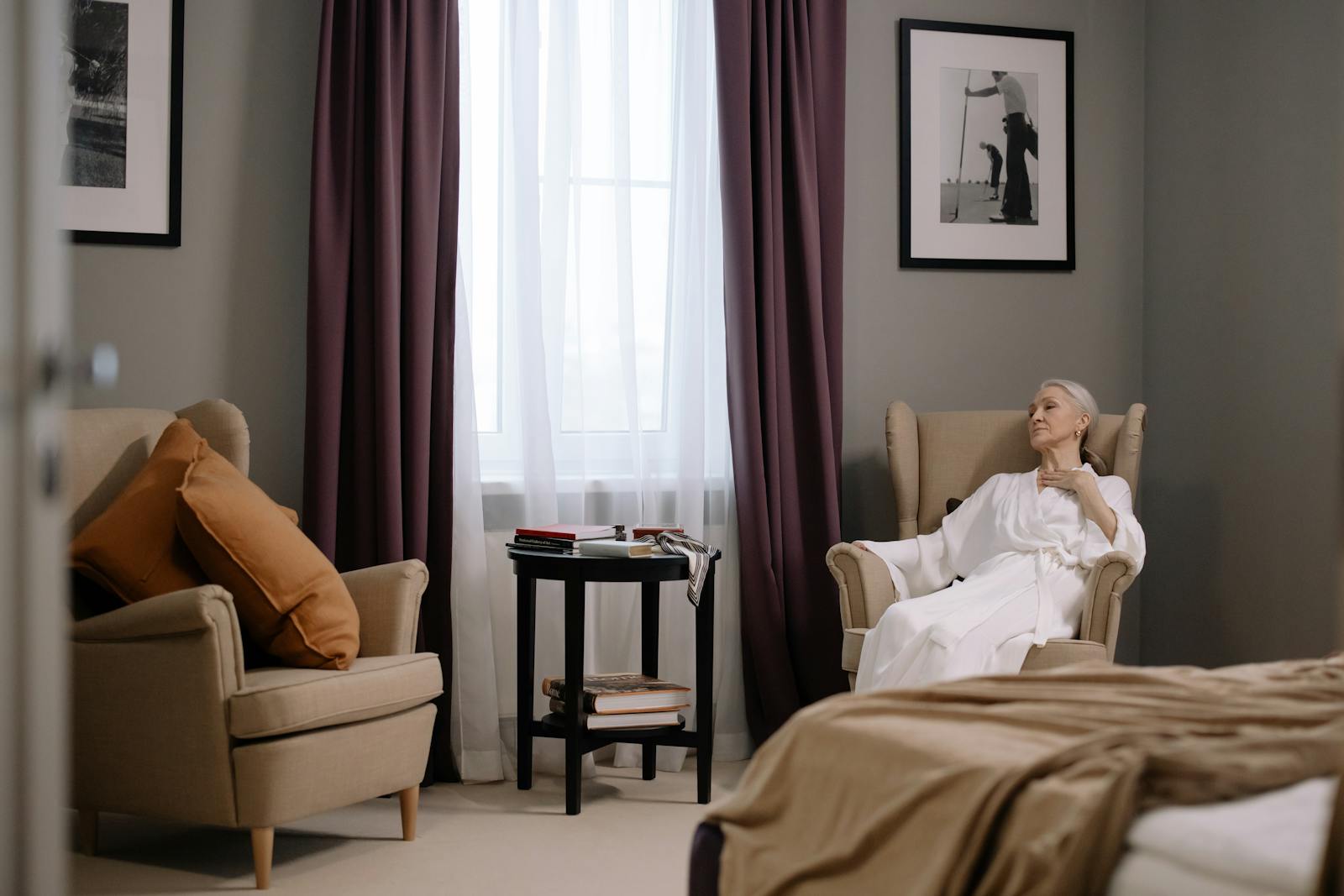
You’ve seen this person. Maybe in a meeting where everything is falling apart — the deadline moved up, the budget slashed, two people pointing fingers. Everyone’s pulse is climbing. And then there’s someone sitting quietly, not checked out, not indifferent, but steady. Almost unnervingly steady.
You might assume they just don’t care. Or that they’re naturally wired for calm. But if you ask them — really ask — you’ll almost always hear a story. A season of life that broke something open and rearranged the wiring. Not because they read a book about stoicism, but because they lived through something that taught their nervous system a brutal, clarifying lesson: panic changes nothing.

The neuroscience of learned calm
Here’s what’s actually happening in the brain of someone who’s survived genuine crisis: their prefrontal cortex — the part responsible for decision-making, impulse control, and long-term thinking — has been trained under fire. Repeated exposure to high-stress situations doesn’t just “toughen you up” in some vague motivational-poster way. It literally reshapes neural pathways.
Research from the University of Wisconsin-Madison found that individuals who had experienced moderate adversity showed better emotional regulation and higher life satisfaction than those who had experienced either no adversity or extreme adversity. There’s a sweet spot — what psychologists call the “steeling effect” — where challenge builds psychological resilience rather than destroying it.
The amygdala, your brain’s alarm system, still fires. The calm person in the room isn’t immune to fear. But their brain has learned, through lived experience, to route the signal differently. Instead of hijacking the whole system, the alarm rings — and then something else happens. A pause. A breath. A quiet internal voice that says: I’ve been somewhere worse than this. I’m still here.
What panic actually costs you
Let’s be specific about what panic does to the body. Cortisol surges. Blood flow redirects away from the brain’s higher functions toward the muscles — useful if you’re being chased by something with teeth, catastrophic if you need to think clearly about a financial decision, a medical diagnosis, or a relationship conflict.
Your working memory shrinks. Your perception narrows. You start seeing threats everywhere and opportunities nowhere. This is what Daniel Kahneman called System 1 thinking on overdrive — fast, reactive, and often wrong.
The calm person isn’t suppressing emotion. They’ve just learned, through painful repetition, that the panic response eats the very resources they need to survive. It’s not philosophy. It’s pattern recognition. The body remembers: last time I panicked, I made things worse. Last time I breathed and waited, I found the exit.
The stories behind the stillness
I’ve talked to enough people to know the pattern. The woman who’s unflappable during a company restructuring? She nursed her mother through two years of cancer. The man who stays measured when his startup nearly folds? He grew up in a household where money disappeared overnight, more than once.
These aren’t people who were born calm. They were forged by circumstances that gave them no choice but to find calm — or collapse. And the finding wasn’t graceful. It involved falling apart first. Multiple times, usually. The composure you see now is the scar tissue of old emergencies.
A study published in the Journal of Personality and Social Psychology confirmed what many of us sense intuitively: people who have weathered significant life challenges report greater resilience, are less reactive to new stressors, and show higher levels of what researchers call “post-traumatic growth.” Growth that doesn’t erase the original wound, but builds something functional on top of it.
Why this matters more as you age
Here’s where this gets personal and practical. As we age, stress doesn’t diminish — it shape-shifts. Career pressures may ease, but health anxieties arrive. Relationships deepen but also carry more weight. Loss becomes a regular visitor instead of a rare one.
The ability to stay calm under pressure isn’t just an admirable personality trait. It’s a measurable predictor of cognitive health. Chronic stress and unchecked cortisol are linked to hippocampal shrinkage — that’s your memory center literally deteriorating. The people who age sharpest aren’t the ones who avoided stress. They’re the ones who learned to metabolize it.
This is something we’ve explored before — the way certain daily behaviors quietly protect the brain while others accelerate decline. Learning to regulate your stress response is one of the most powerful things you can do for long-term mental clarity.

Building calm before crisis forces your hand
Not everyone needs to survive a catastrophe to develop this skill. That’s the good news. The nervous system is trainable. You can build the infrastructure of calm before life demands it.
Practice micro-exposures to discomfort
Cold showers, hard conversations, public speaking, sitting with uncertainty instead of immediately Googling the answer. These small acts teach the amygdala that discomfort isn’t danger. Over time, your baseline shifts. The threshold for panic rises.
Develop a “pause protocol”
The calm person in the room almost always has a tiny ritual — a breath, a phrase, a physical cue — that interrupts the reactive cascade. Navy SEALs use box breathing (four counts in, four held, four out, four held). Therapists teach grounding techniques. The method matters less than the consistency. You need a practiced pause, not a theoretical one.
Reframe your relationship with difficulty
This is subtle but essential. When something hard happens, the panicking mind says: This shouldn’t be happening. The calm mind says: This is happening. What do I do next? That single shift — from resistance to engagement — is the difference between being swallowed by a situation and moving through it. Research by Carol Dweck and her colleagues on growth mindsets confirms that how we frame challenges fundamentally changes our physiological stress response, not just our attitude.
Invest in physical resilience
The body and mind are not separate systems when it comes to stress regulation. Regular movement — especially cardiovascular exercise — directly improves the brain’s ability to manage cortisol. Sleep quality matters enormously. So does nutrition. The calm person often has a body that supports calm, not by accident, but by design.
Calm is not indifference
I want to be clear about something, because this gets misunderstood. The calmest person in the room is often the one who cares the most. They’re not detached. They’re not numb. They’ve simply learned that their caring is more useful when it’s channeled through a steady hand rather than a shaking one.
Indifference looks like calm from the outside, but it’s hollow. Real calm has weight to it. You can feel the difference when you’re around it — there’s a groundedness, a presence that comes from someone who has already met the worst version of a situation in their own life and decided to keep showing up anyway.
The Stoics had a word for this: ataraxia — a state of serene calmness not from the absence of problems, but from the refusal to be controlled by them. Marcus Aurelius didn’t write Meditations from a spa. He wrote it during plague, war, and betrayal. The philosophy was forged in fire, not theory.
What this teaches us about aging well
Every difficult season you survive without being destroyed by it adds a layer of capability. It’s compound interest for the nervous system. And unlike financial returns, this kind of resilience tends to increase with age — if you let it.
The key word is if. Because you can also go the other direction — becoming more rigid, more fearful, more reactive with each passing year. The difference lies in whether you process what happens to you or simply accumulate it. Therapy helps. Journaling helps. Honest conversation helps. Anything that moves experience from the body’s alarm system into the brain’s meaning-making system.
The calmest person in the room didn’t start that way. They were once the most panicked, the most overwhelmed, the most certain the sky was falling. And then they watched the sky not fall. Or they watched it fall and survived anyway. And something in them shifted — permanently, structurally, down to the neurons.
That shift is available to all of us. Not by avoiding difficulty, but by walking through it with the willingness to learn the one thing it keeps trying to teach: panic changes nothing. Presence changes everything.
Feature image by cottonbro studio on Pexels