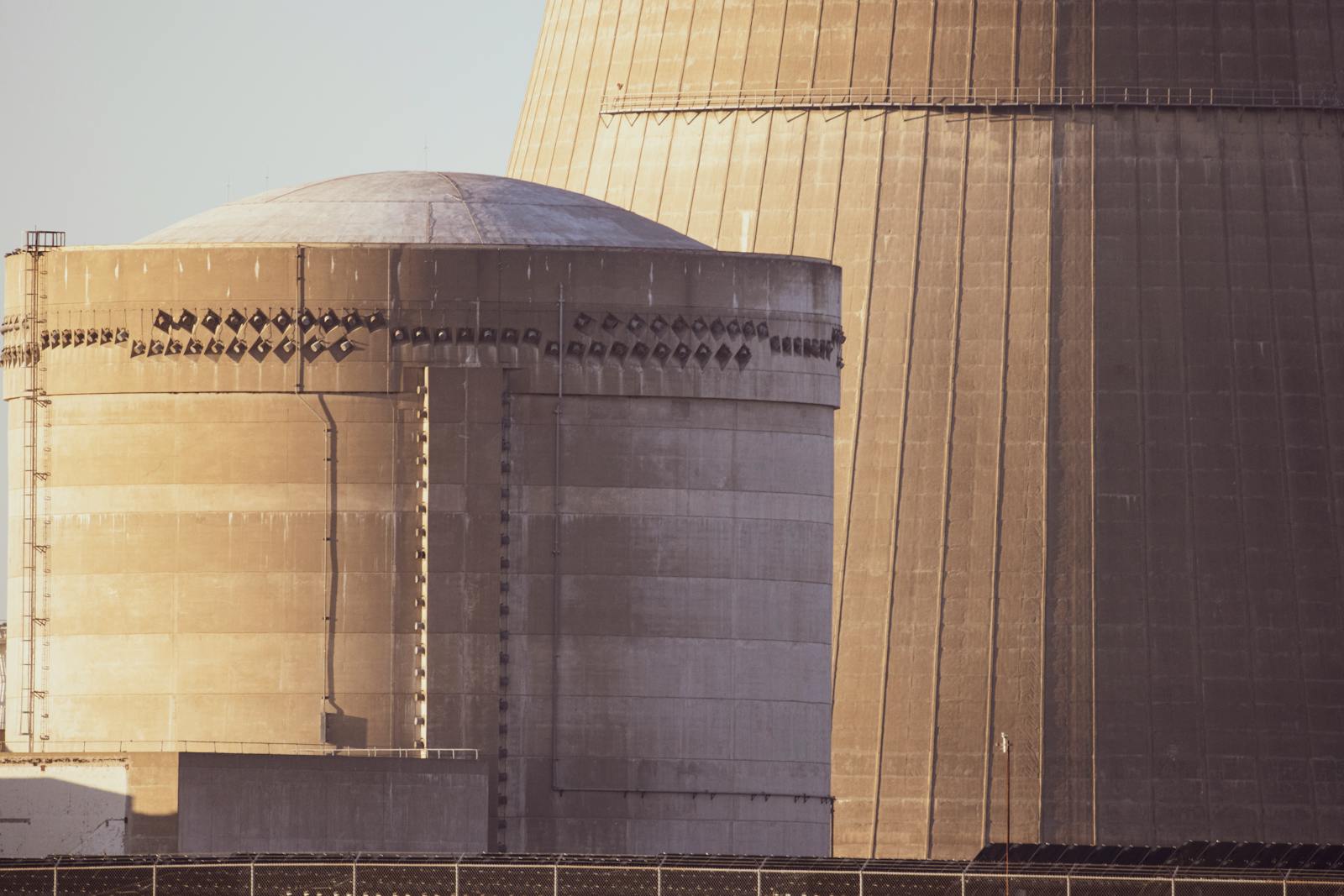
The US Nuclear Regulatory Commission has reportedly issued its first construction approval in nearly a decade, granting TerraPower permission to begin building a sodium-cooled nuclear reactor in Kemmerer, Wyoming. The decision marks a turning point for advanced nuclear energy in the United States and a concrete test of whether next-generation reactor designs can move from whiteboard to grid at the speed the global energy transition demands.
The Natrium reactor, developed jointly by Bill Gates-backed TerraPower and GE Hitachi, is being built as part of the Department of Energy’s Advanced Reactor Demonstration Program. It represents something genuinely new: a reactor designed from the ground up to complement renewable energy rather than compete with it.

A different kind of reactor
Most operating nuclear plants worldwide use pressurised water as a coolant, typically generating around one gigawatt of electricity. The Natrium design departs from that model in several important ways. It uses liquid sodium instead of high-pressure steam for cooling, which allows the system to operate at atmospheric pressure and avoids the engineering challenges associated with containing superheated water.
The reactor itself is designed to produce 345 megawatts of baseload power. But the plant also incorporates a salt-based energy storage system reportedly capable of temporarily boosting output to 500 MW. That storage layer is the critical differentiator: it allows the facility to ramp power up and down in response to fluctuations in wind and solar generation, functioning less like a traditional always-on nuclear plant and more like a dispatchable complement to variable renewables.
For energy systems planners, this flexibility addresses one of the persistent structural problems with decarbonising grids. Renewables are increasingly cost-competitive for generation, but the intermittency gap requires either massive battery storage, gas peaker plants, or something else entirely. Natrium is positioned as that something else.
The regulatory milestone — and what it actually means
The NRC reportedly completed its evaluation nearly 10 months ahead of its initial prediction, a pace partly enabled by the ADVANCE Act passed in 2024 to streamline approval of nuclear projects and promote new reactor designs. TerraPower selected the Kemmerer site in 2021 and submitted its construction application in 2024.
Construction approval, however, is distinct from operational approval. TerraPower will need a separate licence from the NRC before the plant can begin generating power. With a projected completion date of 2030, that operational review will likely extend into the next US presidential administration — introducing a layer of political uncertainty that has historically complicated long-cycle energy infrastructure projects.
This is the institutional reality of advanced nuclear: the technology may work, but the regulatory and political timelines operate on fundamentally different clocks than the market demand they aim to serve.
The datacenter question
The timing matters because the single largest new source of electricity demand in the United States is data infrastructure. Hyperscale cloud providers and AI training facilities are driving unprecedented power requirements, and several major technology companies have publicly explored nuclear energy as a path to reliable, carbon-free baseload power.
A 2030 completion date — which, for a first-of-its-kind reactor, is optimistic — means Natrium arrives after the most acute phase of the current datacenter buildout. The structural incentive for technology companies is to secure power now, which explains the parallel surge in natural gas procurement and the extension of existing nuclear plant lifetimes, even as next-generation designs work through their approval timelines.
The question is whether Natrium can demonstrate the model fast enough to be replicated. If it can, subsequent units would benefit from established supply chains and regulatory precedent. If it encounters the delays typical of first-of-a-kind nuclear projects, the window for advanced nuclear to capture datacenter demand may narrow considerably.

Sodium cooling: proven concept, limited track record
Liquid sodium cooling is not new in principle. Relatively few significant reactors globally have been built using sodium cooling, and the US hasn’t constructed one in decades. The global experience base is thin, concentrated primarily in Russia, France, Japan, and India.
Sodium offers genuine thermodynamic advantages: it conducts heat far more efficiently than water, doesn’t need to be pressurised, and allows for a more compact reactor design. The tradeoff is that sodium reacts vigorously with both water and air, requiring careful containment engineering. Past sodium-cooled reactors, including France’s Superphénix and Japan’s Monju, experienced operational difficulties related to sodium leaks — problems that contributed to the technology’s marginalisation in favour of water-cooled designs.
TerraPower’s design attempts to address these historical issues with modern materials and containment systems, but it remains a first-of-its-kind commercial implementation. The gap between laboratory validation and commercial operation at scale is where most advanced energy technologies encounter their most consequential challenges.
The economics underneath
The Natrium project sits at the intersection of several converging economic forces. Federal support through the Advanced Reactor Demonstration Program provides cost-sharing that de-risks early construction. The ADVANCE Act signals bipartisan legislative intent to accelerate nuclear deployment. And the private sector — in this case, Gates’ investment vehicle — provides patient capital that traditional utility financing structures rarely offer for unproven technologies.
What the Kemmerer project will reveal, over the next four years, is whether this combination of public subsidy, regulatory reform, and private capital is sufficient to overcome the cost overruns and schedule delays that have plagued nuclear construction globally. The structural incentive for the entire advanced nuclear sector is to demonstrate that small, modular, and flexible designs can avoid the multi-billion-dollar cost escalations that made large conventional reactors financially unviable in competitive electricity markets.
For the communities involved — Kemmerer is a former coal town — the project also represents a test of the energy transition’s distributional politics. The site was chosen partly because it offered existing transmission infrastructure and a workforce familiar with energy operations, a model that other coal-dependent regions worldwide are watching closely.
What comes next
TerraPower now enters the most difficult phase: translating regulatory approval into physical construction on schedule and on budget. The NRC’s ahead-of-schedule review is encouraging, but the harder test is whether the supply chain for sodium-cooled reactor components — dormant in the US for decades — can be rebuilt at the pace the project demands.
If Natrium works as designed, it offers a template for integrating nuclear energy into renewable-heavy grids globally. If it stumbles, it will reinforce the scepticism that has kept advanced nuclear in the demonstration phase for a generation. Either outcome will reshape the energy policy landscape well beyond Wyoming.
Feature image by Sean P. Twomey on Pexels