

Correction, 16 September 2026: Berlin’s heritage authority says the unfinished Nazi military-college shell was demolished before its remains were covered with roughly 25 million cubic metres of rubble. The original article said demolition had failed and the shell remained intact.
Rising out of the Grunewald forest on the western edge of Berlin is a 120-meter hill crowned with torn white domes, like golf balls left behind by giants. The hill is called Teufelsberg, Devil’s Mountain, and it appears on no geological map of the region for a simple reason: it is not geology. It is Berlin, the old one, piled up and buried, with three separate empires’ worth of history stacked inside it like sediment.
Layer one: the college that would not die
At the bottom of the hill sits a building. In 1937, Albert Speer’s plans for rebuilding Berlin as Germania, the monumental capital of the Thousand-Year Reich, included a Wehrtechnische Fakultät, a military-technical college, on the city’s western edge, and construction began on a ferocious scale. The war it was meant to serve interrupted it; the shell stood unfinished through the bombing, and after 1945 the Allies decided to erase it along with the rest of the Reich’s military architecture.
They did demolish it. Berlin’s heritage authority says the unfinished shell was blown up after the war and its remaining ruins were then used as the base of a rubble hill.
Layer two: the city itself
From 1950 into the early 1970s, trucks deposited about 25 million cubic metres of rubble, according to Berlin’s official account. The landscaped hill later supported recreation.
By the early 1970s the landscaped rubble hill stood above the demolished building’s remains; the shell is not intact underneath it.
Layer three: the ears
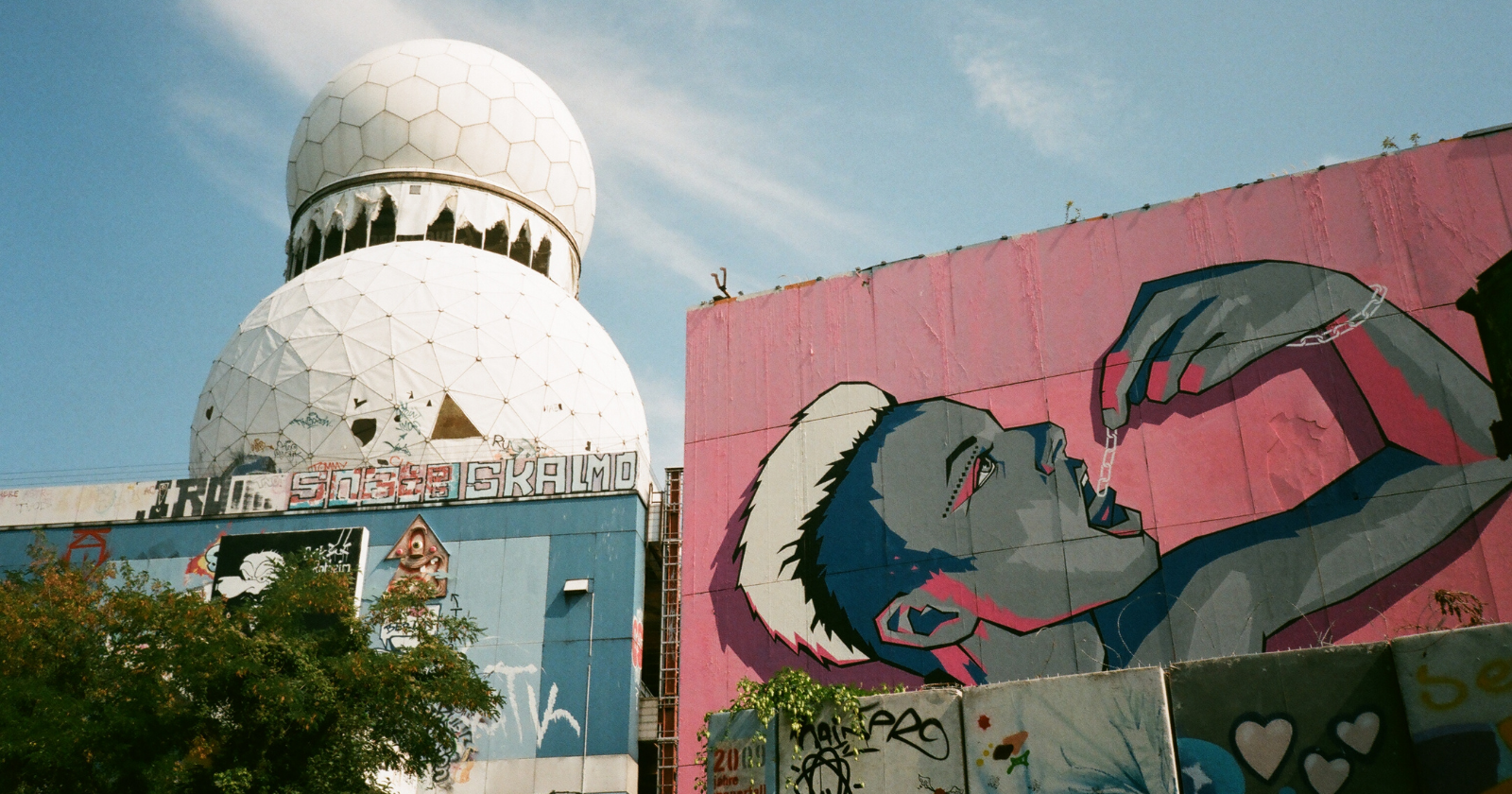
The Americans noticed something about the new mountain before the grass had fully taken. West Berlin sat 160 kilometers inside the Eastern Bloc, a listening post fate had positioned in the enemy’s living room, and height is everything in radio interception. Mobile U.S. units testing sites around the city in the late 1950s found reception on the rubble summit superb, and in the early 1960s the U.S. Army Security Agency, working with the NSA and Britain’s signals services, built a permanent installation on top: Field Station Berlin, its antennas sheathed in the white geodesic radomes that give the hill its silhouette.
For three decades, the station listened around the clock, eavesdropping on Soviet and East German military radio, telemetry and communications from deep behind the Iron Curtain, one of the most valuable intercept sites of the entire Cold War and, reportedly, a contributor to the ECHELON network. A few kilometers east, the Soviets and East Germans listened back from their own towers. The mountain built from the ruins of one war spent the next one wiretapping, its foundations a Nazi ruin, its summit an American ear, its mass the pulverized homes of Berliners in between.
Then the enemy dissolved. With the Wall down and the Soviet Union following it, the station lost its purpose; operations wound down and by 1992 the Americans had stripped their equipment and gone, leaving the radomes empty on the summit.
Layer four: the paint
What followed was three decades of very Berlin limbo. The city sold the site in the 1990s to investors whose plans, hotels, apartments, a spy museum, all collapsed; David Lynch turned up at one point proposing a meditation university; vandals and weather shredded the radome skins; and the fenced, rotting station became a magnet for urban explorers. Eventually the caretakers stopped fighting the inevitable and licensed it: today Teufelsberg operates as a gallery and event site billed as one of the largest street-art spaces in Europe, its towers and halls layered in graffiti, its main radome famous for an echo that turns a hand-clap into a thunderstorm, with tours climbing past murals to the platform where the antennas stood.
The site still compresses several layers of twentieth-century history: an unfinished Nazi project, postwar rubble, a Cold War listening station and today’s street art. The earlier claim that Allied demolition failed was incorrect.
