

Correction, 16 September 2026: The original headline and opening treated the Kaweah Colony’s disputed land claims as settled ownership. The claims were never perfected; the Karl Marx tree name and the colony’s broader history remain.
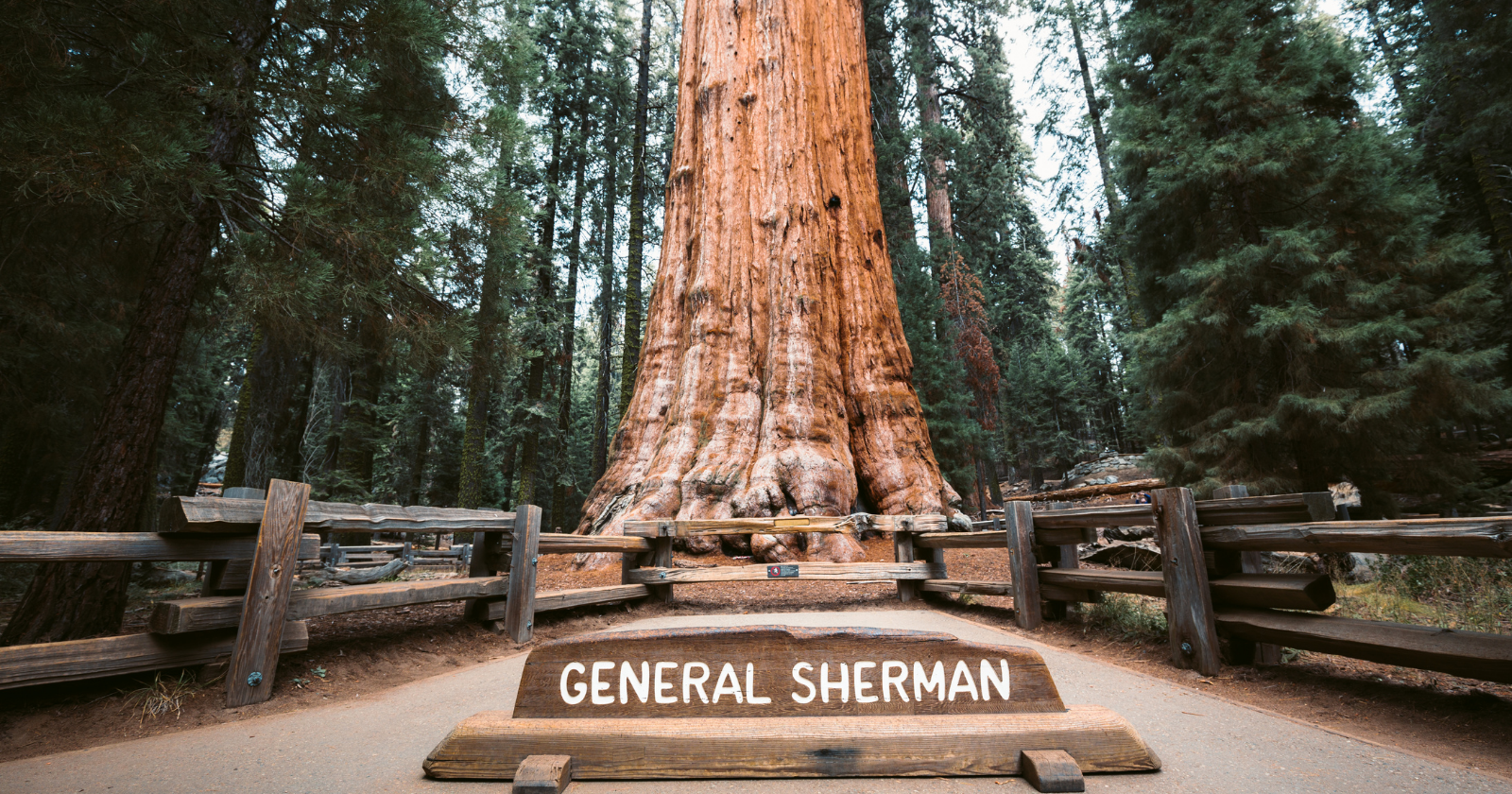
Two million people a year walk the paved path in Sequoia National Park to stand before the General Sherman Tree. The National Park Service notes that members of the Kaweah Colony called it the Karl Marx Tree before the park was created; their land claims were disputed and never perfected.
Fifty-seven socialists and a forest
In 1886, a San Francisco labor organizer named Burnette Haskell led several dozen socialists and trade unionists into the high Sierra of central California. Inspired by Laurence Gronlund’s book The Co-operative Commonwealth, they had formed the Kaweah Colony, a utopian experiment in collective ownership, and they had found the perfect economic engine for it: the Giant Forest, a plateau of colossal sequoias then open to settlement under federal timber law. The colonists filed land claims in coordinated batches, planned a cooperative logging operation, and began the brutal work their whole scheme depended on, hand-cutting an eighteen-mile road up the mountainside to reach their trees.
They paid in time-checks instead of wages, ran a colony town with a school and an orchestra, and printed their own newspaper. And like any settlers, they named things. The greatest tree in their forest, and they understood it was the greatest, was an obvious honor to bestow, and the man they most revered was not a general.
The tree already had a name, as it happened. The official story holds that in 1879 a stockman and former cavalry lieutenant named James Wolverton had christened the giant after William Tecumseh Sherman, the commander he had served under. To the Kaweah colonists that name was not merely uninspiring but objectionable: Sherman had followed his march through Georgia by directing the Army’s campaigns in the Indian Wars, the destruction and forced relocation of the Plains tribes, and the colonists cited exactly that record in setting the general’s name aside. The largest tree on Earth became the Karl Marx Tree, and there is a surviving photograph of the colonists, more than two dozen of them, standing shoulder to shoulder across the width of its trunk.
Four years, one road, and an act of Congress
The colony’s timing was catastrophic. While the Kaweah settlers were still building their road, the movement to protect the sequoias from logging, backed by conservationists and, less romantically, by the Southern Pacific Railroad, which had its own reasons for wanting these particular claims extinguished, reached Washington. In September 1890, Congress created Sequoia National Park, the country’s second national park, and the boundaries fell directly across the colony’s land. The colonists’ claims, which the land office had suspiciously never finalized, were voided; trustees were briefly prosecuted for cutting timber they believed was theirs; and by 1892 the Kaweah Colony had dissolved, its members scattered, largely uncompensated.
The road the colonists built later served early access to the Giant Forest. Their unperfected claims were rejected after the park’s creation, and the colony dissolved; describing that complex dispute as government simply taking property was too categorical.
What survives of Kaweah
The colony left little on the ground: one schoolteacher’s cabin, still standing in the park, the old road, and a tiny community called Kaweah down the valley where a few descendants remained. Historians still argue over the experiment, whether it was doomed idealism, a legitimate enterprise destroyed by railroad lobbying dressed as conservation, or both at once; Jay O’Connell, the colony’s foremost historian, called the park the incidental beneficiary of the colony’s destruction. What no one disputes is the strangeness of the outcome. The sequoias were saved from the axe by the same act that dispossessed the axemen, who were, in fairness, planning to log selectively and had cut almost nothing in four years, having spent their entire collective effort on the road.
The naming, though, is the part that keeps the story alive, because it compresses the whole American nineteenth century into one trunk. A tree that predates Christianity was claimed within eleven years for a Union general by a man who fought under him, for the author of Das Kapital by a colony that read him aloud after dinner, and for the general again by the government that evicted them. The tree, indifferent, added another six rings. It is worth remembering, on the paved path, that the name on the sign is not a fact about the tree. It is the scoreboard of an argument the tree outlived, and will outlive, whichever way it is settled next.
