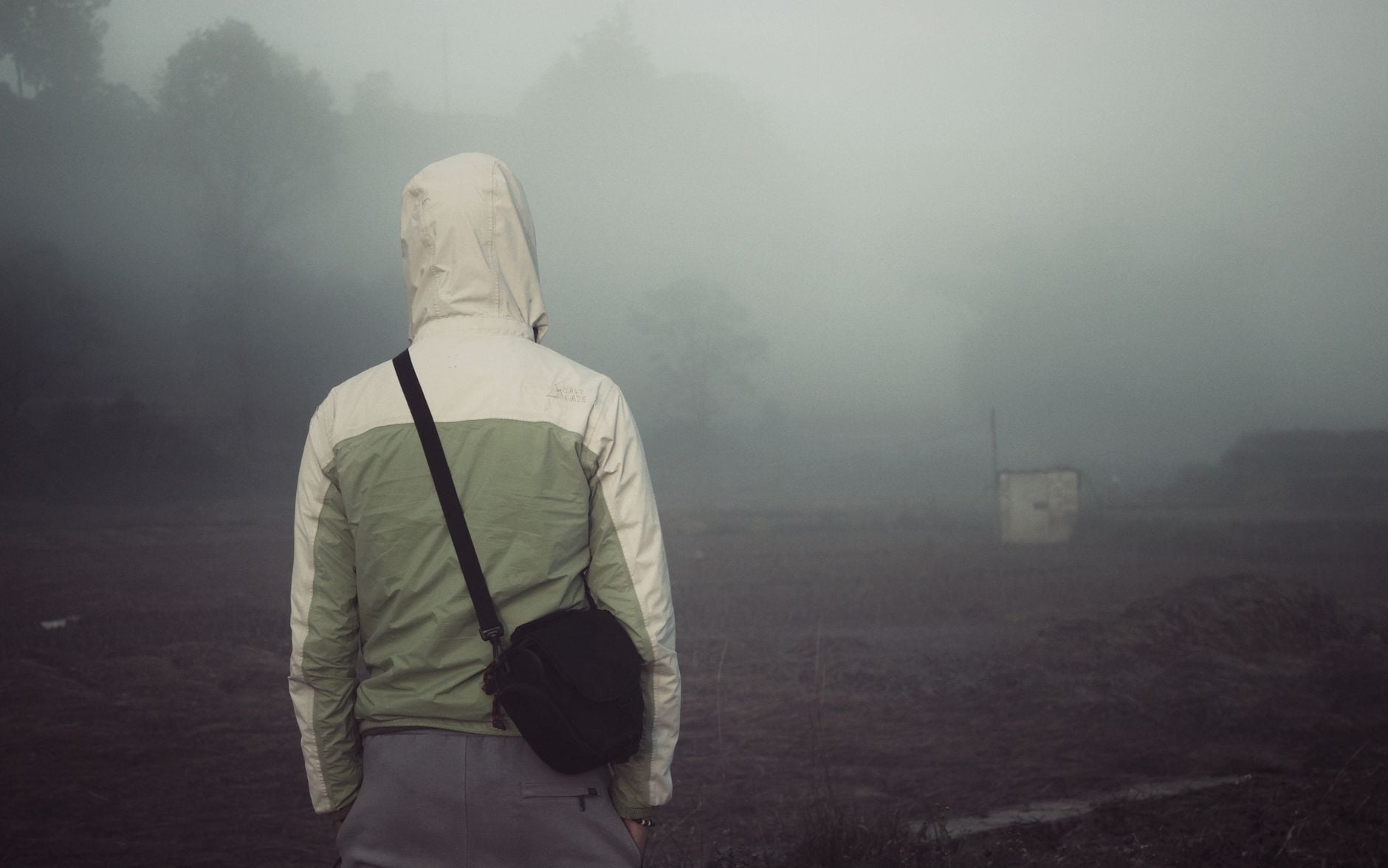
The usual advice for uncertain times is to wait for clarity and then act with courage, as though the two arrive in that order and courage is what you summon once the fog lifts. In our reading of the research, that has it almost exactly backwards. Clarity is rarely something you find before you move; it tends to follow movement. And courage, properly understood, is not a feeling you wait to have but something you do while still afraid. Both ideas are better supported than the wait-until-you-feel-ready version, and both are more useful when the future genuinely cannot be known.
Courage is not the absence of fear
Begin with courage, because most people misunderstand what it is. The popular image is of the fearless person, unbothered where others quail. The research points somewhere more human. Cynthia Pury, a psychologist at Clemson University who has spent years studying bravery, defines a courageous act as one taken voluntarily, in the face of real risk, in pursuit of a worthwhile goal. In her account, courage is not about being unafraid; it is about being frightened and moving forward anyway because something matters more, and her studies find that the perceived value of the goal, not just the size of the risk, is what makes an act register as courageous.
That second half is easy to miss and worth holding onto. Courage is not raw risk-taking, which can be mere recklessness. It is risk taken for something that counts. Which means the route to acting bravely in an uncertain moment runs less through trying to feel less afraid, a mostly futile effort, and more through getting clear on what the fear is in service of. The fear can stay. What changes is whether you have a reason worth carrying it towards.
You cannot think your way to certainty
The clarity half of the problem has its own body of research, and it explains why waiting for the fog to lift so often fails. Psychologists studying what they call intolerance of uncertainty, a line of work developed by Michel Dugas, Mark Freeston and colleagues, have found that a great deal of unproductive worry comes not from uncertain situations themselves but from our reaction to them. In experimental work, when researchers manipulated how tolerant people felt towards uncertainty, their levels of worry shifted in parallel, suggesting that it is the difficulty of sitting with not-knowing, rather than the not-knowing itself, that drives the spinning.
The practical implication is bracing. Worry often presents itself as thinking, as though enough turning-over of a problem will eventually resolve it into certainty. But when the outcome is genuinely unknowable, more thinking does not produce more clarity; it produces more worry wearing the costume of preparation. The person waiting to feel sure before they act, in conditions where sureness is not available, is waiting for something that will not come. At some point the honest move is to stop trying to eliminate the uncertainty and start learning to act inside it.
Clarity comes from values, not forecasts
If you cannot get clarity about outcomes, there is a different kind available, and it is the kind that actually helps. You may not know whether a decision will work, but you can usually know what matters to you, and that is a workable compass when the map has run out. This is where the two halves meet. Pury’s worthwhile goal is not a luxury sitting on top of courage; it is the thing that supplies direction when information cannot.
Clarity in uncertain times, then, is less about seeing the whole path and more about knowing the next right step and why you are taking it. What do I value here, what would I want to have done regardless of how it turns out, what is the smallest honest action in that direction. Those questions have answers even when will it work does not. The compass points not at the destination, which is hidden, but at the bearing, which is yours to choose.
Tolerance is built by approaching, not avoiding
The encouraging part of the uncertainty research is that tolerance for not-knowing behaves like a skill rather than a fixed trait. The treatments built on this model work largely through graded exposure to uncertainty: deliberately doing things without the reassurance of a guaranteed result, and discovering that the discomfort is survivable and usually smaller than feared. Every time you act without certainty and come through it, the intolerance loosens a little.
This is the opposite of the instinct, which is to reduce uncertainty by seeking more information, more reassurance, more delay. Past a point, those become avoidance in a respectable disguise, and they quietly train you to need certainty you can never fully get. Courage and clarity, on this evidence, are less states you wait to arrive in than habits you build by repeatedly stepping into the unknown on purpose.
The honest limits
A few cautions keep this from tipping into a slogan. None of it is an argument for acting rashly. Sometimes the uncertainty is reducible and the right move genuinely is to gather more information before deciding; the skill is telling the difference between uncertainty you can usefully lower and uncertainty you simply have to bear. Tolerance for the unknown is not indifference to it either, and courage aimed at a foolish goal is just risk.
It is also worth being plain that much of the uncertainty research grew out of studying anxiety, and while the everyday version applies broadly, persistent worry that dominates a life is a different matter with its own remedies, and no short essay substitutes for real support where it is needed. What holds for ordinary uncertain times is modest but sturdy: you can act while afraid, and you can act while unsure, and doing so is usually how the fear and the unsureness become manageable.
Where it leaves us
So the sequence most people are taught, find clarity, then find courage, then act, is close to the reverse of what the evidence suggests. More often you act on your values while still afraid and still unsure, and the clarity assembles itself behind you as you go. Courage is being scared and moving anyway towards something that matters. Clarity, in times when the future will not show itself, is knowing what that something is. Neither requires the uncertainty to end first, which is fortunate, because in uncertain times it does not.