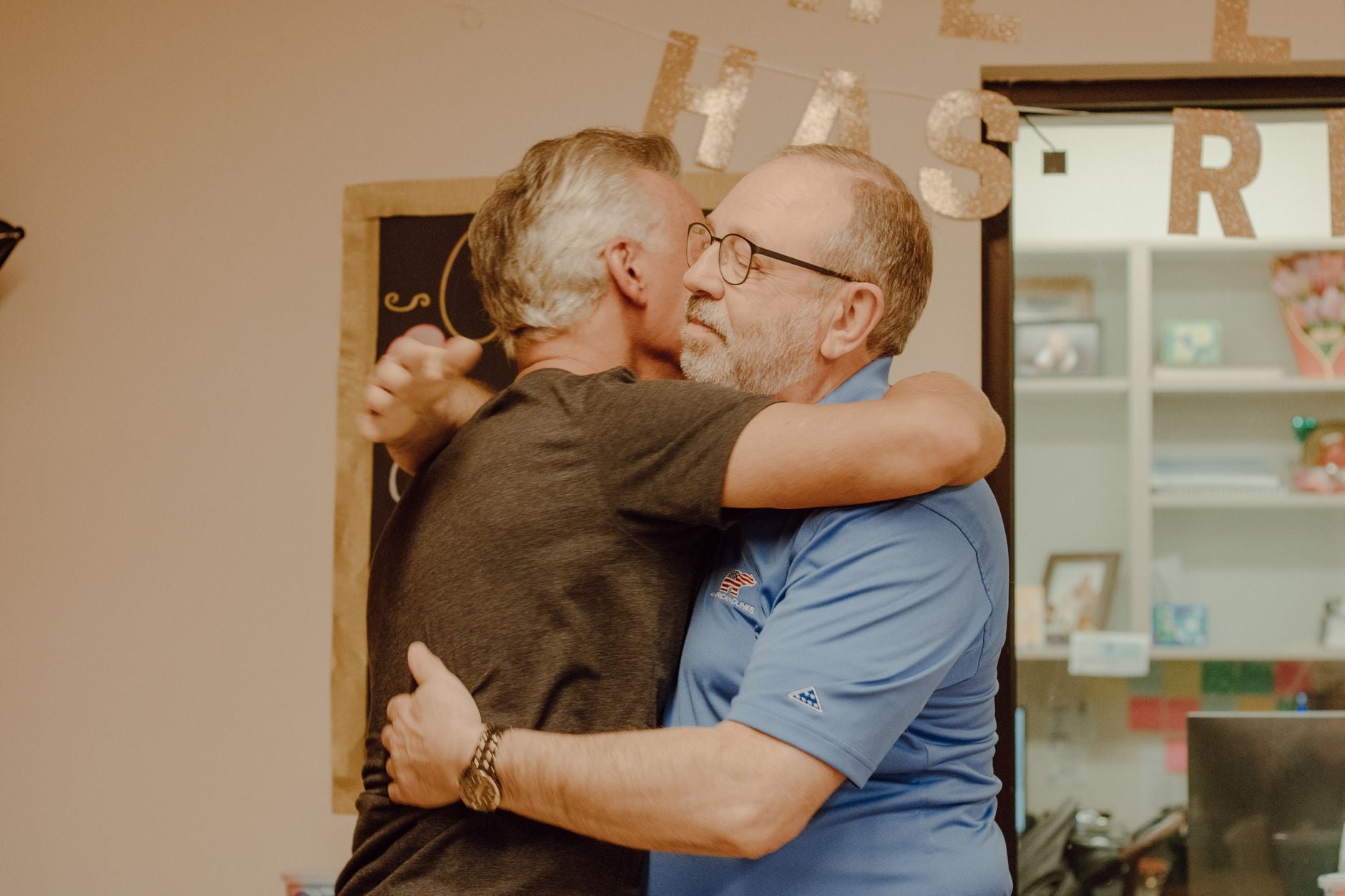
The format of the question promises a list of causes, arranged in the past, belonging to the man. It is a satisfying shape for an article and a difficult one to support, because the research that has measured physical affection most carefully has been measuring something else entirely.
It has been measuring the relationship rather than the person.
What the body-map studies measured
In 2015, Juulia Suvilehto and Lauri Nummenmaa at Aalto University, with Robin Dunbar and Riitta Hari, published a study in the Proceedings of the National Academy of Sciences using an unusually direct method. Aalto’s summary of the work describes the procedure plainly.
Participants listed the people in their social network, from partners and parents down to acquaintances and strangers. Then, for each of those people separately, they coloured in a diagram of a human body to show where that particular person was allowed to touch them.
More than 1,300 people did this, across Finland, England, Italy, France and Russia.
The result was a set of maps that tighten as the relationship gets more distant. A partner is permitted almost everywhere. A parent, a sibling, a friend, an acquaintance, a stranger: each is allowed a progressively smaller region, contracting towards the hands and the upper arms. The areas that produce the strongest pleasure response are also the most restricted to close relationships.
The headline the researchers drew from it is that the closer the bond, the larger the area. Not a personality finding. A relationship finding.
The method is worth pausing on, because it sidesteps a problem that dogs most work in this area. It does not ask people to explain themselves, or to remember anything. It asks where, now, this specific person may put their hand. Whatever else that measures, it is not a reconstruction.
The same shape in Britain and Japan
The obvious objection is that five European countries is not much of a test of anything cultural. In 2019, a larger group including Suvilehto, Nummenmaa, Dunbar, Hari and researchers in Japan published a follow-up in Proceedings of the Royal Society B comparing 386 participants in the United Kingdom with 255 in Japan.
Britain and Japan are about as far apart as two industrialised countries get on the informal reputation for public touching. The structure held anyway. In both, the strength of the emotional bond was linearly associated with how much of the body a person was allowed to touch.
One difference did appear, and it is the interesting one. Western participants reported finding social touch more pleasurable than the Japanese participants did.
So the architecture appears to be shared, and what varies is how much the touching is enjoyed. That is a narrower cultural difference than the stereotype implies, and it sits in a different place from where people usually put it.
What that does to the question
If permitted touch tracks the current relationship this closely, and does so across cultures that differ a great deal in other respects, then a man’s discomfort with physical affection is not obviously a fixed setting he carries from room to room.
It would be at least as reasonable to ask which relationship is being described. The same person can be entirely comfortable with a partner and stiff with a colleague, not because he is inconsistent but because those are different positions on a map that almost everyone appears to be using.
That reframing does not make the original observation false. Some people are more reserved than others about being touched, and that variation is real. It relocates the question from a man’s history to the specific bond in front of him, which is at least a variable that can be observed now rather than reconstructed later.
It also predicts something the childhood framing does not. If discomfort were mainly a fixed residue, you would expect it to hold roughly steady across the people in a man’s life. If it tracks the map, you would expect it to move sharply between relationships of different closeness, and to change as a particular relationship changes. Those are different predictions, and the second one is testable without asking anybody about their upbringing.
What these studies do not answer
A good deal, and it is worth being precise, because this research is easier to overstate than most.
Neither study measured anyone’s childhood. There is no data here on early experience of any kind, so nothing in them confirms or rules out the explanations the original question is fishing for. They describe a pattern in adults, not its origin.
They were also not designed to explain individual differences. The finding is about the average shape of the maps and how that shape responds to relationship closeness. A study built to show a strong general pattern is not the same as a study built to explain why one person sits further along the reserved end than another, and this pair is the first kind.
On the specific question of men, we could not find gender breakdowns reported in either paper, so nothing here should be read as a finding about men in particular. That absence is worth stating rather than glossing, given the question being asked.
The samples are also self-selected online participants in industrialised countries, and the measure is what people say they would permit rather than what they do. Colouring a diagram is not the same as being touched.
There is one further problem with the original format, which we have written about separately. Claims of the form “people who behave like this had these experiences growing up” almost always rest on asking adults to recall their childhoods, and adult recollection has been shown to agree poorly with records made at the time. That does not make such claims wrong. It means the evidence usually offered for them is weaker than the confident phrasing suggests.
What the touch research offers instead is smaller and better supported. There is a shared structure to who may touch whom, it is organised by closeness, it survives the trip from Helsinki to Tokyo, and it is a live property of a relationship rather than a residue of one.
Whether a particular man is comfortable being hugged is a question about that afternoon and that person, and the honest answer is that nobody has the list the question is asking for.