

Some people in their eighties score on memory tests as well as adults twenty to thirty years younger, a pattern researchers at Northwestern University have spent a quarter of a century trying to understand. The programme, which coined the term SuperAgers for this group, has followed hundreds of volunteers since the late 1990s, comparing their brains, their test scores, and their daily lives against those of cognitively average peers the same age.
We are writers, not clinicians. What follows is a reading of this research, not medical advice about dementia risk, memory decline, or any individual’s cognitive health.
A SuperAger, in this research, is defined narrowly: someone 80 or older whose performance on standard episodic memory tests matches or exceeds the average score of people in their fifties and sixties. It is a strict cutoff, not a general description of anyone who feels sharp for their age, and most participants in the broader ageing studies this programme draws from do not meet it.
What looks different inside a SuperAger’s brain
The earliest anatomical findings from this cohort, published in a 2012 paper from the Northwestern SuperAging Project, found that SuperAgers had thicker cortical tissue than cognitively average peers of the same age, particularly in a region called the anterior cingulate cortex. In one part of the anterior cingulate, their cortical thickness was not just preserved relative to same-age peers. It measured thicker than the same region in a comparison group of healthy adults in their fifties and sixties, meaning some SuperAgers showed less tissue thinning in this specific region than people two to three decades younger.
This is a structural, anatomical finding from brain imaging, not a measure of what caused it, and the original sample was small relative to the size of studies typically needed to generalise confidently to every ageing brain. The finding has nonetheless held up across the programme’s subsequent years of recruitment, and it remains one of the more consistently replicated anatomical markers distinguishing this specific group from typically ageing peers.
A separate 2018 paper examining the first ten SuperAgers who had donated their brains for post-mortem study after death added a further, more surprising detail. Some of these individuals showed unusually low densities of the plaques and tangles associated with Alzheimer’s disease pathology despite their advanced age, while others showed more typical age-related pathology despite having tested as SuperAgers during their lifetime. This is an extremely small sample, ten cases, and it should not be read as evidence that strong memory in old age reliably reflects an absence of Alzheimer’s pathology. It suggests, more narrowly, that the relationship between brain pathology and preserved memory function in this group is not uniform even within the SuperAger category itself.
A quarter century of data points to one shared trait, among otherwise different lives
A 2025 retrospective in Alzheimer’s & Dementia, marking the programme’s first 25 years, reviewed the accumulated findings across its full history of participants. The SuperAgers studied over that period turned out to be a genuinely varied group: some exercised heavily, others barely at all; some followed careful diets, others did not; some had years of formal education, others fewer. Diet and exercise habits, the two factors most commonly assumed to explain healthy cognitive ageing, did not reliably distinguish SuperAgers from their cognitively average peers.
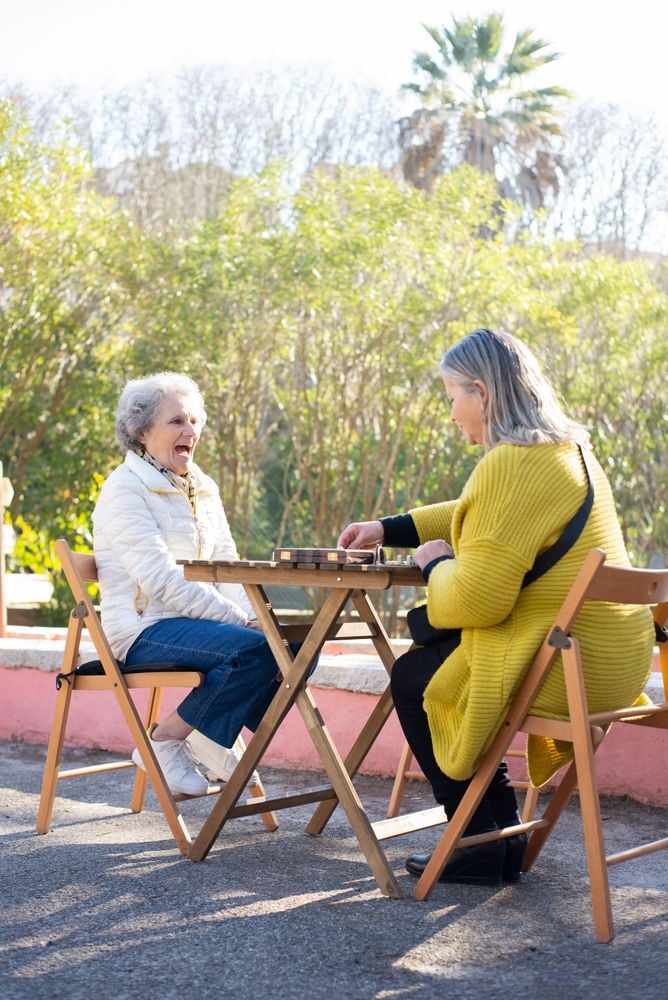
What the retrospective did identify as a shared characteristic across this otherwise varied group was a consistently high level of social engagement. SuperAgers in this cohort tended to report stronger interpersonal relationships and more social connection than cognitively average peers their age, a pattern that stood out precisely because so many other lifestyle factors varied so widely across the group.
This is one research programme’s accumulated findings, drawn from a self-selected group of volunteers who signed up for a long-running cognitive ageing study, not a randomised trial and not a representative sample of every 80-year-old. The relationship between social connection and preserved memory in this data is an association, not a demonstrated cause. The researchers themselves cannot rule out the reverse explanation: that people whose cognition was already ageing well for other, unmeasured reasons simply found it easier to stay socially engaged, rather than social engagement itself protecting their cognition.
Why this is not a formula
None of this supports treating social connection as a guaranteed way to become a SuperAger, and the researchers do not frame it that way either. The anterior cingulate finding is a structural marker observed after the fact in people who already met the strict SuperAger memory threshold. It is not evidence that any given intervention, more socialising, more exercise, a different diet, will reliably produce that same anatomy or that same test performance in someone who does not already have it. Genuinely preserved cognition into one’s eighties likely reflects some combination of genetics, chance, and lived circumstances that this research has only begun to disentangle, and the SuperAging programme’s own investigators describe the underlying mechanism as still unresolved after 25 years of study.
It is also worth being clear about what this research does not measure. Dementia and age-related cognitive decline have many causes, and a strong memory test score in one narrowly defined group of volunteers says nothing about any individual’s personal risk or prognosis. Anyone concerned about their own memory or a family member’s cognitive changes is better served by a conversation with a doctor than by a lifestyle checklist drawn from one cohort study.
What the accumulated 25 years of data does support, read plainly, is narrower and more interesting than a formula: a meaningful subset of people do reach their eighties with memory performance and brain anatomy that looks decades younger than their chronological age, this group does not share the lifestyle habits most commonly assumed to explain healthy ageing, and social connection is the one factor that has consistently stood out across an otherwise strikingly varied group of exceptional agers.
