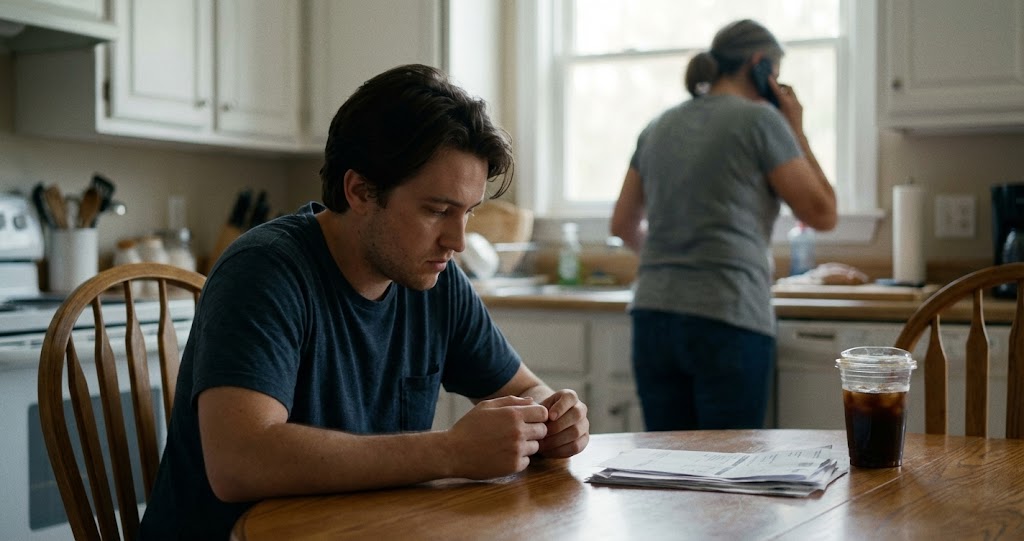
You need help. You know you need help. Maybe it’s practical — you’re drowning at work, your car broke down, you can’t manage what’s on your plate. Maybe it’s emotional — you’re grieving, you’re overwhelmed, you haven’t been okay in a while. The help is there. People have offered. All you have to do is say yes.
And you can’t.
Not because you’re proud. Not because you’re stubborn. But because somewhere deep in your body — in a place that operates below language — asking for help feels like the most dangerous thing you could do. It feels like exposure. Like you’re about to reveal something that will make someone pull away. Like the moment you say I need something from you, you become too much. A burden. An inconvenience. A problem that someone now has to solve at their own expense.
If that’s your experience, psychology has something specific to tell you: this didn’t start with you. It started with someone who was supposed to respond when you needed them — and didn’t.
The system that was supposed to teach you it was safe to need things
Attachment theory, developed by British psychiatrist John Bowlby and later expanded by developmental psychologist Mary Ainsworth, describes a biological system that every human being is born with. Its function is straightforward: when a child feels threatened, distressed, or in need, the attachment system activates, motivating the child to seek proximity to a caregiver for comfort and protection.
This isn’t optional behavior. It’s hardwired. Crying, reaching, clinging, following — these are not signs of weakness or manipulation in an infant. They are genetically encoded survival strategies, designed by evolution to keep vulnerable children close to the people who can keep them alive.
What matters — what shapes everything that follows — is what happens when the child reaches out.
If the caregiver is consistently available, sensitive, and responsive, the child internalizes a simple but foundational belief: When I need something, someone will come. My needs are not dangerous. I am not too much. This is secure attachment, and it creates a template for how the child will relate to others for the rest of their life.
But if the caregiver is consistently unavailable, dismissive, or uncomfortable with the child’s emotional needs — if they withdraw when the child cries, become irritated when the child clings, or respond to emotional distress with silence, coldness, or the implicit message that the child should handle it alone — something different happens. The child doesn’t stop needing. The child stops showing that they need.
What avoidant attachment actually looks like from the inside
In Ainsworth’s landmark Strange Situation experiments, approximately 20 percent of infants displayed what researchers classified as avoidant attachment. When their caregiver left the room, these children showed little visible distress. When the caregiver returned, they actively avoided seeking contact — sometimes turning away, sometimes focusing on toys on the floor, sometimes appearing indifferent.
To an untrained eye, these children looked fine. Independent. Self-sufficient. Easy.
They were none of those things. Physiological measurements told a different story entirely. These children showed elevated cortisol levels — their stress response was fully activated. They were distressed. They just learned not to show it, because showing it didn’t work. Or worse, showing it made things harder.
This is the origin of what Bowlby called “compulsive self-reliance” — a pattern in which the individual denies attachment needs, suppresses expressions of vulnerability, and substitutes independence for connection. It looks like strength. It functions as a survival strategy. And it persists, often for decades, long after the original environment has changed.
The child who learned that reaching out leads to rejection becomes the adult who can’t ask for help without feeling like a burden. Not because they decided to be this way. Because their nervous system was organized around a very specific lesson: Your needs drive people away. The safest thing you can do is need nothing.
The invisible wound of emotional neglect
What makes this pattern so difficult to identify is that it often doesn’t look like trauma. There may have been no abuse, no violence, no dramatic disruption. The household may have appeared functional. The parents may have been physically present, financially responsible, even well-intentioned.
What was missing was responsiveness to the child’s emotional world. And that absence — that consistent failure to see, validate, and respond to a child’s inner experience — is what psychologists now recognize as childhood emotional neglect.
Research has established that childhood emotional neglect is the most common form of child maltreatment — and among the most damaging. A study published in Psychophysiology found that emotional neglect in childhood shapes adult social functioning through a biological pathway: it was associated with lower plasma oxytocin levels, which in turn were linked to insecure attachment representations, which predicted elevated fear and avoidance of social situations. The oxytocin and attachment systems fully mediated the relationship between early emotional neglect and later social dysfunction — even after controlling for other forms of maltreatment.
In other words, when a child’s emotional needs are consistently unmet, the brain’s bonding chemistry is altered. The system that’s supposed to make connection feel safe instead makes it feel dangerous. And that alteration doesn’t just affect how you feel about relationships in the abstract. It affects whether you can pick up the phone when you’re struggling and say, honestly, I need help.
What’s actually happening when you can’t ask
When you feel that visceral resistance to asking for help — the tightening in your chest, the voice that says don’t bother them, the automatic pivot toward handling everything alone — that’s not a rational assessment of the situation. That’s your attachment system running a program it installed in childhood.
Research on attachment and emotion regulation has mapped this with precision. Individuals high in avoidant attachment employ what researchers call “deactivating strategies” — they suppress emotional distress, avoid closeness and interdependence, deny attachment needs, and withdraw from others when stressed. These strategies developed in response to caregivers who disapproved of or punished closeness and expressions of vulnerability.
The function of these strategies is protective: if showing need reliably produces rejection, humiliation, or abandonment, then not showing need is adaptive. It solves a real problem in a real environment. The child who stops crying because crying never brings comfort is not weak or broken. They’re intelligent. They’ve read the room and responded accordingly.
The problem is that the strategy outlives the environment. The child becomes an adult, surrounded by people who would willingly help — a partner, friends, colleagues, a therapist — and the old program keeps running. The request for help forms in the mind, reaches the throat, and stops. Because somewhere below conscious thought, the nervous system is still predicting that the response to “I need you” will be the response it always was: absence, irritation, withdrawal, or the devastating implication that you should have been able to handle this on your own.
The burden story
The word that comes up most often — the word that people with this pattern use again and again when they describe why they can’t ask for help — is burden.
“I don’t want to be a burden.” “I feel like I’m bothering people.” “I don’t want to impose.” “They have their own problems.”
This language feels like consideration. It sounds like empathy. But it’s neither. It’s a belief system built on a childhood in which your needs were, in fact, treated as an imposition — not necessarily with cruelty, but with absence. With a parent who was emotionally unavailable, overwhelmed by their own life, uncomfortable with feeling, or simply not equipped to attune to a child’s interior world.
The child in that environment receives a message that is never spoken aloud but is absorbed completely: Your needs are a problem. The good version of you is the version that doesn’t need anything.
That message becomes an internal working model — a term Bowlby used to describe the cognitive-emotional template that organizes a person’s expectations of relationships. The working model of the avoidant child says: people are not reliable sources of comfort. Showing vulnerability invites rejection. The only person you can count on is yourself. And if you need more than you can provide yourself, that’s a personal failure, not an invitation to connect.
This model doesn’t feel like a belief. It feels like reality. It feels like the way the world works. And that’s precisely what makes it so difficult to change — because the person experiencing it doesn’t see a distortion. They see truth.
The cost of compulsive self-reliance
The research on what avoidant attachment costs people over a lifetime is extensive and consistent.
Avoidant individuals seek less social support in response to stress, report less satisfaction with the support they receive, and maintain pessimistic beliefs about the futility of seeking help from others. They report higher levels of loneliness and social isolation, despite often appearing socially competent on the surface. In romantic relationships, they tend toward emotional distance, difficulty expressing vulnerability, and a pattern of withdrawing when their partner needs closeness.
Studies on childhood maltreatment and adult outcomes have found that emotional neglect predicts both anxious and avoidant attachment styles in adulthood, which in turn predict depression, anxiety, and lower self-esteem — effects that were still measurable 30 years after the original neglect occurred.
But perhaps the deepest cost is the one that’s hardest to measure: the loneliness of being surrounded by people who would help you if you let them, and not being able to let them. The exhaustion of carrying everything alone, not because you want to, but because the alternative — exposing your need — feels like it will cost you something you can’t afford to lose.
This is the paradox of compulsive self-reliance: it protects you from the pain of rejection by guaranteeing the pain of isolation. You never get turned away because you never reach out. And you tell yourself this is strength, because that’s the only story that makes the loneliness bearable.
The path out is the thing that feels most dangerous
If you recognize yourself in this, the therapeutic literature is clear on one point: the repair happens in relationship. Not in isolation. Not through more self-sufficiency. Not by becoming even better at handling things alone. The wound was relational — it happened in the space between you and someone who was supposed to respond — and the healing has to be relational too.
This doesn’t mean you need to suddenly start asking everyone for everything. It means beginning to notice, with curiosity rather than judgment, when the “I don’t want to be a burden” voice activates. It means recognizing that voice not as wisdom but as an echo of an old environment that no longer exists. It means testing, in small ways, whether the prediction your nervous system keeps making — that your needs will drive people away — is still accurate.
Most of the time, it’s not. Most of the time, the people around you are not your childhood caregiver. Most of the time, when you say “I need help,” what comes back is not absence. It’s relief that you finally asked.
Attachment researchers have consistently found that attachment styles, while stable, are not fixed. They can be revised through what psychologists call “earned security” — the gradual process of having new relational experiences that contradict the old working model. A therapist who is reliably present. A partner who responds to vulnerability with warmth rather than withdrawal. A friend who doesn’t flinch when you tell them the truth.
Each of those experiences, over time, rewrites a sentence that was drafted in childhood. The old sentence says: If I show you what I need, you’ll leave. The new one, built slowly through evidence, says something different: If I show you what I need, you’ll stay.
What you’re really afraid of
You’re not afraid of the help. You’re not afraid of the inconvenience. You’re afraid of the thing that happened before you had language for it — the moment when you reached out and no one came, when you cried and were met with silence, when you needed something that the person standing closest to you couldn’t give. You’re afraid that asking now will produce the same result. That the rejection will confirm what you’ve always suspected: that you are, at bottom, too much.
You’re not too much. You were just in the wrong room.
The room has changed. The people in it have changed. The only thing that hasn’t changed is the program running in the background, telling you to handle it alone because that’s what’s safe. That program was written by a child who had no other option. You are not that child anymore. You have options now that you didn’t have then.
The bravest thing you’ll ever do isn’t carry everything yourself. It’s set something down in front of someone and let them help you hold it.
That’s not weakness. It’s the repair.