

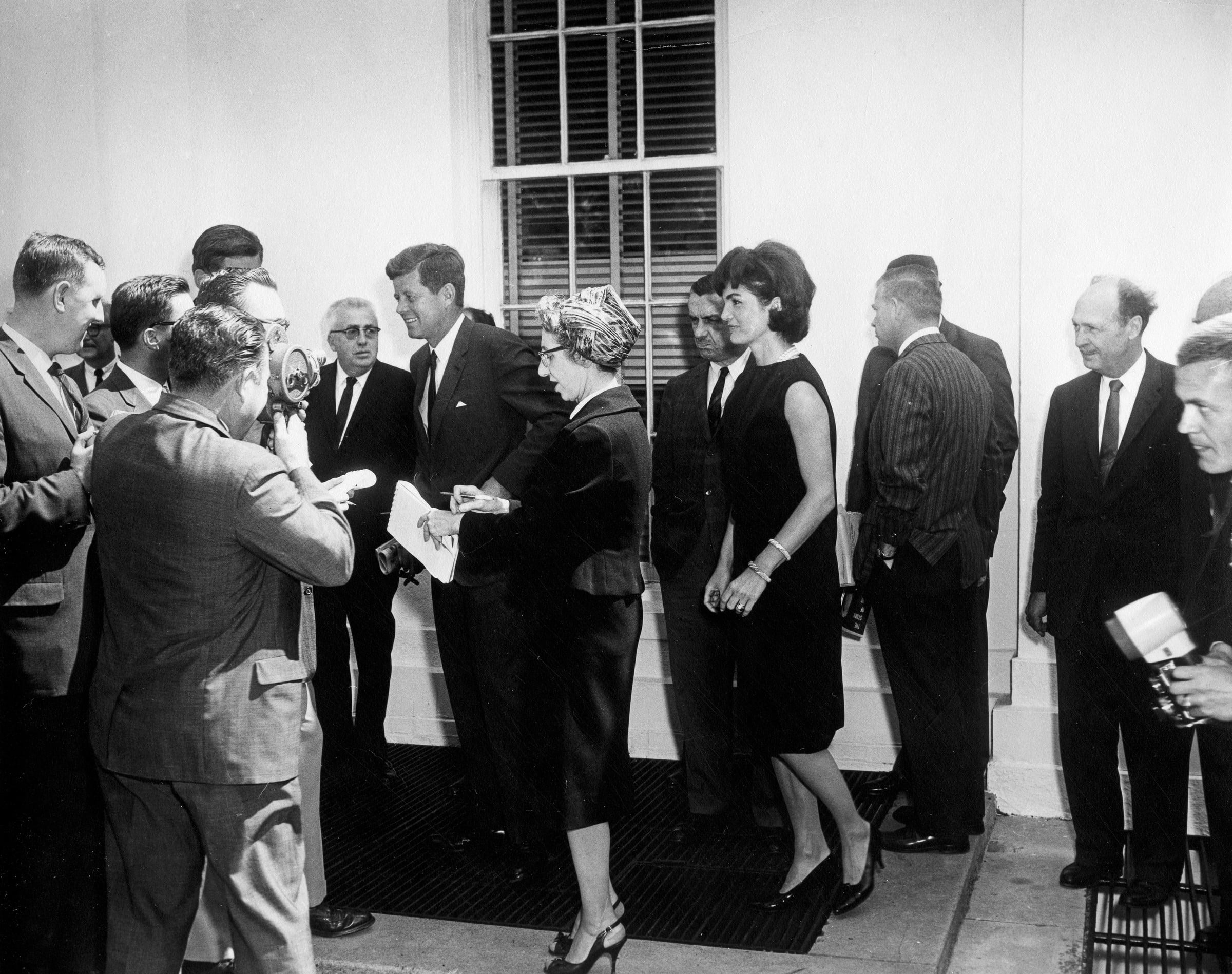
On 24 May 1961, at 1:00PM, President John F. Kennedy and First Lady Jacqueline Kennedy hosted Prince Rainier III and Princess Grace of Monaco for a White House luncheon. The occasion survives in a dated folder of White House Photographs held by the John F. Kennedy Presidential Library.
The official record is precise about the essentials. It identifies the occasion as a luncheon in honor of Prince Rainier and Princess Grace, dates the material to 24 May 1961, and gives the starting time as one o’clock in the afternoon. It also identifies Kennedy, Jacqueline Kennedy, Rainier, and Grace among the people associated with the folder.
That is narrower than the story often built around the meeting, and the narrowness is important. Later viewers can read glamour, intimacy, or diplomatic significance into a photograph. An archival description establishes who was present, when the event occurred, and how the material was catalogued, but it does not establish what anyone felt or said.
What the collection actually records
The photographic folder belongs to the Kennedy Library’s White House Photographs collection and carries the digital identifier JFKWHP-1961-05-24-D. Its preferred citation names White House photographer Cecil Stoughton, while its folder description also contains the collection codes AR07, ST02, and KN03.
The record describes one black-and-white negative measuring 2¼ inches square. That matters because the folder should not be presented as proof of a complete visual sequence unless the individual images and their descriptions have been examined separately. The page establishes the luncheon and its participants, but it does not provide a transcript, a detailed chronology, or evidence of the conversation.
A separate White House social-events file for the 24 May luncheon contains 15 digital pages and is associated with a seating plan. Together, the photographic and documentary records show how an official social engagement entered the institutional archive through more than one type of material.
The archive also includes an important rights qualification. It states that documents prepared by United States officials as part of their official duties are in the public domain, while warning that some other archival materials may still be subject to copyright or intellectual-property restrictions. The collection therefore should not be described as uniformly unrestricted without checking the status of the particular item being used.
The hinge between 1956 and 1961
The five-year interval in the title is accurate. Grace Kelly married Prince Rainier in 1956 and became Princess of Monaco, ending a Hollywood career that had included an Academy Award and leading roles for Alfred Hitchcock. A TIME retrospective on her film career notes that she retired from Hollywood at 26 after becoming princess.
By May 1961, she was no longer arriving at an American public event as a working film star. She attended the White House luncheon as Princess Grace, alongside Monaco’s sovereign prince. Her earlier profession remained part of her public identity, but her official position had changed.
That change explains much of the fascination that later attached itself to the photographs. The meeting brought together a former American film star who had entered European royalty, Monaco’s ruler, a young American president, and a first lady already becoming an international style figure. Even without invented dialogue or psychological interpretation, the combination was unusually rich in public symbolism.
Where popular history reframes the photographs
Historical photographs often acquire a second life outside the archive. They circulate online without their catalogue descriptions and become evidence for broader stories about elegance, diplomacy, celebrity, or a supposedly more composed political age.
Those readings can be engaging, but they remain interpretations. A smile does not establish warmth, a glance does not prove intimacy, and a formal photograph cannot reveal the private dynamics of the room. The archive can verify an encounter without validating every story later attached to it.
The distinction is what gives this luncheon continuing interest. In the Kennedy Library, the material is documentation of a presidential event. In popular circulation, the same occasion becomes a meeting of Hollywood, royalty, and American political power.
What remains after those interpretive layers are separated from the record is modest but firm. On 24 May 1961, at one o’clock in the afternoon, President John F. Kennedy and Jacqueline Kennedy hosted Prince Rainier III and Princess Grace of Monaco for a White House luncheon. Five years after Grace Kelly left Hollywood and became a princess, the event placed her back in an American spotlight under an entirely different title.
