

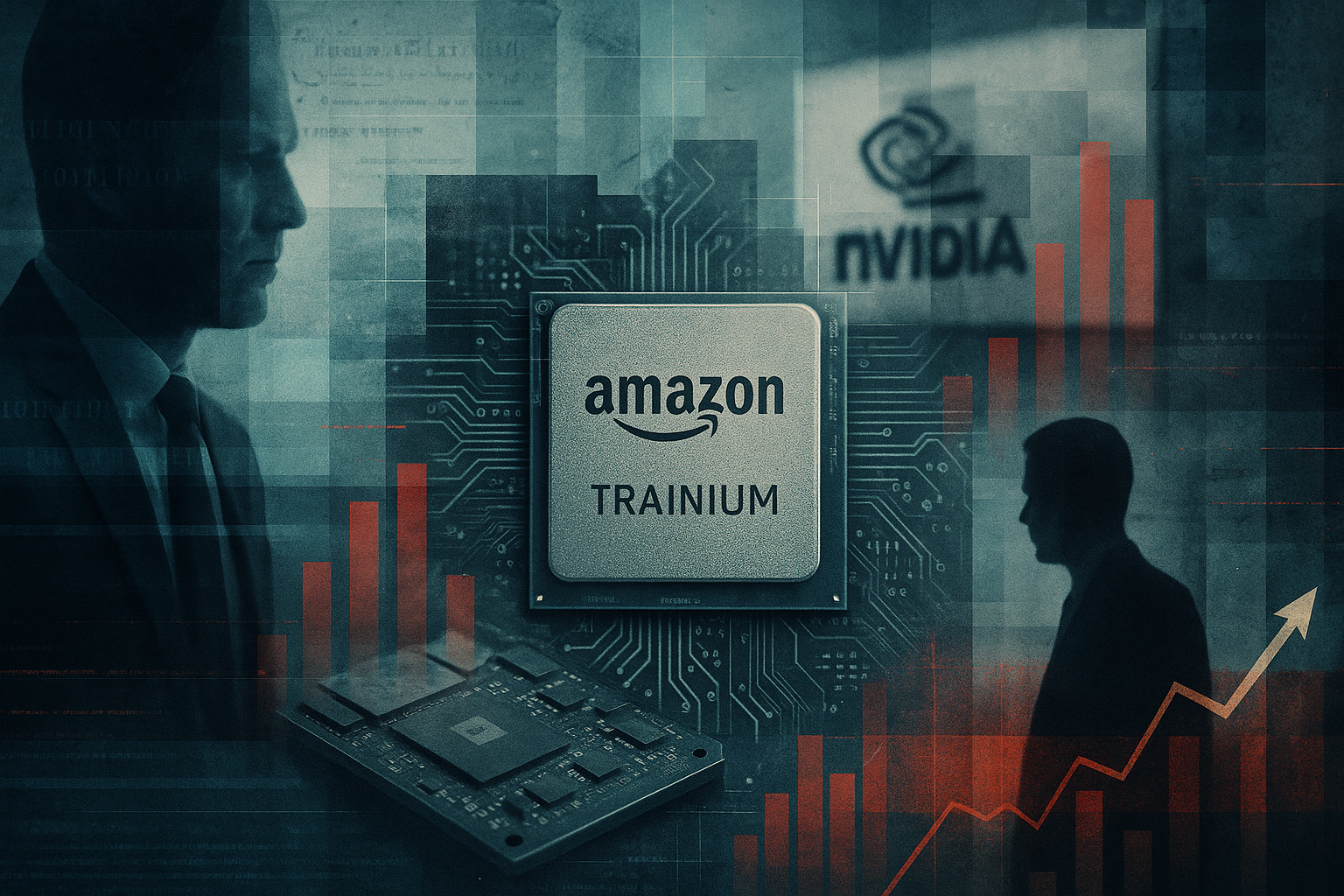
Amazon just announced a chip that could break Nvidia’s stranglehold on AI infrastructure. At their re:Invent conference on December 2nd, 2025, AWS unveiled Trainium3, and the numbers tell a story that most tech coverage is underselling.
The headline figures: Trainium3 delivers four times the performance of its predecessor. It’s built on a 3-nanometer process. Amazon claims it offers up to 50 percent cost savings compared to comparable GPU-based training. But what matters isn’t the specs. What matters is what this means for the architecture of power in AI.
For years, Nvidia has held something close to a monopoly on the chips that train and run artificial intelligence models. Not a legal monopoly, but a practical one. If you wanted to build AI at scale, you bought Nvidia. There was no real alternative. Jensen Huang’s company captured somewhere between 80 and 95 percent of the AI chip market, depending on how you measure it. That kind of dominance doesn’t just mean high prices. It means one company gets to shape what AI development looks like, who can afford to participate, and who gets left out.
Amazon is now making a serious play to change that equation.
The economics of dependency
Here’s what most people don’t understand about Nvidia’s position: the markup isn’t just about supply and demand. It’s about lock-in. Once you’ve built your infrastructure around CUDA, Nvidia’s proprietary software platform, switching costs become enormous. Your engineers know CUDA. Your code is written for CUDA. Your entire machine learning pipeline assumes Nvidia hardware underneath it.
This is how technological dominance actually works. It’s not just about having the best product. It’s about making your product the default substrate on which everything else gets built. Then you can charge what you want, because the alternative isn’t buying a competitor’s chip. The alternative is rebuilding everything from scratch.
Nvidia’s chips became allocation constrained, with companies waiting months for supply. Organizations hoarded GPUs like they were gold reserves. And in a sense, they were. Access to compute became a competitive advantage in itself, separate from any actual innovation in AI.
Amazon’s bet with Trainium3 is that this dependency can be broken, at least for companies running their AI workloads on AWS. The chips won’t be sold directly. They’ll be available through Amazon’s cloud services, which changes the calculation entirely. You don’t need to buy the hardware. You don’t need to build the data centers. You just need to be willing to run your workloads on Amazon’s infrastructure instead of buying Nvidia chips and racking them yourself or renting them through other providers.
What the benchmarks actually show
Amazon claims Trainium delivers 30 to 50 percent cost reductions compared to GPU alternatives for training and inference. That’s a significant gap if it holds up in real-world deployments. The company also announced Trainium4 is already in development, with specifications promising six times the FP4 throughput and support for Nvidia’s NVLink Fusion interconnect technology.
The Anthropic partnership matters more than the specs. Anthropic is one of the leading AI labs, creator of Claude, and a company Amazon has invested $4 billion in. When Amazon says Trainium chips are good enough for serious AI development, they can point to Anthropic as proof. This isn’t vaporware. Anthropic has been training their models on over 500,000 Trainium2 chips in what AWS calls Project Rainier.
But benchmarks are always contested territory. Nvidia will release their own numbers showing their chips performing better on different tasks. The real test will be whether companies actually migrate their workloads to Trainium, and whether they stay there once they do.
Early reports suggest the migration is happening. Companies including Karakuri, Metagenomi, NetoAI, Ricoh, and Splash Music are already reporting cost reductions of up to 50 percent with Trainium. The AI video startup Decart is achieving four times faster frame generation at half the cost of GPUs. This isn’t a hypothetical anymore.
The vertical integration play
What Amazon is doing with Trainium fits a pattern I’ve been watching for years. The most powerful tech companies are all moving toward vertical integration, controlling more and more of their own stack. Apple designs its own chips. Google has its TPUs. Microsoft is developing custom AI accelerators. Amazon has been building Graviton processors for general compute and now Trainium and Inferentia for AI workloads.
The logic is straightforward: if you depend on another company for a critical component, you’re vulnerable. They can raise prices. They can prioritize other customers. They can fail to innovate in directions you need. The solution is to build it yourself.
But there’s another dimension to this that doesn’t get discussed enough. When Amazon builds its own chips, optimized for its own cloud infrastructure, they’re not just reducing costs. They’re deepening the moat around AWS. If Trainium really does deliver better price-performance for AI training, but only if you run on AWS, that’s a powerful incentive to consolidate your infrastructure with Amazon.
The chip becomes a mechanism for platform lock-in, just as Nvidia’s CUDA created lock-in to their hardware. Amazon is trying to shift the locus of dependency from the chip manufacturer to the cloud provider. This isn’t liberation from monopoly. It’s a transfer of monopoly power from one layer of the stack to another.
The price of compute
I think about the cost of compute more than I probably should. Running a media company that increasingly depends on AI tools, I feel the pricing in ways that abstract market analysis doesn’t capture. Every time we spin up a workload, there’s a meter running somewhere. The companies that control that meter have enormous power over what’s possible to build.
When Nvidia had near-total dominance, the price of training a large language model became a barrier to entry that only well-funded startups and major corporations could clear. Estimates for training frontier models now run into hundreds of millions of dollars. Most of that cost is compute. If you can’t afford the GPUs, you can’t play the game.
In theory, competition in AI chips should bring those costs down. More suppliers, more options, lower prices. That’s the story Amazon is telling. And there’s probably some truth to it. Trainium3’s pricing, if Amazon’s claims hold, would make serious AI development accessible to more organizations than Nvidia’s pricing allows.
But I’m skeptical that this competition will fundamentally democratize AI development. What it might do instead is shift who captures the value. Instead of Nvidia extracting monopoly rents from AI training, Amazon extracts them through cloud services that happen to include custom silicon. The companies building AI still pay. The question is just who receives the check.
This connects directly to something I wrote about recently regarding Singapore’s wealth concentration. When average wealth rises but median wealth falls, that’s not prosperity—it’s concentration. The same dynamic plays out in AI infrastructure. The headline is “competition is bringing costs down.” The reality is costs remain so high that only companies with massive backing can train frontier models. AWS offering 30 to 50 percent cost reductions doesn’t democratize AI. It makes it slightly less oligarchic.
Nvidia’s response
Nvidia isn’t standing still. They announced their Blackwell architecture and have been steadily rolling out chips that maintain their performance lead. Jensen Huang has been explicit that Nvidia plans to keep advancing faster than competitors can catch up. Their entire 2025 production of Blackwell chips was already sold out as of November 2024, according to reports.
The company also has relationships with all the major cloud providers. AWS still offers Nvidia GPUs alongside Trainium. So does Google Cloud, Azure, and everyone else. Nvidia’s strategy seems to be maintaining enough of a performance edge that customers who need the absolute best will keep paying the premium, while accepting that cost-sensitive workloads might migrate to alternatives.
This is probably a sustainable position for now. The AI labs pushing the frontier need every advantage they can get. A 10 or 20 percent performance improvement might be worth a significant price premium when you’re racing competitors to the next capability threshold. But for the much larger market of companies deploying AI rather than pushing its boundaries, cost matters more than absolute performance. That’s the market Amazon is targeting.
The infrastructure beneath intelligence
There’s something almost absurd about how little attention we pay to the physical infrastructure of artificial intelligence. We talk endlessly about what AI can do, what it might become, how it will transform society. We talk much less about the chips, the data centers, the power plants, the cooling systems, the supply chains that make it all possible.
But that infrastructure is where the real decisions get made. Who builds the chips determines what’s possible to compute. Who owns the data centers determines who has access. Who controls the power supply determines where AI can be deployed at scale. These aren’t technical footnotes. They’re the material conditions that shape what intelligence can be built and who gets to build it.
This matters for the same reason I documented in my recent pieces on Palantir’s surveillance infrastructure and Clearview AI’s facial recognition system. When I sold my Palantir stock after CEO Alex Karp explained that constitutional scrutiny of war crimes was a business opportunity, I was seeing power consolidation in real time. These companies profit from state power. But state power runs on infrastructure. And AI infrastructure increasingly means whoever controls the chips controls what gets built.
Amazon’s Trainium3 is a move in this infrastructure game. It’s not about the chip itself, not really. It’s about who controls access to the compute that powers artificial intelligence. The fight isn’t between democratization and monopoly. It’s about which concentration of power controls the infrastructure. AWS versus Nvidia. Google TPUs versus Nvidia GPUs. Microsoft Maia versus Nvidia Blackwell.
The customers writing nine-figure checks get more options. Everyone else is still locked out. The bottleneck shifted. It didn’t disappear. And whoever controls the bottleneck still determines who gets through.
