

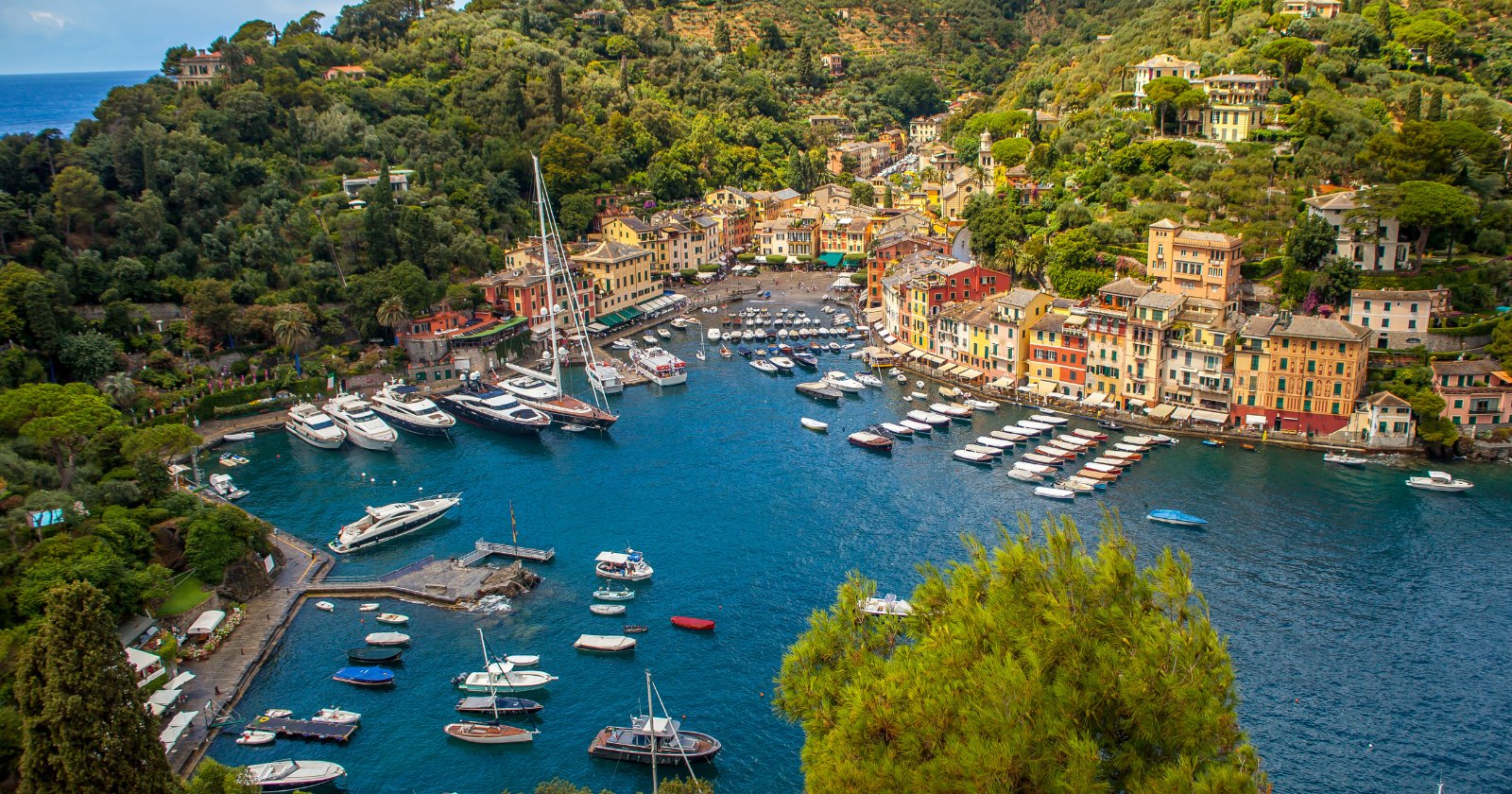
Portofino is a village of fewer than 500 permanent residents on the Ligurian coast, roughly an hour southeast of Genoa. It is also, by most measures, one of the most recognisable places in Europe. A tight crescent of coral and ochre buildings around a harbour so precisely composed that it appears, to visitors arriving by boat or on foot along the coastal path, almost staged. The view has been a commercial asset for well over a century. It has also, increasingly, become a regulatory project.
For years, Portofino’s municipality has maintained strict controls over any modification to the facades of its buildings. Window colours, plant arrangements, signage, and external fixtures are all subject to approval processes designed to preserve what the local administration describes as the visual coherence of the townscape. Into this framework, the air conditioner has arrived as an unusually fraught object. Common enough in contemporary Italian life, and increasingly necessary given the direction Mediterranean summers are travelling, but visually disruptive in a way that other modern additions, hidden behind walls or tucked under rooflines, are not.
In 2024, the municipality moved more aggressively on enforcement than it had in previous years. Residents who had installed external units, some recently, some years earlier, received formal notices. Local media reported inspections and fines. And the mayor, Matteo Viacava, gave a series of interviews defending the rules as necessary to preserve the town’s character, while also acknowledging the residents’ predicament directly: “We all depend on AC now.”
The view as economic infrastructure
To understand why Portofino enforces aesthetic rules that would be considered extraordinary in almost any other context, it helps to understand what the town actually is. Portofino does not have a significant agricultural sector, a manufacturing base, or a service economy that could sustain it independently of tourism. What it has is the image: the harbour, the coloured buildings, the particular quality of light. That image drives not only direct visitor spending but also the property market, which has made Portofino one of the most expensive places to own real estate in Italy. The visual coherence of the place is, in a direct economic sense, what the place is.
This logic is not unique to Portofino. Several Italian heritage towns, including the Cinque Terre villages along the same coast and dozens of others further inland, operate under similar regulatory frameworks, and for similar reasons. Heritage designation by bodies including UNESCO and the Italian Ministry of Culture carries with it both protections and obligations, and local administrations often interpret those obligations expansively when the visual character of the place is what draws the visitors who pay the bills.
What made Portofino’s 2024 enforcement cycle notable was less the existence of the rules than the texture of their application. Reports in the Italian press described a situation in which residents were being reported to the municipality, anonymously in some cases, by other residents. In a community of under 500 people, where most adults know most other adults, this produced a particular social discomfort that became a story in its own right. The image of neighbours filing formal complaints about the placement of an air conditioning unit in a town the size of a small apartment block carries an absurdist quality that the Italian press did not miss.
The climate context that the town cannot ignore
The difficulty with Portofino’s position is that it is being argued at a moment when the climate pressures that make air conditioning feel necessary have become harder to dismiss as preference. The Mediterranean has been tracking well above historical temperature norms for several consecutive summers. The Copernicus Climate Change Service’s 2024 European State of the Climate report confirmed that the year ranked among the warmest on record for southern Europe, with heat events of longer duration and greater intensity than the regional average for the preceding century.
Italy recorded multiple heat alert periods in 2024, with temperatures in Genoa and along the Ligurian coast reaching levels that prompted public health warnings. For the elderly residents of Portofino, and the town has an age demographic typical of many small Italian coastal settlements, skewed significantly older than the national average, air conditioning is not primarily a comfort consideration. It is a health one. The Italian National Institute of Health has documented a consistent relationship between extreme heat events and excess mortality among adults over 65, formalized through a national mortality surveillance system that has tracked the at-risk population since 2004.
Against this backdrop, the municipality’s argument that visible air conditioning units primarily represent an aesthetic problem starts to look harder to defend. It is one thing to restrict modifications that are genuinely discretionary. It is another to restrict modifications that residents may reasonably describe as necessary for their wellbeing, particularly when the town in question sits within a country that has suffered measurable heat-related excess mortality in recent years and is projected to face significantly worse conditions over the coming decades.
A preview of conflicts to come
Portofino is an extreme case. Its wealth, its fame, and its administrative intensity set it apart from most heritage towns dealing with similar pressures. But the underlying conflict it represents is becoming increasingly common across southern Europe. Heritage preservation law was largely written during an era when the climate conditions those places were designed to manage were relatively stable. The buildings of Portofino, with their thick stone walls and north-facing windows, reflect centuries of vernacular adaptation to a Ligurian climate that was, by modern standards, relatively mild. The people living in those buildings now are navigating a different climate.
Heat-health action plan guidance, developed through the WHO European Region with European Commission co-funding, encourages member states to treat heat as a public health priority and to ensure that housing and urban planning don’t inadvertently block adaptation. How that guidance interacts with heritage law, which operates under a different regulatory framework and is administered by different bodies, remains largely unresolved.
The legal picture is further complicated by the fact that heritage restrictions of the kind Portofino applies are not uniformly understood to override health and safety considerations. Italian administrative law does provide mechanisms for residents to argue that compliance with an aesthetic restriction creates undue hardship, and it is plausible, though untested, that future hardship claims could draw on heat mortality data as supporting evidence. No such case appears to have been tested in Portofino specifically, but the broader jurisprudence is evolving, and on the merits it should.
What gets resolved and what doesn’t
Portofino’s air conditioner dispute did not end cleanly in 2024. Some residents complied with removal notices; others are understood to have appealed. The neighbour-reporting dimension subsided as a news story but left behind the kind of social residue that small communities tend to carry for years. The mayor’s office has not, publicly, indicated any revision to its position on visible external units, though local media have reported that conversations about approved technical solutions, units positioned to be invisible from the harbour or street level, are ongoing.
The deeper question is whether a regulatory regime built around the preservation of a view can keep asking older residents to absorb the physical cost of summers their buildings were never designed for. On the evidence so far, the answer should be no. A façade can be restored. A heatwave death cannot. Discreet placement and technical workarounds will solve part of this, and the municipality is right to pursue them, but the framing in which aesthetic continuity is treated as the default and resident health as the exception requesting accommodation has the priorities the wrong way around.
The air conditioner has become, in Portofino at least, a proxy for a much larger negotiation about who a heritage place is ultimately for. On that question, the people inside the buildings have the stronger claim.
