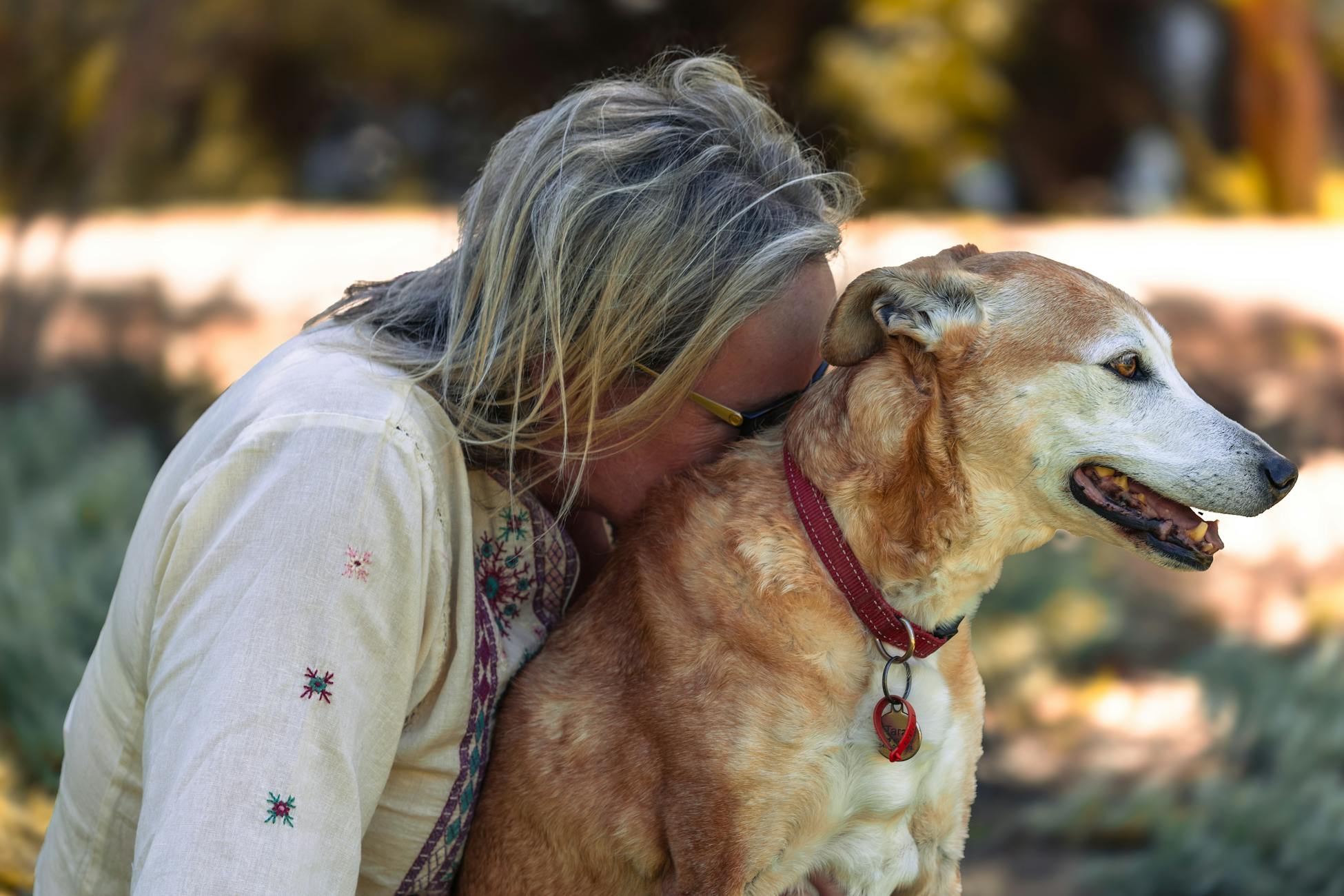
Most people think pet grief is disproportionate. It isn’t. We just have the math wrong, because we’ve been taught to rank grief by the social importance of the relationship instead of by what that relationship actually did inside our lives. Parent outranks pet. Spouse outranks parent. The culture has a whole accounting system for this and it falls apart the moment someone’s fourteen-year-old dog stops breathing and they find themselves on the kitchen floor at 2 a.m. wondering what’s wrong with them.
If you’ve ever seen this happen to someone you care about, or experienced it yourself, you know what the first reaction usually is. Not sadness. Something closer to confusion. People often describe feeling “insane” — not because the grief is unfamiliar, but because it feels out of proportion to what they’ve been taught to expect. Someone can lose a parent and hold themselves together, then lose a dog two years later and come completely undone. And the first thing they want to know is what’s wrong with them.
Research suggests that the answer is: nothing. The grief isn’t disproportionate to what was lost. The grief is accurate. People have just underestimated what they had.
The witness problem
Here’s what it keeps coming back to. The dog saw you.
Not the version of you that your coworkers saw, or your parents, or even your partner in most cases. The dog saw the version of you that existed when nobody else was watching. The version that cried on the bathroom floor after the phone call. The version that talked to itself while cooking. The version that sat on the couch at 2 a.m. scrolling through old photos after a bad day. The version that laughed at its own jokes. The version that was boring, petty, tender, strange, unguarded.
No human in your life got all of that. Your partner got a curated version. Your closest friends got specific slices. Your family got the role they assigned you decades ago and mostly still see. But the dog got the whole unedited reel, for years, and it required nothing from you in exchange. No performance. No translation. No being strong, being smart, being together, being fine.
Some psychologists who study human-animal attachment have started to describe this dynamic in ways that used to sound sentimental and now sound clinical. A recent analysis in Psychology Today on what pet loss reveals about attachment cited research finding that around 7.5 percent of pet owners rate the loss of their animal as more distressing than losing a human loved one. That number sounds impossible until you realize what those people are actually saying. They’re not saying they loved the dog more. They’re saying the dog knew them more.
What the dog actually witnessed
I want to be specific about this, because “unconditional love” is the phrase people reach for and it’s not quite right. The dog didn’t love you unconditionally. The dog simply had no conditions to begin with. There’s a difference. Your dog watched you go through a breakup and didn’t ask what you did wrong. Your dog watched you get fired and didn’t wonder if you’d recover financially. Your dog watched you become a worse version of yourself for six months and didn’t file it away as evidence. Your dog watched you have the same three-hour argument with yourself about whether to text someone back, and the dog was there for the texting and the not-texting and the regret and the relief, and none of it changed how the dog greeted you in the morning. That greeting stayed the same on your best days and your worst days, and after a decade you stopped noticing it, which is exactly the point. It had become the baseline. It had become the thing you could count on without thinking about it, and that’s the rarest thing a relationship can offer an adult.
This is not a small thing. This is, for a lot of adults, the only relationship in their life that ever worked this way. When grieving pet owners try to explain what’s happening to them, they often say some version of the same thing: he saw me through everything. They aren’t exaggerating. They mean it literally. The dog was there for the divorce, the diagnosis, the move, the career change, the worst year, the best year. The dog observed it all from the couch. It asked nothing. It offered nothing but its presence, which turned out to be the entire thing.
When the dog dies, what dies with it is the only reliable witness to your private life. That’s the loss. Not the animal. The witness.
Why the grief feels heavier than expected
There’s a specific kind of shock that hits people about a week after the pet has been buried, and it’s not about the absence of the animal. It’s about the sudden realization that there is now no one alive who has seen the full picture. The secret crying. The long conversations with yourself. The grief you never told anyone about. The joy that had no audience. All of it existed because the dog was in the room. And now nobody is in the room.
This is why people who have also lost parents or partners will sometimes quietly admit, usually only to themselves, that the dog’s death broke something the human deaths didn’t. It’s not a ranking of love. It’s a recognition that some relationships operate as containers for your private self, and when those containers break, you lose the self they were holding.
Some researchers studying the human-animal bond in clinical contexts have started to argue that pets occupy a category that our grief rituals haven’t caught up to. We have funerals, condolence cards, bereavement leave. We do not have cultural architecture for the grief of losing the being who knew what you were like at 3 a.m. for a decade. So people feel it privately, assume it must be disproportionate, and then feel ashamed on top of the grief.
The shame is its own injury. If you’ve ever encountered discussions about the shame of grieving a dog more than a parent, you know the particular loneliness of feeling something the culture won’t sanction. You’re not just grieving. You’re grieving while being told your grief is embarrassing.
The private self problem
It’s worth thinking about why the dog ended up with this job in the first place. Why the dog, and not the humans.
Part of it is structural. Humans have schedules, opinions, needs, and memories that outlast the moment. If you fall apart in front of a human, that human will bring it up six months later, or ask if you’re doing better, or file it away as a data point about your stability. The dog won’t. The dog has no incentive to keep score and no capacity for it. You can be your worst self in front of the dog and there is no downstream cost.
But there’s a harder part too, which is that a lot of adults never actually let any human see them at full volume. Not because the humans are untrustworthy, but because by the time we’re grown we’ve learned that intimacy has a bill attached to it, that being fully known means being evaluated, remembered, and occasionally used against us later. There’s a version of avoidance that masquerades as self-sufficiency and most of us run it without noticing.
And honestly, that’s where the real weight of this grief lives. When the dog dies, we don’t just lose a companion. We lose the one relationship where we didn’t have to perform, translate, or protect ourselves. Psychology tells us that being truly seen — without judgment, without consequence — is one of the deepest human needs. Most of us struggle to find that in our human relationships. The dog offered it effortlessly, every single day, and we often don’t realize how much we depended on it until it’s gone.
So if you’re on the kitchen floor at 2 a.m. wondering what’s wrong with you, here’s the answer: nothing. You’re not grieving out of proportion. You’re grieving the loss of your most honest mirror, the only living being who saw everything and stayed anyway. That’s not a small loss. That’s one of the biggest losses a person can experience, and the fact that the culture hasn’t built rituals for it doesn’t make it smaller. It just makes it lonelier.