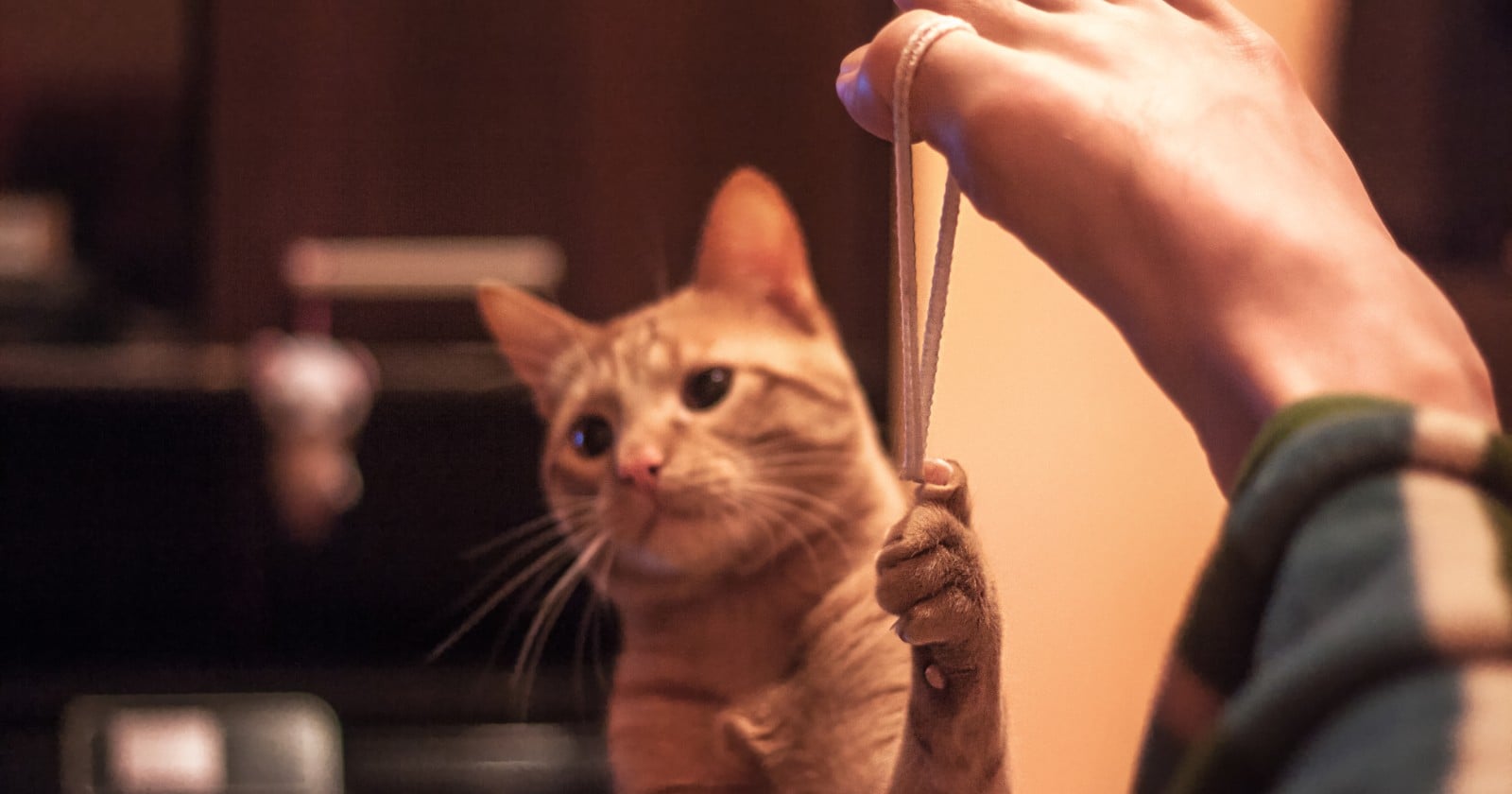
The pet effect is the everyday version of a research claim: that an animal in the house makes people happier, and steadier when things go wrong. It is one of the few findings almost nobody argues with, and it has never had a settled evidence base underneath it. Published results run positive, null and negative, and the disagreement is old enough to have its own literature.
Sanne Peeters, Nele Jacobs, Karin Hediger, Jannes Eshuis and Mayke Janssens went looking for the pet effect inside ordinary days. Working from the Open University of the Netherlands, they recruited 188 dog and cat owners living in the Netherlands or Belgium, put a research app on their phones, and prompted them ten times a day for five consecutive days at semi-random moments between half past seven in the morning and half past ten at night. The study logged 7,963 notification records.
The answer came back in two halves. The half about bad days is the one that changes anything.
What the buffering tests returned
Stressful events moved mood. On a seven-point positive-affect scale, a one-point rise above a person’s own average event-stress rating went with a drop of 0.41. Pooled across both species, interacting more with the animal at that moment made no detectable difference to that drop: the term testing exactly that dependency came back at 0.01 for positive affect, with a p-value of 0.315 and a confidence interval running from minus 0.01 to plus 0.04. That is the finding the abstract and the conclusion report, and it is the one everybody will quote.
Pooling is where the species go. Before that model, the paper fits one that carries species alongside stress and interaction, on 2,385 moments from 169 people, coding dogs as zero and cats as one. In that model the stress-by-interaction term is the slope for dog owners alone, and for positive affect it comes back at 0.04, with a p-value of 0.018 against the corrected threshold of 0.025 and an interval of 0.01 to 0.08 that excludes zero. Dog owners interacting more held on to more of their good mood when something went wrong. The cat slope in the same model runs the other way, near minus 0.02. The three-way term that tests whether the two species really differ comes back at minus 0.06, with a p-value of 0.040, just outside the corrected threshold, and the paper’s stated rule is that “when the three-way interaction was not significant, the corresponding two-way interaction between pet interaction and stress was interpreted” in a model re-estimated without the species terms. That is what it did, and the pooled 0.01 is the result. The dog-conditional coefficient sits in the table and is never discussed.
The same test using activity stress, the low-grade friction of doing something you would rather not be doing, came back empty for both positive and negative mood. For event stress, though, the species difference on negative affect did clear the threshold, and that is dealt with further down, because it did not go in the direction anybody expected.
The pet-interaction effect reported further down and the event-stress effect here sit on different predictor scales, interaction rated one to seven and event stress recoded to zero to three, so they cannot be divided into a ratio and neither can be called the larger. The finding is not that the pet effect is outweighed by the stress effect. It is that the two did not interact.
And the reach of that null is narrower than it first sounds, for a reason built into the design. The interaction question was only put to people when the animal was already in the room, so every moment in this analysis is a moment with a pet present. What was tested is whether interacting more buffers stress, over and above whatever the animal’s presence is already doing. A stressful moment with the dog there was never compared against the same moment with the dog out. The authors say so directly, and point at their own earlier work suggesting that if a buffer exists it may attach to presence rather than to engagement. Anyone quoting this as “pets do not help under stress” is quoting something the data cannot carry.
Every reading behind that null is a person tapping a phone about their own mood, which is a real measurement and a thin one, and reading a paper closely is a different activity from treating anyone. Where an animal is doing genuine work holding somebody’s week together, or where the stress is the kind that does not lift, a doctor or a counsellor is the right call.
Ten pings a day for five days
Nothing in the study was hypothetical. Mood was four positive words, cheerful, satisfied, happy and enthusiastic, and six negative ones, insecure, lonely, anxious, irritated, sad and guilty, each rated one to seven for how the person felt at that moment. Activity stress was three questions about whatever they were doing: whether they would rather be doing something else, whether it took effort, and whether they were any good at it. Event stress asked them to rate the most important thing that had happened since the last prompt from very unpleasant to very pleasant, and only the unpleasant half counted.
Interaction with the animal was a single question, “we are interacting”, rated one to seven.
The sample skewed female, 146 of the 188, and educated, with 159 holding a vocational or university qualification; people were recruited through students’ personal networks, social media, veterinary practices, pet stores and owner clubs. And compliance was low: on average people answered about a third of their prompts, with a spread running from nobody at all to most of them. The researchers kept everyone rather than dropping the patchy responders, which is a defensible choice and an unusual one. Of the 188 recruited, 171 contributed observations to the main model, across 2,707 moments.
Six-hundredths of a point per point of interaction
Because each person’s interaction score was measured against their own average, the result is about within-person change. On the occasions when someone was engaging with their animal more than they usually did, positive affect ran higher and negative affect ran lower: 0.06 of a point of positive affect for each extra point of interaction, confidence interval 0.04 to 0.08, and minus 0.02 of a point of negative affect, interval minus 0.03 to minus 0.01. Both cleared the study’s corrected threshold comfortably.
Six-hundredths of a point per point of interaction, on a seven-point mood scale, is not a mood swing. What makes it interesting is that it holds up across 2,707 separate moments, which is a different kind of claim from “it cheers you up” and a more defensible one.
The researchers had predicted a stronger effect for dogs, on the reasoning that dogs are more socially demonstrative. They did not find one: the pet-interaction-by-species term missed the corrected threshold for positive affect, at p = 0.053 against 0.025, and was nowhere near it for negative affect. The point estimate leaned towards dogs. So this study reports no species difference, which is not the same as showing the two are equal. There is a wrinkle the paper leaves alone: in the larger model that also carries event stress, a related species term does clear the threshold, at 0.011, though that one is conditional on stress sitting at a person’s own average and so is not the same quantity.
Which way the arrow runs is also unresolved. The study is observational, and a person already in a good mood may simply be likelier to get down on the floor with the dog. Nothing in five days of simultaneous measurements separates that from the animal doing the lifting, and the authors name time-lagged analysis as the fix they did not run. A related gap: the social-context control only recorded whether a person was alone or with other people, not the quality or closeness of those relationships, so the study cannot say whether the animal’s contribution is independent of human support.
The cats went the other way
For negative affect the three-way term cleared the threshold, at 0.007, so here the paper split the sample and ran the two species separately, against a threshold of 0.05 rather than 0.025. Dogs showed no detectable moderation, at minus 0.00, though interacting with the dog was still associated with lower negative affect. Cats showed a moderation of 0.04, interval 0.01 to 0.07: when someone was interacting more with a cat, an unpleasant event was associated with more negative affect, not less.
The authors’ own reading is cautious and it should be. The cat models rest on 718 observations against 1,667 for dogs, and the paper says in as many words that the pattern may reflect a subtle association rather than a robust effect and needs replicating before anyone leans on it. Their tentative explanation is that cats offer quieter, lower-demand company, which may make the interaction more emotionally salient exactly when someone is already upset, and that support which does not match what a person needs can sometimes make things worse. That is a hypothesis about a small result, offered as one.
There is research pointing the other way, and it is not junk. This paper’s own introduction cites two examples, Beetz and colleagues in 2012 and Rodriguez and colleagues in 2021, as studies that do find animals buffering stress; the same paper later cites Rodriguez again for how heterogeneous the field is. Which is the point. This is one study, in two countries, over five days, in a self-selected sample.
Measured on ordinary days
The claim people usually make for their animals is a claim about crisis: the dog gets me through. The phones caught something else. A few hundredths of a point per point of interaction, reliably, on an ordinary Tuesday. In the moments that had just gone wrong, the pooled reading found nothing marking the animal out as doing more. Read by species it comes apart: on positive mood the dog coefficient points to a buffer, and on negative mood the cat coefficient points the other way, and the paper’s own discussion reports neither as buffering, concluding that “no evidence was found for a general stress-buffering effect of companion animals” and that “the only significant effect was species-specific and emerged in cats.” The animal stayed good company when the day turned. What five days of phone taps settle about the turning itself depends on which animal is in the room.