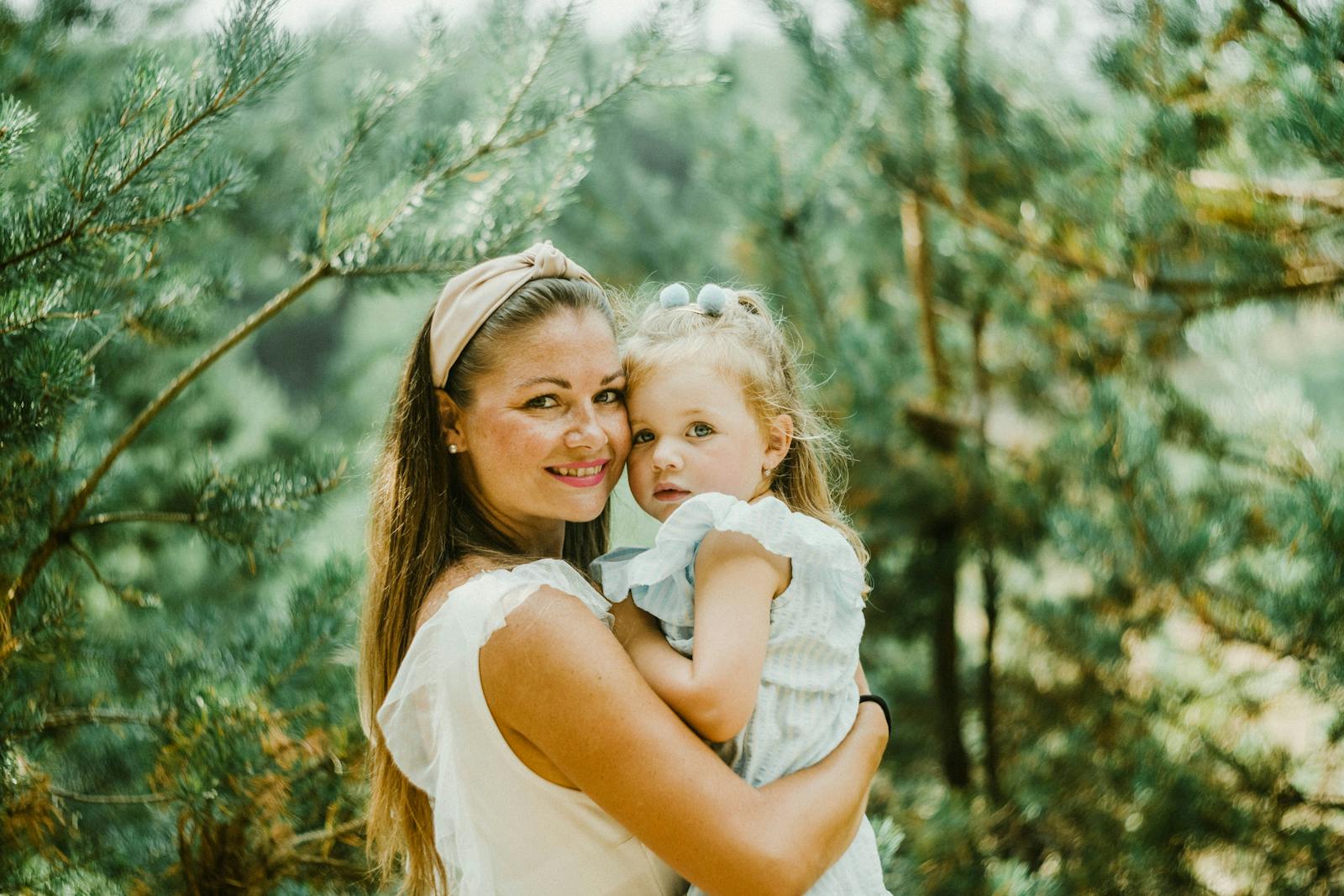
My daughter was laughing at something on the floor. I don’t even know what it was: a sock, maybe, or the way the dog had positioned himself like a tiny furry sphinx in a patch of sunlight. She was laughing with her whole body, the kind of full-throttle, uncontrolled sound that only small children and very drunk adults ever produce. Then she stopped. Looked at me. And said, “Sorry for being loud.”

Nobody in the room had told her to be quiet. Nobody had shushed her. Nobody had even glanced up with mild irritation. She just… stopped herself. And apologized for the crime of experiencing joy at full volume.

The conventional wisdom around moments like this is reassuring: children learn social awareness naturally, and adjusting their behavior shows healthy development. Self-regulation is a milestone. We celebrate it. We call it emotional intelligence. And to some degree, that framing is correct. But there’s a difference between a child learning when to use an indoor voice and a child learning that her natural state of being requires an apology. The first is socialization. The second is something else entirely.

I recognized it instantly because I remember the exact day it happened to me.

The moment the volume knob turns down

I was about six, maybe seven. We had family over, and I was doing something unremarkable: telling a story, probably too fast, probably too animated. My father put his hand on my shoulder and said, quietly enough that only I could hear, “You don’t need to be the center of attention.” He wasn’t angry. He wasn’t cruel. He was teaching me something he genuinely believed was useful: modesty, restraint, the social skill of taking up less space.

And I learned it. I learned it so well that for the next three decades, I calibrated my enthusiasm before expressing it. I checked rooms before I laughed. I monitored how much space my personality occupied and trimmed the edges preemptively.

My father wasn’t a bad parent. He was a good one operating from a blueprint he’d inherited. His mother had taught him the same thing, and her mother before that. The pattern didn’t start with any single person. It just kept going, like a song everyone hums without remembering the original melody.

child laughing freely
Photo by Natasha Babenko on Pexels

What struck me about my daughter’s apology wasn’t the words. It was the speed. She corrected herself before anyone else had a chance to. The self-editing had already become automatic, and she’s barely old enough to tie her shoes.

When self-regulation becomes self-suppression

Developmental psychologists have observed differences between healthy self-regulation and premature self-suppression. Research on coregulation shows that children develop the ability to manage their emotions through consistent, responsive interactions with caregivers. A child learns to calm down because a calm adult has modeled it, over and over, in real time. That process takes years to mature.

But what happens when the modeling isn’t about calming down? What happens when the lesson a child absorbs is that certain emotional states are inherently inappropriate?

The answer is that self-regulation gets hijacked. Instead of learning “I can feel this and manage it,” the child learns “I shouldn’t feel this at all.” The skill that’s supposed to help them navigate the world becomes a tool for erasing parts of themselves.

A four-year-old apologizing for laughing too loudly hasn’t learned emotional regulation. She’s learned emotional surveillance.

The inheritance nobody talks about

I wrote recently about spending two decades building a life designed to earn approval from people who stopped keeping score years ago. The thread that connected that piece to this moment with my daughter is the same one: we inherit not just values from our parents, but operating systems. And those operating systems run in the background long after the original programmer has forgotten writing the code.

The intergenerational transmission of parenting patterns has been observed across multiple studies in developmental psychology. Parents don’t just pass on eye color and temperament. They pass on the invisible rules about which emotions are acceptable, how much space you’re allowed to occupy, and whether your natural impulses need to be apologized for.

This isn’t always dramatic. Often the transmission is quiet. A raised eyebrow when a child is too exuberant. A gentle correction delivered with love but laced with an unspoken message: “Be less.” A parent’s visible discomfort with loudness or mess or uncontained energy, which the child reads and responds to before any words are spoken.

Children are extraordinary readers of the room. Research on observational learning has demonstrated that children don’t need to be explicitly instructed to adopt behaviors. They watch. They absorb. They replicate. Social learning theory tells us that the models children observe, especially primary caregivers, shape norms and behavior in ways that persist long into adulthood.

My daughter didn’t learn to apologize for laughing from a lecture. She learned it from the air in the room. From the thousand tiny signals that accumulate into a personality.

Who taught me, and who taught them

When I say I remember who taught me, I want to be precise about what I mean. I’m not blaming my father. That would be too simple, and also unfair.

My father grew up in a household where restraint was the highest virtue. His parents were products of their own upbringing, shaped by economic pressure and cultural expectations that valued quiet competence over expressive joy. Being small, being modest, being careful about how much of yourself you revealed: these weren’t personality flaws. They were survival strategies.

The problem is that survival strategies have a half-life that extends far beyond the circumstances that created them. A behavior that made sense in one generation becomes a reflexive template in the next.

In my recent piece on how lower-middle-class financial habits persist long after the scarcity is gone, I explored this same principle: the nervous system learns a pattern under pressure, and then the pattern outlives the pressure by decades. The same mechanism applies to emotional expression. You learn to be small when being small keeps you safe. Then you keep being small long after the danger has passed, and you teach your children to be small too, because you’ve forgotten it was ever a choice.

My father didn’t decide to teach me to suppress my enthusiasm. He was running inherited software. And until I watched my daughter apologize for laughing, I didn’t fully realize I was running it too.

What the apology actually means

A child who apologizes unprompted for a natural behavior is telling you something important. She’s telling you she’s already built an internal model of what she believes is acceptable, and she’s already monitoring herself against it.

That model didn’t come from nowhere.

It came from every micro-reaction she’s observed. The slight tension in a parent’s jaw when a shriek hits a certain pitch. The speed with which someone says “inside voice” during a moment of delight. The difference in warmth she receives when she’s calm versus when she’s wild.

Children are data scientists. They collect thousands of observations and build predictive models about what earns love and what risks its withdrawal. By four, many of them have already constructed an internal editor sophisticated enough to catch joy before it reaches full expression and reduce it to something more palatable.

The tragedy isn’t that children learn to modulate. That’s part of growing up. The tragedy is when they learn to modulate the wrong things.

parent child quiet moment
Photo by Kindel Media on Pexels

Catching the pattern before it sets

Here’s what I did when my daughter apologized for laughing. I sat down on the floor next to her and I laughed. Not performatively. Not to make a point. I laughed because the dog genuinely did look ridiculous lying there, and because my daughter’s laugh is one of the best sounds on earth, and because I wanted her internal data scientist to record a different observation: loud joy is welcome here.

Then I said something simple: “You never have to be sorry for laughing.”

She looked at me like she was processing this. Then she went back to laughing at the dog.

I don’t think one moment undoes a pattern. Patterns are stubborn. They’re reinforced by repetition, not by single corrective events. But I also know that patterns can be interrupted. The research on coregulation suggests that consistent adult responses shape a child’s developing self-regulation capacities, which means the signals I send in a thousand small moments will accumulate into something she carries forward.

The question isn’t whether I’ll get it right every time. I won’t. The question is whether the overall signal is clear: your full self is welcome in this house.

The harder work: uninstalling your own software

Teaching your child that her laughter doesn’t require an apology is the easy part. The harder part is noticing the moments when your own inherited programming activates.

I still catch myself dimming. In meetings, at dinners, in conversations where I have something to say but some old subroutine runs a quick calculation: Is this too much? Am I taking up too much space? Will this enthusiasm be received or judged?

Thirty years of practice makes that calculation nearly instantaneous. It happens below conscious awareness, which is exactly what makes it so persistent. You don’t fight habits you can’t see.

The Buddhist concept of samskaras (mental impressions or imprints) describes this with useful precision. Every repeated experience leaves a groove, and the groove makes it easier for energy to flow in that direction next time. Over years, the grooves become channels, and the channels become the only paths you know. Changing direction requires not just wanting to change, but noticing the groove in real time, which demands a kind of ongoing attention most people reserve for meditation retreats.

But parenting, if you let it, is its own kind of meditation retreat. Children mirror your patterns back to you with uncomfortable clarity. My daughter’s apology was a mirror, and what I saw in it was my father’s hand on my shoulder at a family gathering thirty years ago.

What I want her to keep

I don’t want to raise a child who has no social awareness. The world requires calibration. There are moments when quiet is appropriate, when reading the room matters, when restraint serves genuine kindness.

But I want her to learn calibration, not erasure. I want the dial to be something she adjusts consciously when the situation calls for it, not something that’s been permanently turned down by the age of four because she absorbed the unspoken message that her natural volume was a problem.

I wrote about the psychology of people who start saying no after decades of automatic agreement, and one of the things that struck me while writing it was how many of those people traced their pattern of over-compliance back to childhood. Specifically, back to a moment very much like my daughter’s: a moment when they learned that their natural impulse needed correction.

The correction was small. A glance, a word, a hand on the shoulder. But the lesson was enormous: who you are, at full volume, is inconvenient.

That’s the lesson I’m trying to intercept.

Not because my parents were wrong to teach what they taught. They were doing their best with the tools they had. But because I can see the pattern now, which means I have a choice they didn’t know they had. I can let it continue, or I can put my body on the floor next to my daughter and laugh at a ridiculous dog and let her record a different kind of data.

She won’t remember this specific moment. That’s fine. The point was never the moment. The point is the accumulation. The thousand small signals that add up to either “edit yourself” or “you’re welcome here, all of you, even the loud parts.”

Especially the loud parts.

Feature image by Helena Jankovičová Kováčová on Pexels