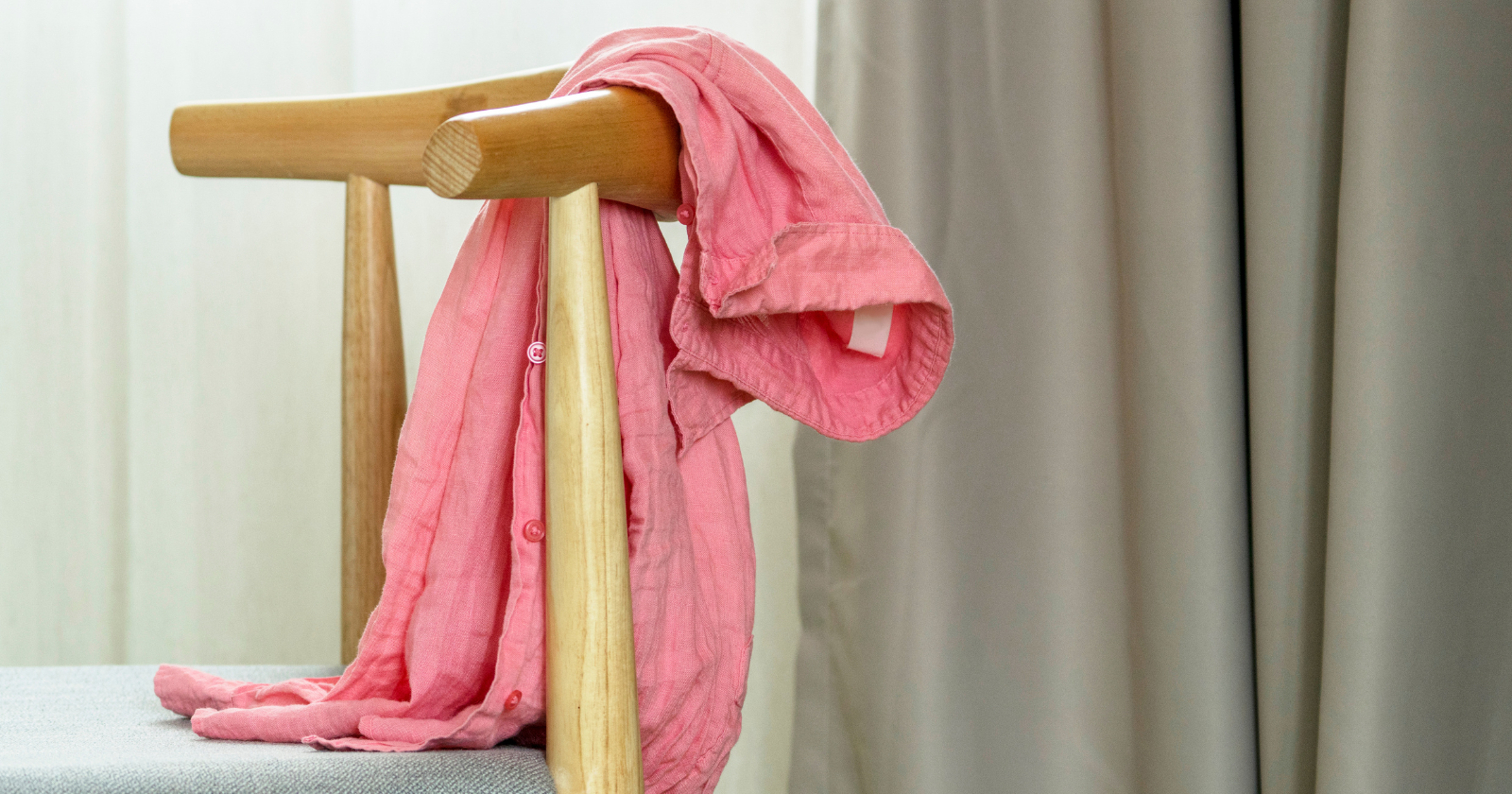
The chair is almost never empty. A cardigan draped over the back, jeans folded once and slung across the seat, a shirt worn for two hours to a dinner and now stranded in a state that isn’t dirty but isn’t quite clean. Every household has some version of it: the chair, the exercise bike, the treadmill, the corner of the dresser where clothes accumulate in soft, ambiguous piles.
People who live this way are often quietly embarrassed by it. They shouldn’t be.
The chair is not a failure of discipline. It is a rational response to a category problem that no closet, no laundry hamper, and no organisational book has ever properly addressed: the clothes that occupy the middle ground between clean and dirty.
The category the laundry system forgot
Domestic organisation systems assume a binary. Clothes are either clean (folded, in drawers, hanging) or dirty (in the hamper, waiting to be washed). Every storage solution ever sold, from Marie Kondo’s folding method to modular closet systems, is built on this two-state model.
But most adults wear their clothes in three states, not two. Clean. Dirty. And the third, unnamed category: worn once, aired out, still fine for tomorrow, but wrong to fold back into the drawer with the freshly laundered shirts.
The jeans worn for a few hours on Saturday. The sweater put on over a clean shirt for a chilly evening. The pyjamas from last night that will be worn again tonight. None of these belong in the hamper. None of them belong in the drawer either.
So they end up on the chair.
A liminal object in a liminal state
Psychologists have a name for the mental and physical zones that sit between two more defined states: liminal spaces. The term originally described psychological transitions, the period between an old self and a new one, but it applies just as neatly to physical objects and locations that don’t fit tidy categories.
Health writers describing the concept note that liminal spaces can be physical locations, like airports, train stations, and elevators, or psychological states of in-between. They are, by design, temporary. Bridges rather than destinations.
The bedroom chair is a household airport. Clothes pass through it on their way from worn to washed, or from worn to worn-again. The problem is that airports work because planes eventually leave. The chair works less well because nothing schedules the departure.
Research on the neuroscience of liminal environments suggests these spaces have a real cognitive function. Writing in Psychology Today, researchers describe how transitional zones give the brain a pause, a place to hold something before deciding what happens next. The chair is doing exactly that. It’s a holding pattern for a decision the mind hasn’t finished making.
Why the decision keeps getting postponed
Deciding what to do with a half-worn sweater is a tiny question. Multiply it across every garment in the house and it stops being tiny.
The quality of choices deteriorates with volume. A summary of the science on decision fatigue describes it as a decline in the quality of decisions after making several consecutive choices, with cognitive and self-regulatory resources becoming depleted.
By the time a person is undressing at the end of a long day, the executive function required to determine is this shirt clean enough to reuse, and if so, where should it live overnight? is essentially gone. The chair is what happens when the brain has run out of adjudication.
Writing in Forbes, leadership researchers describe decision fatigue as a quiet saboteur that erodes judgment through the sheer accumulation of small choices. Household life is nothing if not an accumulation of small choices. The chair is the tell.
The clothes are doing a kind of thinking for you
There’s another layer. The chair isn’t only a storage failure. It’s also a memory device.
When a person drapes yesterday’s jeans over the arm of a chair, they are, in effect, leaving a note for their future self: these are wearable, don’t overthink tomorrow morning. The chair reduces the number of decisions that need to be made when getting dressed the next day. It’s an outsourced piece of cognition, made of fabric.
This is not unlike the reason some people keep the same books stacked on the nightstand for years. As we’ve explored in the small pile of unfinished books that signals the day is allowed to end, physical objects sometimes hold psychological positions that would otherwise take conscious effort to maintain. The chair does the same job for morning.
Humans offload memory and decision-making onto their environments. Notes on the fridge. Keys by the door. A pair of trousers on the chair is part of the same family of behaviours. It’s cognition, distributed across the room.
Why no household system has solved it
Every attempted solution runs into the same wall. The clothes-in-limbo need to be somewhere visible, because forgetting they exist means either washing them prematurely or losing track of them entirely. But visible storage in a bedroom, by definition, looks like clutter.
Hooks on the back of the door help for one or two items but fail at scale. Valet stands, popularised in the mid-twentieth century, were designed for exactly this problem but only accommodate a single outfit at a time. Second closets are a luxury few can spare. Baskets and bins collapse the visibility that made the system work in the first place.
The chair persists because it is the most honest solution. It admits that the clothes exist in an intermediate state and gives them an intermediate place to be.
The shame is the extra problem
What complicates the chair is not the chair. It’s the feeling that having one signals a moral or organisational shortcoming.
Home organisation culture, particularly over the last two decades, has quietly moralised tidiness. A cluttered surface implies a cluttered mind. A pile of clothes suggests someone who has lost control. The industry that sells storage sells this framing because it drives purchases.
But the chair predates the industry. Every generation, in every culture that wears layered clothing, has invented some version of the middle-ground surface. In Japanese homes it might be a folded stack on a low shelf. In older European households a wooden clothes horse near the bedroom. The specific piece of furniture varies. The behaviour is universal.
What has changed is not the pile. It’s how people feel about having one.
Reading the chair honestly
Rather than treating the chair as a problem to be solved, it may be more useful to read it as information about how a person actually lives.
A chair with two items on it, cycled regularly, is a functional third category, working exactly as intended. A chair with fourteen items, some of which have been there for months, is a different signal. It’s usually pointing to something else: a stalled decision about which clothes still belong to the current self, or a period of overload where even three-second choices feel like too many.
The distinction matters. Similar to the drawer of unused pens and notepads that quietly holds the memory of a self that once believed the right tools would unlock the writing, the chair sometimes holds clothes belonging to a version of the person who no longer exists. The jeans that don’t quite fit anymore. The blazer for the job that ended two years ago.
When the chair becomes archaeological rather than functional, it’s saying something worth listening to.
The small daily gap, honoured
The clothes on the chair are proof of a life that isn’t organised around single-use cycles. Most garments, most of the time, are worn more than once between washes. This is not laziness. It is textile reality, and increasingly, environmental sense.
What the chair reveals is the mismatch between how clothes actually get used and how storage is designed to hold them. The washing machine imagines two states. The wardrobe imagines two states. The wearer knows there are at least three.
Some households have started experimenting with a slightly more formal version of the chair: a designated hook rail, a labelled shelf, a small open-fronted cabinet in the bedroom for the in-between garments. These solutions work not because they eliminate the pile but because they legitimise it. The middle category gets an address.
Others simply accept the chair. There is a quiet dignity in this. It stops the daily internal argument about whether one is failing at housekeeping and reallocates that mental energy to something that actually matters.
What the chair is really saying
The chair is a small monument to the fact that domestic life is messier than the systems designed to contain it. People are not machines that alternate between fully clean and fully dirty. Neither are their clothes.
The chair, seen clearly, is not clutter. It is a working prototype of a household category that no manufacturer has yet built furniture for, kept alive by the millions of people who quietly need a place to put yesterday’s sweater.
It is also a reminder that some of the daily rituals that look like disorganisation are actually improvised solutions to problems the culture hasn’t named. The people with a chair full of clothes have solved something. They are just embarrassed about the solution.
They needn’t be.