

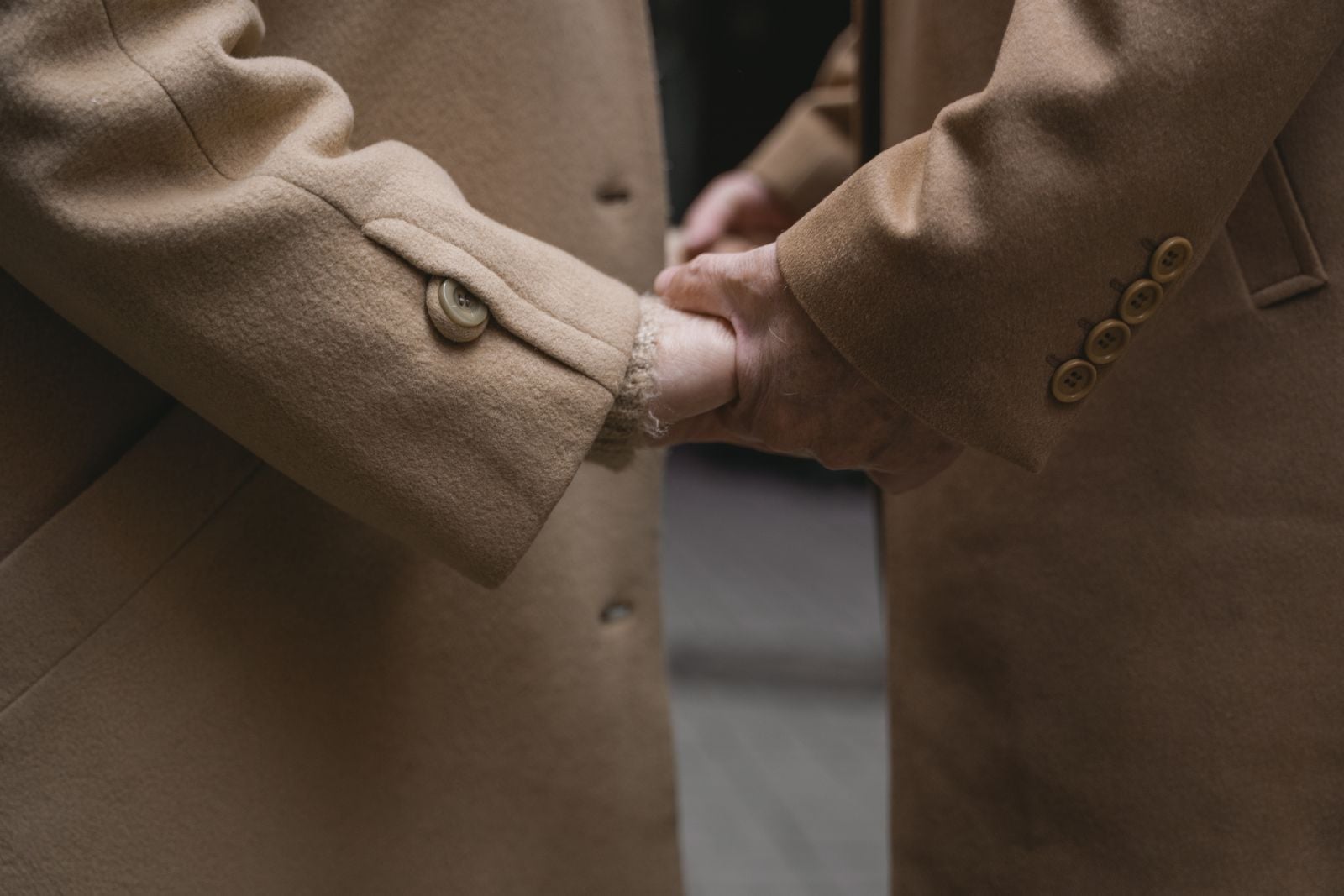
A coat that has outlasted most of your friendships is not a failure of consumer imagination. It is a quiet form of literacy about what actually lasts.
The person still wearing the same navy wool overcoat they bought in their late twenties, now creased at the elbows and softened at the collar, is often assumed to be frugal, sentimental, or slow to update their taste. The assumption misses the point entirely.
What they have figured out is closer to a principle: some objects earn their place in a life the same way people do. Through years of showing up when needed, without drama, without asking to be replaced.
The cultural bias against keeping things
Most contemporary advice about belongings treats them as clutter waiting to be released. Minimalism, decluttering, capsule wardrobes, the seasonal purge — the moral weight sits firmly on the side of letting go.
There is real wisdom in that. A closet stuffed with clothes never worn is its own kind of burden. But the pendulum has swung so far that people who genuinely use and love an old object often feel they have to explain themselves.
They don’t. A twenty-year-old coat that still gets worn every winter is not clutter. It is the opposite of clutter. It is proof of a working relationship.
Why some objects age into meaning
Trust is built on a repeated experience of competence, benevolence, and integrity over time. Something demonstrates that it will do what it said it would do, again and again, until the assumption of reliability becomes automatic.
Objects can do this too. A well-made coat that has kept you warm through fifteen winters has, in a functional sense, kept its promises. The seams have not given way. The lining has not shredded. It performs the small daily miracle of doing exactly what it was built to do.
As explored in psychology research on trust repair, trust has to be rebuilt slowly through consistent, observable behaviour after a breach. The reverse process is quieter but just as real. Consistent, observable reliability, extended over enough time, becomes something a person stops questioning.
The strange status of a long-owned thing
There is something almost embarrassing about admitting how old a favourite object is. People will apologise for a coat, a bag, a pair of boots the way they might apologise for a messy kitchen — as if longevity were a lapse in ambition.
Consider what humans have actually kept alive across time. Ancient bristlecone pines in California’s White Mountains have been growing for thousands of years. The Hartford Courant has been published continuously since 1764. Oxford has been teaching since the 11th century. Twinings has been selling tea from the same London location since 1706.
Against that scale, a twenty-year-old coat is barely a moment. And yet the reflex is to feel that a thing bought before the last two phone upgrades is somehow suspect.
What long ownership actually teaches you
People who keep objects for decades tend to develop a specific kind of attention. They notice how something wears. They know which button is loose. They can tell you what year the small stain near the pocket happened and what they were doing when it did.
This is not sentimentality. It is a form of care that most disposable relationships with things never allow. You cannot know a coat this way if you replace it every three years.
And the coat, in turn, comes to carry information. The weight of it in your hand at the front door is familiar in the same way a friend’s laugh is familiar. You do not have to think about it. You know it is there.
The rewatch principle, applied to objects
There is a parallel here to the way people return to the same films year after year. Rewatching is not avoiding new stories. It is returning to a version of themselves that the film knows how to summon.
Old objects do the same work in a more physical register. Slipping into a coat you have worn for twenty years is a small act of continuity. It says, whatever else has changed, this at least is still here. You are still the person who bought this. The person is still the one wearing it.
In a life that has probably shed jobs, addresses, and relationships across those two decades, that continuity is not trivial.
Reliability as the quiet foundation of attachment
The word attachment usually gets applied to people. But the underlying mechanism — the nervous system learning that something is safe because it has been safe, repeatedly, over time — does not discriminate between animate and inanimate sources of consistency.
Many people find that background voices or sounds at night signal safety, a pattern often established in childhood when voices in another room meant the house was safe. The nervous system does not update easily. It reads what it has learned to read.
A coat that has hung in the same hallway for fifteen years operates on similar terms. It is a small landmark of continuity in a body’s map of the world.
The economics are almost incidental
People sometimes defend long ownership on financial grounds. A good coat that lasts twenty years is cheaper per wear than five cheap coats bought across the same period. This is true, and it is the argument most likely to convince a sceptical friend.
But it is not the real reason anyone keeps a coat that long. Nobody who genuinely loves an old object is running the maths in their head each winter. The value is not amortised. It is accumulated.
Every winter added is not a saving. It is a deepening.
What the Harvard longitudinal work suggests, indirectly
The 80-plus year Harvard Study of Adult Development famously found that the quality of close relationships is a stronger predictor of health and happiness in later life than wealth, career, or intelligence. The word that keeps surfacing in the study’s findings is not intensity or excitement. It is warmth. Reliability. The sense that someone is there.
The same qualities that predict a good long friendship — showing up, being consistent, being predictably competent at the small things — are the qualities that make certain objects worth keeping.
None of this is to suggest that a coat is a friend. Only that the criteria a person uses to decide what stays in their life tend to be more consistent than they realise. Reliability is reliability, wherever it appears.
The resistance to novelty is not the point
It would be easy to frame all this as a case against buying new things. That would be missing the point in the other direction. People who own decades-old coats are not against new coats. They are simply not interested in replacing something that is still working.
The mistake in consumer culture is not the availability of new things. It is the assumption that arrival of the new automatically retires the old. A twenty-year-old coat does not become worse the moment a newer one exists.
The wearer of the old coat has simply refused to accept that framing. They have made a small, private decision that the standard is performance, not novelty.
What this looks like in practice
The person who keeps the same coat for twenty years usually keeps other things the same way. The mug used every morning. The pen that has been refilled seven times. The kitchen knife that has been sharpened to a slightly thinner blade than it started with.
These are not curated. They are not aesthetic choices for anyone else’s benefit. They are the residue of a hundred small moments of not-replacing.
Over time, a home starts to feel less like a stage set and more like a working environment. Nothing in it is trying to impress anyone. Everything in it has earned its spot.
A quieter definition of change
The assumption that keeping old things means resisting change gets the direction wrong. Change happens constantly, whether anyone permits it or not. Bodies age, cities reshape, friendships end, careers end. The coat, meanwhile, keeps doing what it has always done.
In that light, the coat is not a refusal of change. It is a small, deliberate anchor against a current that never stops moving. One fixed point in a life that has revised nearly everything else.
The person wearing it has not stopped growing. They have simply figured out that growth does not require throwing away what already works.
The wider quiet
There is a certain composure in people who have long relationships with their belongings. They are harder to sell to. They are less anxious about seasonal trends. They tend to be slower to feel that they are falling behind.
Some of this shows up in the broader work on what a settled life looks like — the kind of small, ordinary steadiness explored in pieces like the art of being unbothered. A person who is not worried about their coat being out of style has one less thing to be unsettled by. Multiply that across a household, and a genuine quiet starts to accumulate.
It is not a philosophy. It is not a brand. It is closer to a habit of noticing what is already good enough.
What the coat knows
The coat, of course, knows nothing. It is wool and lining and buttons and thread. It has no opinion about being kept.
But the person who has kept it has, over the years, learned something the coat could never have told them directly. That certain things earn their place slowly. That reliability is a form of love that does not need to announce itself. That the objects still in a life after twenty years are, in a small way, the ones that never gave anyone a reason to look for a replacement.
Which is, when you think about it, the same test the best friendships pass.
