

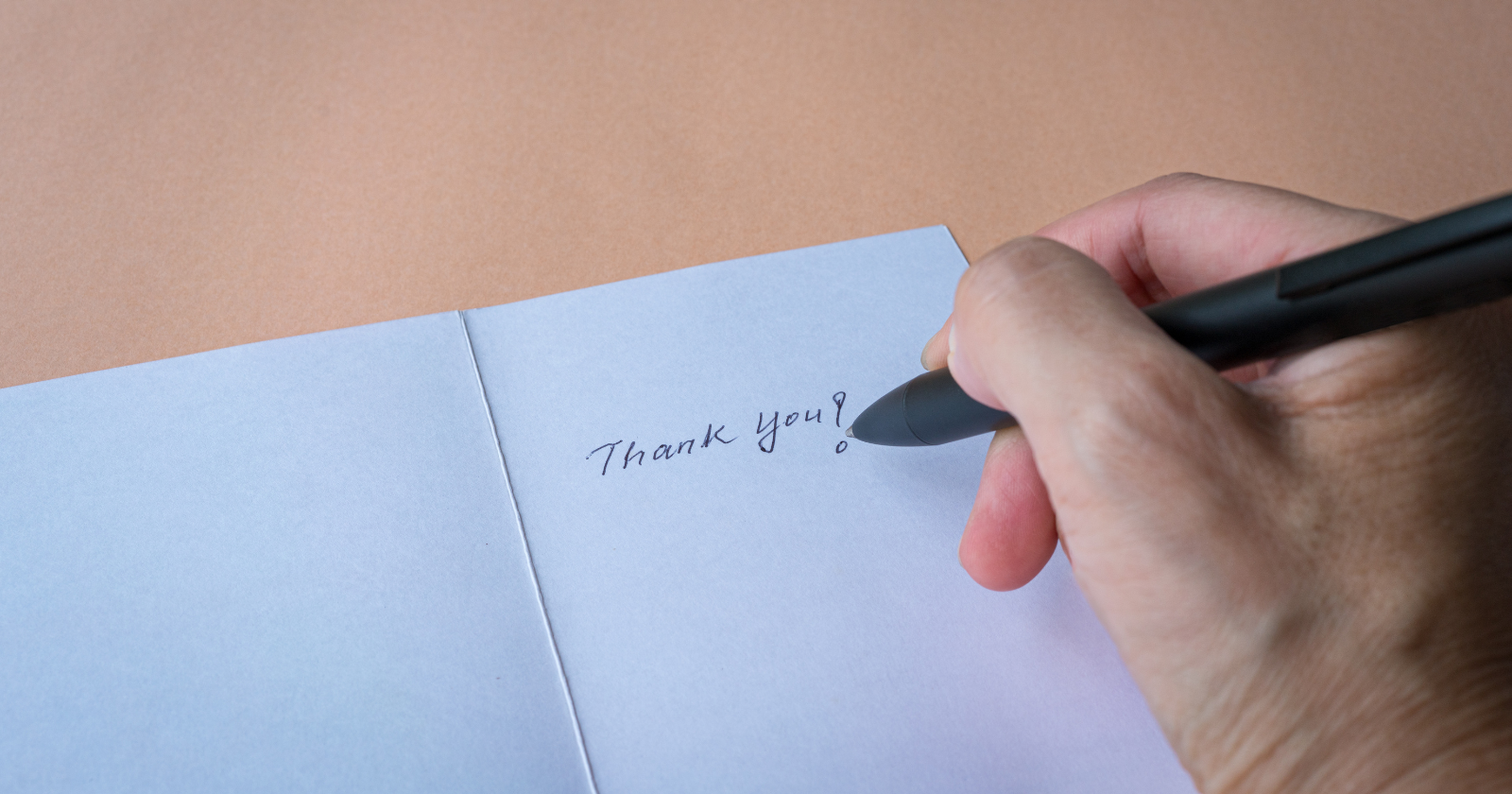
A handwritten thank-you note now feels almost disproportionate to the favour it acknowledges. A colleague covers a meeting, a neighbour brings in a parcel, or a friend hosts dinner, and the expected response is usually a quick message sent before the moment has fully settled.
The person who chooses paper instead is not necessarily preserving an old rule of etiquette. They may simply be choosing a medium that requires more attention, gives gratitude a physical form, and makes an otherwise ordinary thank-you difficult to overlook.
What the pen does that the keyboard does not
Handwriting is slower than typing, but that slowness changes the task. Research reviewed by Psychology Today indicates that handwriting engages motor, language and attention systems, with an EEG study finding more widespread brain connectivity during handwriting than typing.
That does not mean every handwritten sentence becomes permanently fixed in memory. It does suggest that writing by hand requires more simultaneous decisions about movement, wording, space and pace than tapping keys does.
Students taking notes by hand also tend to record fewer words than laptop users. Because they cannot capture everything verbatim, they have to select, condense and reorganise information as they write. The pen does not merely slow transcription. It can force the writer to decide what matters.
Research involving children has similarly found advantages when unfamiliar letters or characters are learned through handwriting rather than typing. The movement involved in forming a symbol gives the brain more information than simply pressing the key that represents it.
Why a thank-you specifically
Gratitude can be reduced to an emoji, but something is lost in the reduction. Expressing appreciation can strengthen relationships by showing care, recognising another person’s actions and bringing people closer.
A handwritten note makes that expression unusually visible. The recipient can see that someone chose a card, found a pen, composed the message and arranged for it to reach them. The medium quietly communicates effort before the first sentence has even been read.
A quick “thank you” and a handwritten note may contain the same basic information. They do not carry the same evidence of time. One appears instantly among dozens of other notifications, while the other arrives as an object made for a particular person.
The writer has to remain with the feeling
Handwriting also changes what happens on the sender’s side. Because the hand cannot usually keep pace with thought, the writer has to stay with the sentiment long enough to choose a few precise words.
A message thanking someone for staying late, making an introduction or noticing that something was wrong becomes harder to write vaguely. The writer has to identify the action and explain why it mattered. That small demand can turn a routine courtesy into a clearer recognition of what another person actually contributed.
The permanence of ink adds another kind of attention. A typed sentence can be rewritten repeatedly before it is sent. A handwritten sentence asks the writer to commit, or at least to live with a crossed-out word and continue.
The habit is not limited to one generation
Handwritten notes are often associated with retirees, formal families or expensive stationery. In practice, the habit appears wherever people want communication to feel more deliberate than the surrounding digital noise.
Some people learned the practice from parents or grandparents. Others arrived at it after years of sending messages that were efficient but forgettable. For them, buying cards and stamps is not a return to a vanished social code. It is a way of making certain messages harder to treat casually.
The note can appear in professional settings, after weddings and interviews, or between friends who already communicate online every day. Its meaning comes partly from contrast. A voice note feels different from a text, a call feels different from a voice note, and a letter now arrives like a small event.
Slowness used on purpose
The handwritten note belongs to a broader group of habits that can look like resistance to technology but are often attempts to use attention more deliberately. A paper calendar offers a view of time that a series of phone alerts does not. A notebook keeps an unfinished thought visible without surrounding it with tabs, advertisements and incoming messages.
The thank-you note works in much the same way. Its inconvenience is not an accidental flaw. The walk to the postbox, the stamp and the few minutes spent writing create a boundary around the act.
Repeated details can also make the practice feel grounding: the familiar pen, the box of cards and the place where they are kept. Writing after a difficult day may redirect attention, briefly but concretely, towards someone who made life easier.
The note as a private act of attention
Some thank-you notes are strategic. Businesses send them to customers, candidates send them after interviews, and professionals use them to maintain relationships. The intended impression is part of the reason they exist.
A habitual note-writer may be doing something less calculated. Sitting down to write requires the person to name who has been kind, what happened and why it deserves to be remembered. That process can matter even before the envelope is sealed.
A message typed while walking home might say only, “Thanks for dinner.” A note written the next morning creates room to remember whether the real gift was the food, the invitation, the conversation or the fact that someone noticed the writer needed company.
Over time, the blank cards waiting on a desk can become a quiet prompt. They ask who has recently shown up, who offered help without being asked and which moments should not be allowed to disappear into the speed of the week.
What the recipient actually receives
A handwritten note does not arrive beside a work alert, a group-chat argument and a delivery notification. It appears among bills, catalogues and administrative mail as the rare envelope that was created for the person opening it.
That difference affects how it is handled. The recipient may read it twice, leave it on a desk or place it in a drawer with other objects that carry personal meaning. A digital message can also be saved, but it remains inside the same device that holds thousands of photographs, conversations and reminders.
The handwriting itself contributes to the sense of presence. The uneven spacing, pressure, corrections and shape of the letters are traces of someone’s physical involvement. No inference about personality or health is required for that to matter. The message looks like it came from a particular hand rather than from a standardised font.
Why the habit persists in a paperless world
Predictions about the death of handwritten correspondence usually assume that people choose communication tools mainly for efficiency. That is true when the goal is to transfer information as quickly as possible. It is less true when the goal is to make another person feel that a moment was noticed.
The thank-you note survives because it does several things at once. It slows the writer down, gives the recipient something physical and introduces a small cost in time and effort. Those qualities would be weaknesses in many forms of communication. In an expression of gratitude, they become the point.
People who send handwritten notes are not necessarily defending formal manners or trying to recreate another era. They may simply understand that some kinds of care become more convincing when they involve a little friction.
The pen was never only about etiquette. It was about leaving proof that someone was worth the time.
