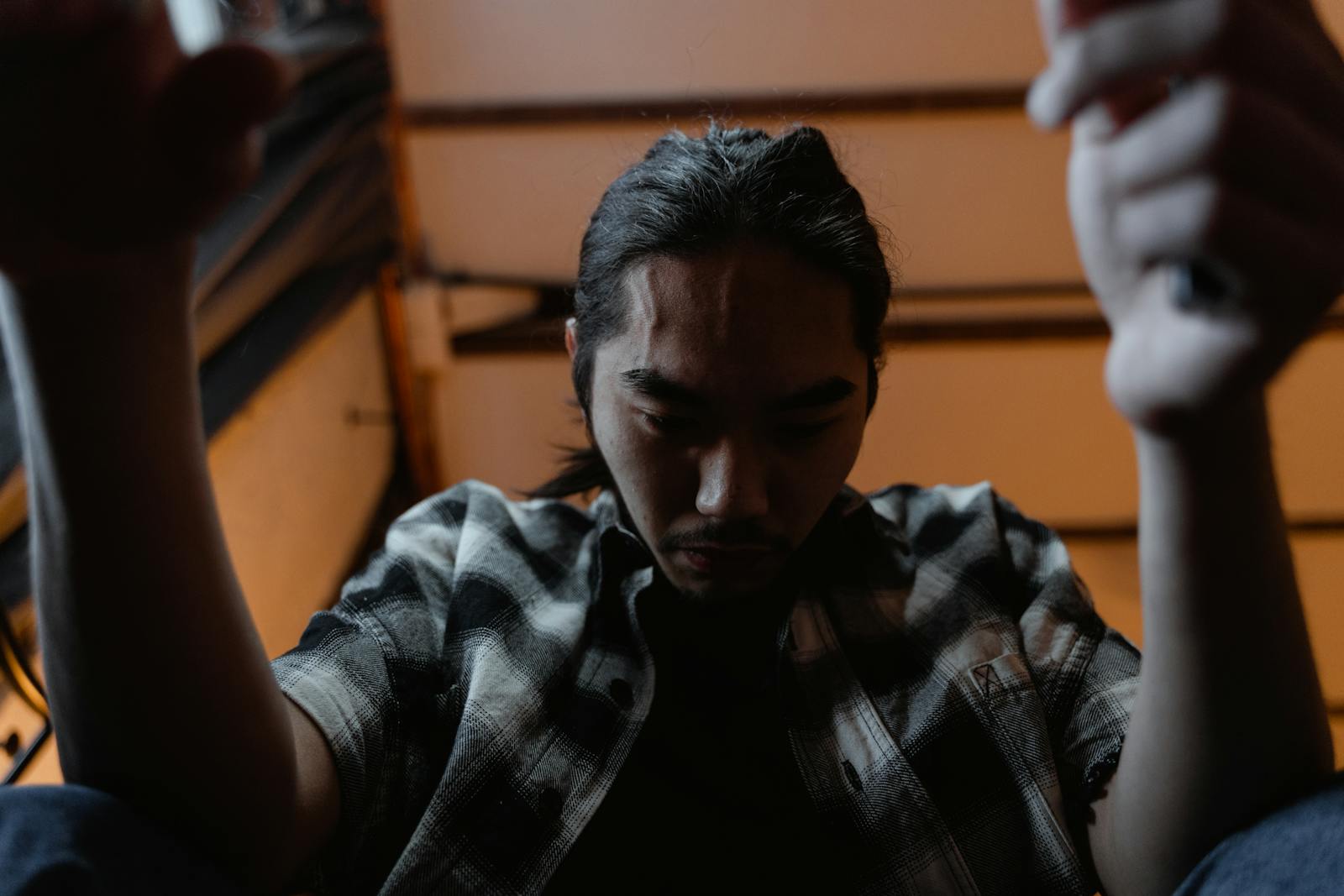
You’ve seen them before. The person in the meeting who doesn’t flinch when the client pulls out. The friend who listens to your panic spiral about a layoff with steady eyes and a slow nod. The parent who stays impossibly composed in the emergency room while everyone else is unraveling.
We sometimes mistake this calm for coldness, or assume it’s a personality trait — something they were born with. Sometimes that steadiness develops through processing adversity. It can also reflect temperament, learned regulation, professional training or other experiences.

Calm isn’t the absence of fear — it’s the other side of it
There’s a concept in trauma psychology called post-traumatic growth: self-reported positive change following a struggle with adversity. It is neither universal nor proof that trauma itself produced calm. Researchers Richard Tedeschi and Lawrence Calhoun at the University of North Carolina Charlotte have spent decades studying this phenomenon, and their findings are striking: people who’ve endured genuine hardship often report increased personal strength, deeper relationships, and a shifted sense of what actually constitutes a crisis.
This isn’t toxic positivity dressed up in academic language. It’s a measurable psychological shift. When you’ve already lost a business, survived a health scare, or rebuilt your life after a betrayal, the threshold for what rattles you simply moves. The presentation that goes sideways at work? Your nervous system has seen worse. It knows the drill. It knows you survived.
That quiet composure you notice in certain people isn’t indifference. It’s recognition. They’ve already walked the terrain everyone else is imagining.
The neuroscience of a re-calibrated threat response
Here’s where it gets interesting at the biological level. Our brains are prediction machines. The amygdala — that almond-shaped structure responsible for processing fear — doesn’t just react to what’s happening now. It reacts to what it expects will happen, based on past experience.
Past experience can influence later threat responses, but it does not let us infer that a survivor’s amygdala has catalogued a crisis and will dampen future panic. Trauma responses vary substantially, including distress, recovery and resilience.
Think of it like an immune system for psychological stress. You don’t get stronger by avoiding every germ. You get stronger by encountering challenges, recovering, and building a more calibrated response. A calm response may reflect effective regulation, but outward composure alone does not reveal what someone is experiencing internally.
It’s not that nothing bothers them
This is the part people get wrong. The assumption is that calm people don’t feel anything. In reality, many of them feel everything — they’ve just developed a wider window between stimulus and response. Psychologists call this the window of tolerance, a concept developed by Dr. Dan Siegel. It refers to the emotional zone in which a person can experience stress without flipping into fight-or-flight or shutting down completely.
People who’ve processed past hardship — not just endured it, but genuinely worked through it — tend to have a wider window. They can sit with discomfort longer. They can hold space for someone else’s panic without absorbing it. They pause before they react, not because they’re suppressing emotion, but because their system has learned that the pause itself is power.
The difference between survival and suppression
Here’s an important caveat, because not all calm is created equal.
Some people appear calm because they’ve dissociated. They’ve walled off their emotional responses not through growth, but through protection. This is a freeze response, and it looks like composure from the outside but feels like emptiness on the inside.
The concepts should not be collapsed. Resilience and post-traumatic growth are distinct constructs. Dissociation can involve detachment, altered awareness or numbness, but appearance alone cannot establish it; the National Center for PTSD describes a range of common trauma reactions. Only a qualified clinician can assess persistent or impairing symptoms.
If you recognize yourself in the second description, that’s not a failure. It’s information. And the path from suppression to genuine calm is one of the most worthwhile journeys a person can take.

What the calmest people have in common
After years of reading the research and observing this pattern in real life, a few traits consistently show up in people who carry this kind of earned steadiness:
1. They’ve stopped catastrophizing — because they’ve lived the catastrophe
Most anxiety is about the imagined worst case. Once you’ve actually lived through your worst case, the imagination loses its grip. You know what rock bottom feels like. More importantly, you know it didn’t destroy you.
2. They have a different relationship with control
People who’ve survived serious adversity often develop what psychologists call secondary control — the ability to adjust their own response when they can’t change the situation. They’re not passive. They’re strategic. They’ve learned to invest energy only where it can actually make a difference.
3. They prioritize nervous system regulation — often without calling it that
The calm person who takes a walk before responding to a tense email, who breathes deliberately in traffic, who goes to bed at a consistent time — they’re not being boring. They’re maintaining the biological foundation of their composure. They know, from hard experience, what happens when that foundation cracks.
4. They hold complexity without panic
Life is messy. Relationships are contradictory. Careers don’t follow scripts. The calmest people have often learned to hold two truths at once — things are hard and they’ll be okay — without needing the tension resolved immediately. This is a hallmark of psychological maturity, and it almost always comes from lived experience rather than theory.
Building this kind of calm intentionally
The good news is you don’t have to wait for catastrophe to develop a more grounded relationship with stress. You can cultivate it deliberately.
Choose manageable challenges carefully. A difficult conversation or a realistic physical goal may help someone practise tolerating discomfort, but the right challenge depends on the person and circumstances. Cold-water exposure is not presented here as a mental-health treatment.
Process what you’ve already been through. Many people carry unresolved experiences that could be a source of strength if they were properly integrated. Therapy, journaling, even honest conversation with someone you trust — these are not luxuries. They’re how raw survival gets refined into wisdom.
Watch how you narrate your past. The language people use about hard experiences can matter, but no single narrative proves recovery or activates a guaranteed growth response. Both can be true. Choose which one you feed.
The quiet authority of someone who’s already been there
There’s a reason we instinctively trust calm people in a crisis. It’s not just that their composure is reassuring — it’s that we sense, on some level, that their steadiness was earned. It carries weight. It carries authority.
If you’re someone who has walked through your own fire and come out the other side with a quieter nervous system and a wider perspective, know this: that calm isn’t something you stumbled into. You built it, brick by brick, in moments when everything in you wanted to fall apart.
And if you’re still in the middle of your fire right now — still afraid, still rattled, still wondering if you’ll make it through — look at the calm people around you. They’re not a different species. They’re just a few chapters ahead.
You’re writing the same story. Keep going.
Feature image by MART PRODUCTION on Pexels