

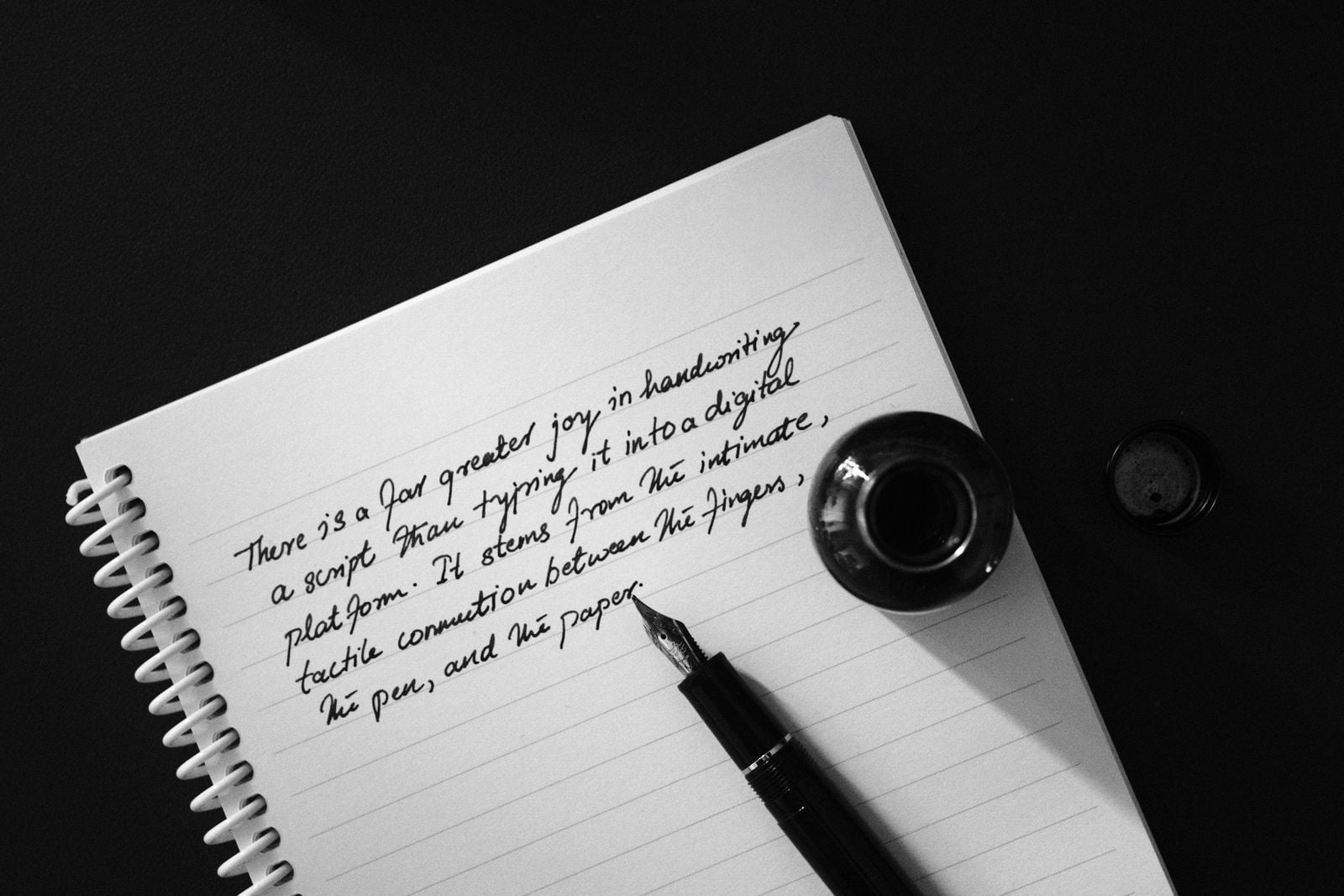
A drawer of unused stationery can behave less like household clutter and more like a fossil bed. Each layer records a version of a person who once stood in a bookshop aisle and believed, quite genuinely, that the leather-bound notebook in their hand might be the missing piece. Dig through the strata and there are receipts, ambitions, and a slow archaeology of intention.
Most people assume the drawer stays full because its owner is disorganised, wasteful, or unable to let things go. Research on regret and the ideal self offers a more interesting lens. For some people, throwing the objects away may feel like admitting something specific about who they once imagined they were becoming.
The gap between the person buying the pen and the person meant to use it
Three versions of the self can coexist inside a single person. There is the actual self, made up of the traits currently in operation; the ought self, shaped by duties and obligations; and the ideal self, built from hopes, aspirations, and the private conviction that a better version is still waiting to emerge. A summary of research by psychologists Thomas Gilovich and Shai Davidai describes failures to become the ideal self as a particularly enduring source of regret.
The unopened notebook belongs symbolically to that ideal self. It was bought while imagining a future where mornings begin with a warm drink and a page filled with clear sentences. The pen was chosen to match that morning, but the actual self was the one who eventually inherited the drawer.

Photo by Magda Ehlers on Pexels
Why the “coulda” regret sticks longer than the “shoulda”
Gilovich and Davidai found that enduring regrets often involve failures to fulfil hopes, goals, and aspirations rather than failures to meet duties. A regret linked to obligation can sometimes be answered with a concrete action, such as making an apology, returning a call, or finally completing the paperwork. The action may not erase the mistake, but it can give the regret a clearer ending.
A coulda regret is harder to close because the imagined future may remain technically possible. The novel could still be written, the drawings could still be made, and the journal could still begin tomorrow. Because the opportunity appears to remain open, the regret can remain active as well.
The stationery drawer sits neatly inside that tension. Every fresh notebook can be read as evidence that the window remains open. It can also become evidence that another year passed without anyone walking through it.
What the Zeigarnik effect can and cannot explain
Bluma Zeigarnik’s 1927 experiments examined whether people remembered interrupted tasks better than completed ones. Her participants worked through a series of activities, some of which were interrupted, and the original study reported stronger recall for the unfinished tasks. That result became known as the Zeigarnik effect.
The finding is often repeated as proof that unfinished tasks automatically occupy more mental space. However, a 2025 meta-analysis by Romain Ghibellini and Beat Meier found no general memory advantage for unfinished tasks. The researchers concluded that the effect depends heavily on circumstances and individual differences, while the separate tendency to resume interrupted tasks appears more consistent.
A Psychology Today discussion describes the familiar idea that unfinished business can claim an outsized share of attention. That remains a useful description of how an unfinished project can feel, but it should not be treated as a universal rule about memory. The drawer may hum for one person and remain emotionally silent for another.
A Forbes feature uses the effect in the narrower context of relationships, arguing that unresolved feelings can keep people mentally returning to an ending that never felt complete. An unopened notebook can be understood as a smaller, tidier version of that experience. The comparison is an analogy, not proof that every unused notebook represents an active psychological loop.
Opportunity, and the strange weight of a still-open door
Opportunity can intensify regret because an open door leaves room for corrective action. In a 2005 study, Neal Roese and Amy Summerville found that greater perceived opportunity was associated with more intense regret. Their review also placed education at the top of American regret rankings, partly because returning to education remains possible across much of adult life.
The stationery drawer can work through the same logic. The tools are still there, the pens still write, and the paper is still blank. The person who bought them may still be capable of becoming the writer they had in mind.
Giving the objects away can therefore feel less like clearing space and more like declaring that the opportunity has closed. Many people are not ready to make that declaration. The drawer stays because the possibility stays with it.
The particular grief of the notebook you almost used
There is a specific tenderness to notebooks that were opened once, filled for three pages, and then abandoned. These can feel heavier than the sealed ones because the sealed notebook still contains pure potential, while the half-used one contains evidence. It shows that the hoped-for version of the self appeared briefly and then disappeared.
The handwriting on page one is usually careful because someone was trying. By page three, the writing may have loosened, the entries may have become sparse, and then the entries stop altogether. The remaining pages stay blank and slightly warped from being carried between homes, bags, and imagined new beginnings.
Throwing such a notebook away can feel like discarding a version of the self in the middle of an unsuccessful attempt. That is more emotionally complicated than disposing of ordinary paper. It is understandable that the decision rarely feels urgent on a Tuesday afternoon.
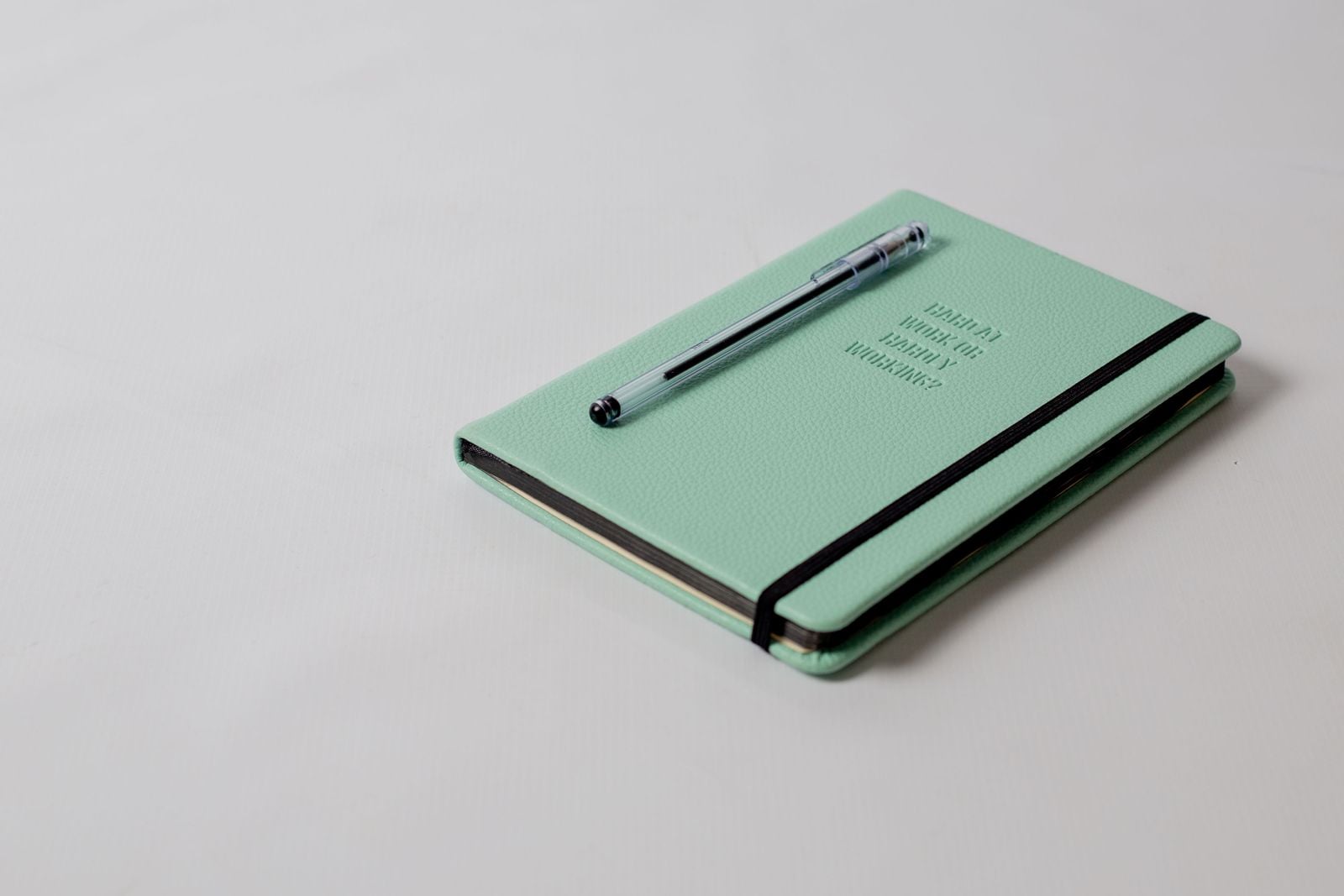
Photo by Nathi Ngwenya on Pexels
Why the ideal self keeps buying more supplies
The goals associated with an ideal self are often abstract. Be a good writer, be a creative person, become more thoughtful, or finally make time for the work that matters. These goals have no obvious completion criteria, so progress can be difficult to measure.
The ought self tends to operate in specifics. File the paperwork, show up to the appointment, pay the bill, and return the call. Each task contains its own visible ending.
Because the ideal self cannot easily measure progress toward an abstract identity, it may reach instead for symbols of progress. A new notebook, a better pen, or a planner with the right kind of grid can make movement feel tangible. For a few minutes after the purchase, the ideal self and the actual self seem to overlap.
Then ordinary life returns, the overlap collapses, and the drawer takes the notebook. The purchase was not necessarily foolish because it briefly kept an identity alive. It simply could not do the work that the identity required.
The brain dump that never happens
Productivity writers often recommend a brain dump as a practical response to mental clutter. A recent guide describes it as the process of writing down every task, idea, or responsibility occupying the mind so it can be organised. The usefulness of the method lies in giving vague obligations a visible form and a possible next step.
The stationery drawer can be seen as a brain dump that remained physical. Every notebook represents a project or thought the ideal self hoped to externalise. The irony is that the externalisation never made it out of the packaging, so the tools intended for the offload became the offload themselves.
What the objects are actually doing
It helps to name what a drawer of unused stationery may really be holding. It might contain the memory of a Sunday afternoon when someone believed a fountain pen would repair a habit of not writing. It might hold a birthday gift from a partner who wanted to encourage the poems, or a notebook bought at an airport before a trip that was supposed to change everything and mostly did not.
These objects are not only office supplies. They are timestamps attached to moments of confidence, tenderness, ambition, or escape. Their practical function may have expired while their symbolic function remained intact.
Silicon Canals has explored this pattern in adjacent forms, including the coat that outlasts most friendships and the voicemails kept long after a parent has gone. Objects that outlive their original function are often recruited into work they were never designed to perform. They carry meaning in the same way a bookmark carries a place.
The tool is not the block
The awkward truth underneath the drawer is that the tools were probably never the missing piece. Writing may not have happened because of time, exhaustion, competing responsibilities, fear that the work would be bad, or the sharper fear that it would be merely mediocre. A better pen could not remove any of those conditions.
Believing that the pen might help was still doing something useful. It kept the writer-self available as an identity, even when that identity was not producing pages. As long as the supplies remained, that version of the person did not feel entirely gone.
A summary of earlier regret research noted that participants did not regret time spent learning skills or pursuing hobbies they later abandoned. The deeper regret appeared around the skills that were never attempted at all. A page written badly and abandoned may therefore sit lighter in a life than a notebook that never left the drawer.
What the loop actually needs
The Forbes feature on unresolved endings argues that closure does not always depend on receiving an external answer. People can sometimes create a conclusion by naming what was unfinished, accepting that every answer may never arrive, and writing their own ending. That claim was made about relationships, but it offers a useful metaphor for possessions tied to abandoned plans.
Applied to a stationery drawer, the process looks less like an aggressive decluttering session and more like an acknowledgement. The notebook belonged to a version of the person who wanted to write, and that version was real even if the project never became real. The identity does not have to be mocked or erased before the object can be used, donated, or discarded.
Some people may open the notebook and finally write in it. Others may decide that giving it away is a more honest ending. Neither outcome has to be treated as proof of failure.
The quiet reason the drawer is kept
The drawer may be clutter, and excessive buying may sometimes be part of the story. But for some adults, it is also a small museum of selves who were once believed in. Each pen was purchased during a moment of hope that the gap between the person writing a shopping list and the person who might write something more could finally close.
That the gap remained open is not a moral failing. It is what happens when an abstract ideal is asked to compete with full inboxes, tired evenings, and obligations that arrive with clearer deadlines. The notebook lost that competition, but the hope attached to it did not disappear as easily.
Before deciding whether to keep the drawer or thin it out, it may be worth noticing what each object once represented. Much of what is inside was bought by a person who believed change was still possible. That belief may be worth recognising, even when the paper itself is finally allowed to go.
